A3 Inorganic Chemistry
No description yet. This curated deck is ready for daily study.
Card preview (24)
How do all electronic configurations of Group 2 elements end
S (^2)
What happens to all group 2 elements in redox reactions
Oxidised to form 2+ ions
General symbol equation for Group 2 elements reacting with dilute acid

General symbol equation for Group 2 elements reacting with water

General symbol equation for Group 2 elements reacting with oxygen

State and explain the reactivity of Group 2 elements
• Reactivity increases down group • More shells • More sheilding • Nuclur attraction decreases • Ionisation energy decreases • Less energy required to remove outer-shell electron
Down Group 2, what happens to elements reducing power
Strong reducing agents
State how solubility changes down the group and so the effect this has on the solution produced
• Solubility increases • More alkaline solutions form • Solutions have higher pH
General symbol equation for metal oxide reacting with water

What property of group 2 compounds make them useful
They are basic
What is the use of calcium hydroxide in commerce, and what is the equation
• Neutralise soil acids in agriculture

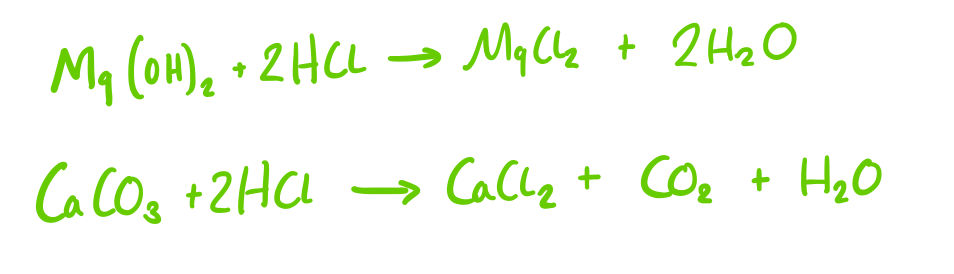
What is the use of magnesium hydroxide and calcium carbonate in commerce, and what are their equations
• Antacids to treat indigestion
What electronic configurations do all group 7 elements end with
s(^2)p(^5)
What happens to all group 7 elements in redox reactions
Reduced to form 1- ions
How do all group 7 elements exist
Diatomic molecules
Why does the boiling point of group 7 elements decrease down the group
• London forces become stronger • More energy needed to break London forces
State and explain the trend in reactivity down the group 7
• Reactivity decreases • More shells • Atomic radius increases • More sheilding • Nuclear attraction decreases • Ionisation energy decreases • More energy required to attract outer-shell electron
Colour of chlorine regular
Colourless
Colour of chlorine aqueous
Colourless
Colour of chlorine organic
Colourless
Colour of bromine regular
Red-Brown
Colour of bromine aqueous
Orange
Colour of bromine organic
Brown
Colour of iodine regular
Dark grey