Nitrogen- and Phosphorus-Containing Compounds
No description yet. This curated deck is ready for daily study.
Card preview (12)
amino acid configuration in all eukaryotes
L-amino acids
stereochemistry in all amino acids in eukaryotes, except cysteine
(S) sterochemistry
generates an amino acid from an aldehyde which is mixed with ammonium chloride (NH4Cl) and potassium cyanide (KCN); ammonia attacks the carbonyl, generating an imine; the imine is attacked by the cyanide, generating an aminonitrile; the aminonitrile is hydrolyzed by two equivalents of water, generating an amino acid
Strecker synthesis
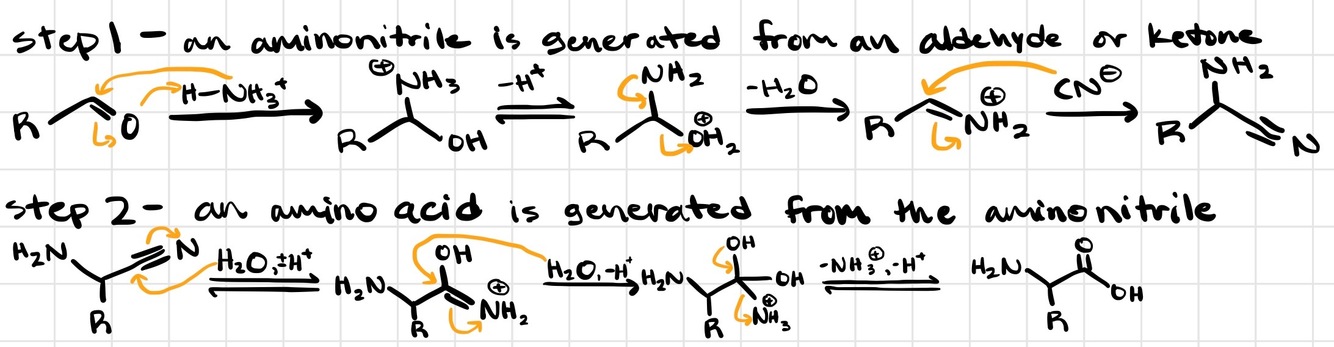
Strecker synthesis
generates an amino acid from potassium phthalimide, diethyl bromomalonate, and an alkyl halide using two SN2 reactions, hydrolysis, and decarboxylation; phthalimide attacks the diethyl bromomalonate, generating a phthalimidomalonic ester; the phthalimidomalonic ester attacks an alkyl halide, adding an alkyl group to the ester; the product is hydrolyzed, creating phthalic acid (with two carboxyl groups) and converting the esters into carboxylic acids; one carboxylic acid of the resulting 1,3-dicarbonyl is removed by decarboxylation
Gabriel synthesis
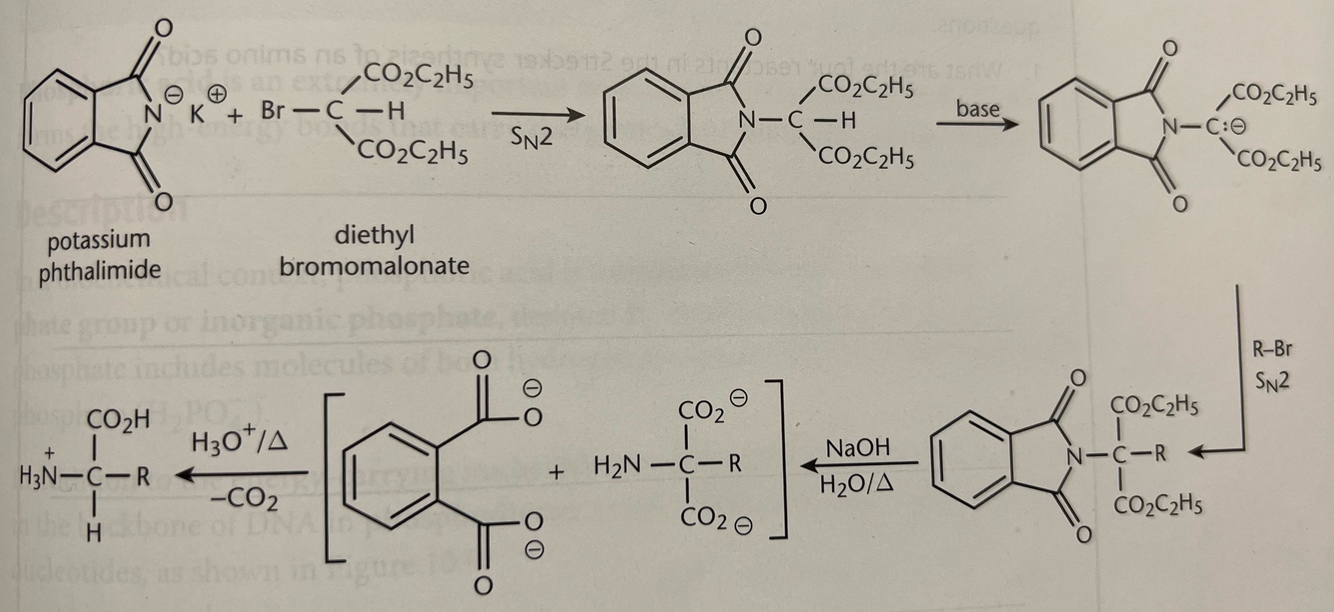
Gabriel synthesis
source of phosphorus; a buffered mixture of hydrogen phosphate (HPO4^2-) and dihydrogen phosphate (H2PO4-)
inorganic phosphate (P(i)) (phosphate group)
contains phosphorus in phosphodiester bonds
backbone of DNA
is released in the formation of phosphodiester bonds; can then be hydrolyzed to two inorganic phosphates
pyrophosphate (PP(i), P2O7^4-)
relative energy level of phosphate bonds because of large negative charges in adjacent phosphate groups and resonance stabilization
high energy
carbon-containing compounds that also have phosphate groups; e.g. nucleotide triphosphates (like ATP or GTP) and DNA
organic phosphates
wide variety allows phosphoric acid to act as a buffer over a large range of pH values
phosphoric acid has 3 hydrogens, each with a unique pKa