Energetics & Equilibria 4: Equilibrium
No description yet. This curated deck is ready for daily study.
Card preview (15)
Write the expressions for the eq constant for the following reaction involving • gases • dissolved species • solids and liquids A + B ⇔ P + Q
solids: trick question, solid species don’t contribute to expression
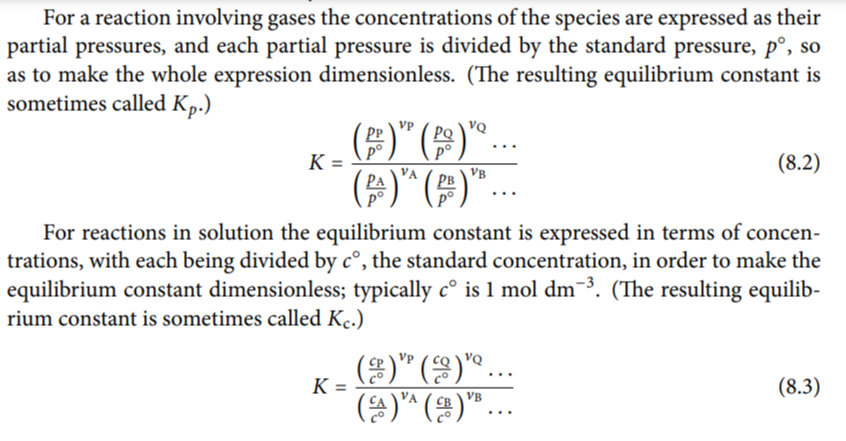
Why do solids and liquids in reactions not contribute a term to the eq constant expression?
Chemical potentials of solids/liquids = standard chemical potentials I.e. µ = µo, so the term that solid A with coefficient vA = (µ/µo)vA = 1. Therefore the contribution is to multiply the overall expression by 1 – no change.
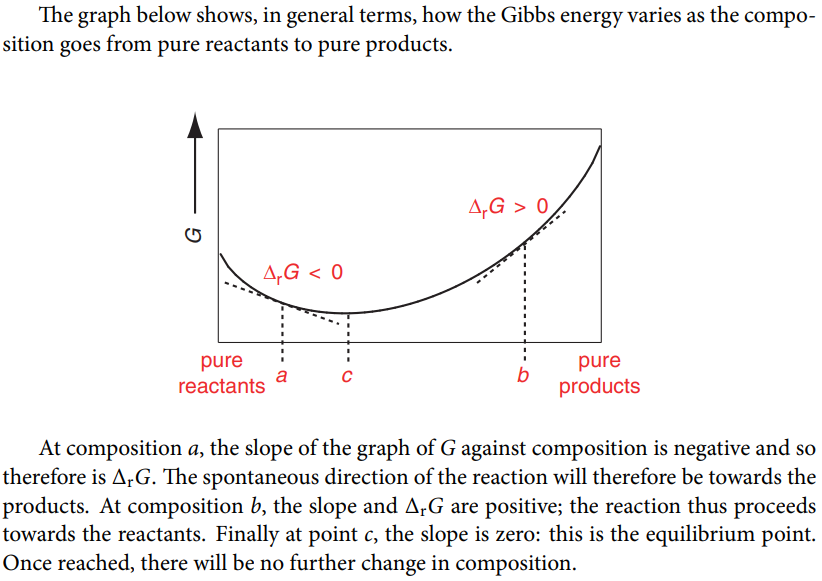
What is true of Gibbs energy at equilibrium?
∆rG = 0 Effectively, ∆rG is the slope of a graph of Gibbs energy against composition, composition being the ratio of products to reactants. See image
Give the expression linking the standard Gibbs energy of reaction and the equilibrium constant.
∆rGo = -RTlnK
Derive that ∆rGo = -RTlnK
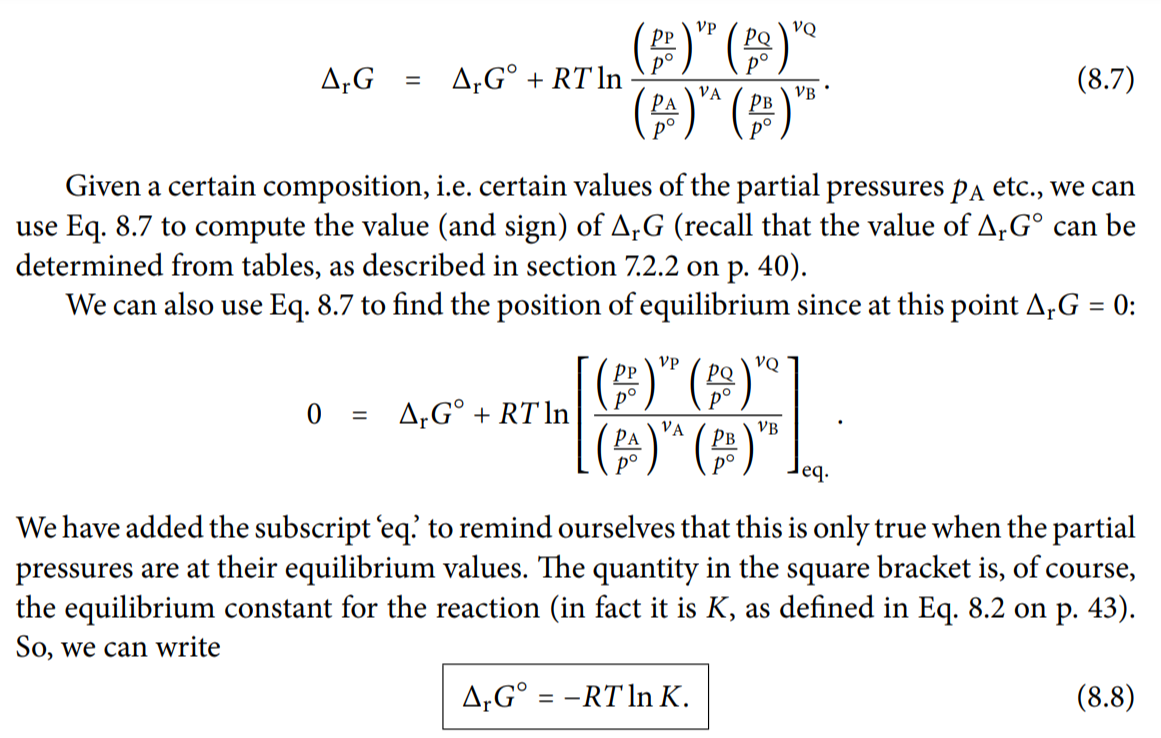
Assume generic reaction A + B ⇔ P + Q For a mixture of gases (NB you could do equiv calculation assuming solutions instead): ∆rG = vpμp(pP) + vQμQ(pQ) - vAμA(pA) - vBμB(pB) Assume all species are gaseous μ(pi) = μoi + RT ln(pi/po) Then sub in chemical potential expressions ∆rG = vp(μoP + RT ln(pp/po)) + vQ(…) - vA(…) - vB(…) Gather together the standard chemical potentials ∆rG = (vpμoP + vQμoQ - vAμoA - vBμoB) + vpRT ln(pp/po) + vQ(…) - vA(…) - vB(…) Quantity in bracket = ∆rGo. Put the stoichoimetric coefficients onto the ln terms So ∆rG = ∆rGo + RT ln(pp/po)vp + …etc Then gather the ln terms, from here on see image
CaCO3(s) ⇔ CaO(s) + CO2(g) Derive an expression for ΔrGo at equilibrium.
ΔrG = µ(CO2) + µ(CaO) - µ(CaCO3) For the solids, µ = µo. For CO2 gas, write in terms of partial pressure, recalling µi(pi) = µoi + RTln(pi/po) ΔrG = µo(CO2) + µo(CaO) - µo(CaCO3) + RTln(pCO2/po) ΔrG = [µo(CO2) + µo(CaO) - µo(CaCO3)] + RTln(pCO2/po) Quantity in [] = ΔrGo ΔrG = ΔrGo + RTln(pCO2/po) At equilibrium, ΔrG = 0, so: ΔrGo = -RTln(pCO2,eq/po) This demonstrates that, although solids/liquids don’t contribute to the expression for the eq constant K, they do still contribute to ΔrGo, and so they affect the value of K indirectly
• Rearrange the standard Gibbs energy equation to make K the subject • Use this to explain how the sign of the standard Gibbs energy predicts the position of equilibrium
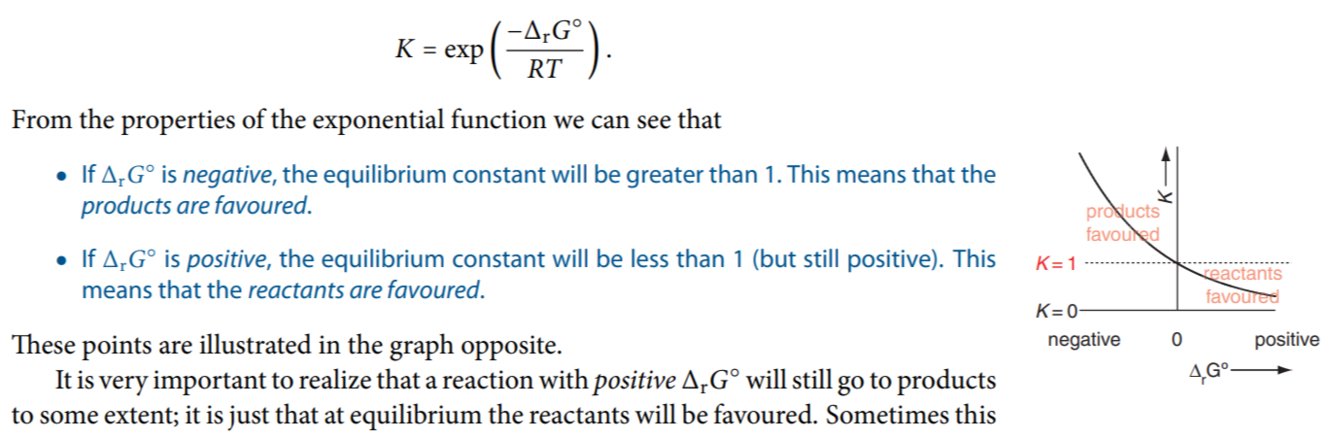
reaction with +ve change in standard gibbs energy proceeds to some extent. overall, going from reactants to products is associated with a rise in gibbs energy, so this isn’t spontaneous and doesn’t occur. however, it’s not a straight line from reactants to products – it’s a curve which falls then rises. at the minimum of the curve is where gibbs energy is at a minimum. this is the eq composition. Use this graph to demonstrate the basis of Le Chatelier’s principle, e.g. why the act of removing products (altering concentration) is counteracted.
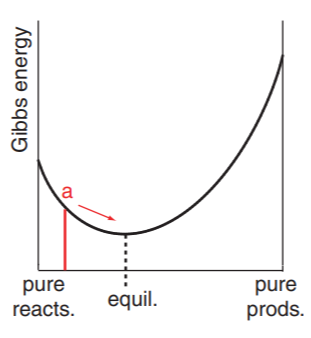
• removing product increases proportion of reactant in mixture • graph moves from eq position to position marked a • to return from a to eq is associated with a decrease in gibbs energy, therefore spontaneous • so some reactants reform products to counteract the change
• Derive the temperature-dependence of the equilibrium constant • Use this to explain why, for an endothermic reaction, increasing temperature shifts eq to products, and vice versa
Derivation Recall ΔrGo = -RTlnK and also ΔrGo = ΔrHo - TΔrSo So -RTlnK = ΔrHo - TΔrSo Divide through by -RT lnK = -(ΔrHo/R)(1/T) + (ΔrSo/R) Interpretation Assume ΔrHo and ΔrSo are temperature-independent over a modest temperature range. • For an endothermic reaction, ΔrHo > 0, so -(ΔrHo/R)(1/T) is negative, so increasing T makes the term less negative, so lnK and thus K increase. Shifts eq towards products (increased K) • For an exothermic reaction, ΔrHo rHo/R)(1/T) is positive, so increasing T makes the term less positive, so lnK and thus K decrease. Shifts eq towards reactants (decreased K) NB this approach is only applicable for reactions which go to completion
Another method for determining the temperature-dependence of K uses the Gibbs-Helmholtz equation. Write it out
d/dT(G/T) = -H/T2 (constant pressure)
Another method for determining the temperature-dependence of K uses the Gibbs-Helmholtz equation: d/dT(G/T) = -H/T2 (constant pressure) Use this to derive the van’t Hoff equation: dlnK/dT = ΔrHo/RT2
d/dT(G/T) = -H/T2 (constant pressure) Replace with standard quantities d/dT(ΔrGo/T) = -ΔrHo/T2 (constant pressure) Sub in ΔrGo = -RTlnK –> ΔrGo/T = -RlnK d/dT(-RlnK) = -ΔrHo/T2 Divide through by -R dlnK/dT = ΔrHo/RT2
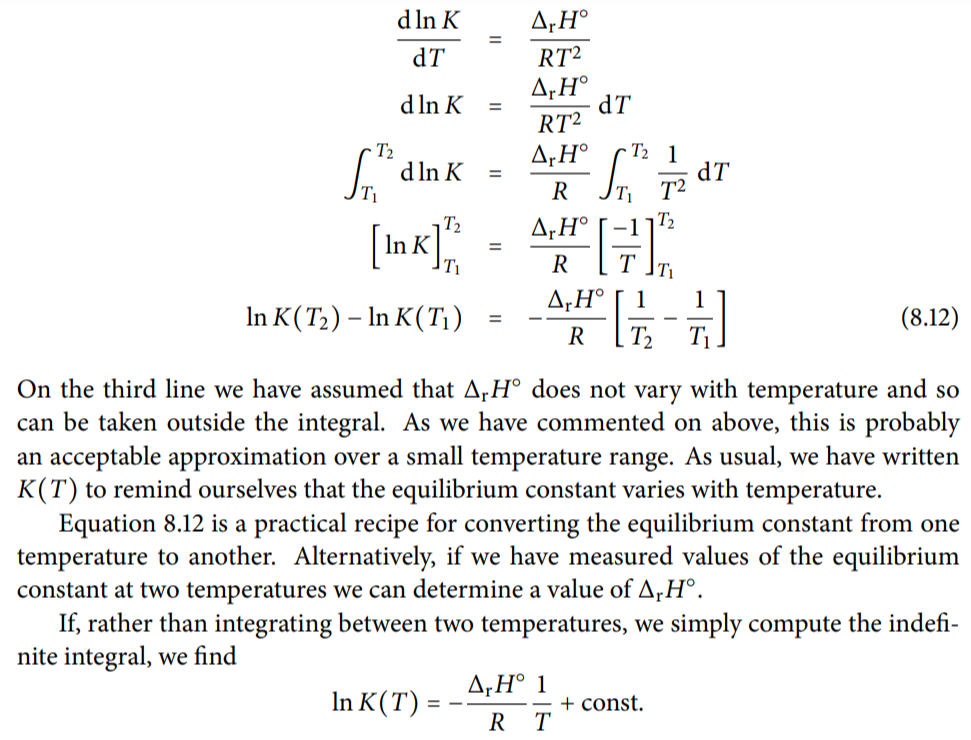
Another method for determining the temperature-dependence of K uses the Gibbs-Helmholtz equation to derive the van’t Hoff equation: dlnK/dT = ΔrHo/RT2 Use this to derive the temperature-dependence (should get the same result as before).
For dissolved species, altering pressure doesn’t have a significant effect, but it does for gaseous species. State how pressure affects the equilibrium constant and composition.
• For a gas phase reaction, Kp and ∆rGo are related via ∆rGo = −RT lnKp, and ∆rGo is defned under standard conditions (pressure = 1 bar), so Kp does not vary with pressure • Composition of eq mixture changes in order to keep Kp constant
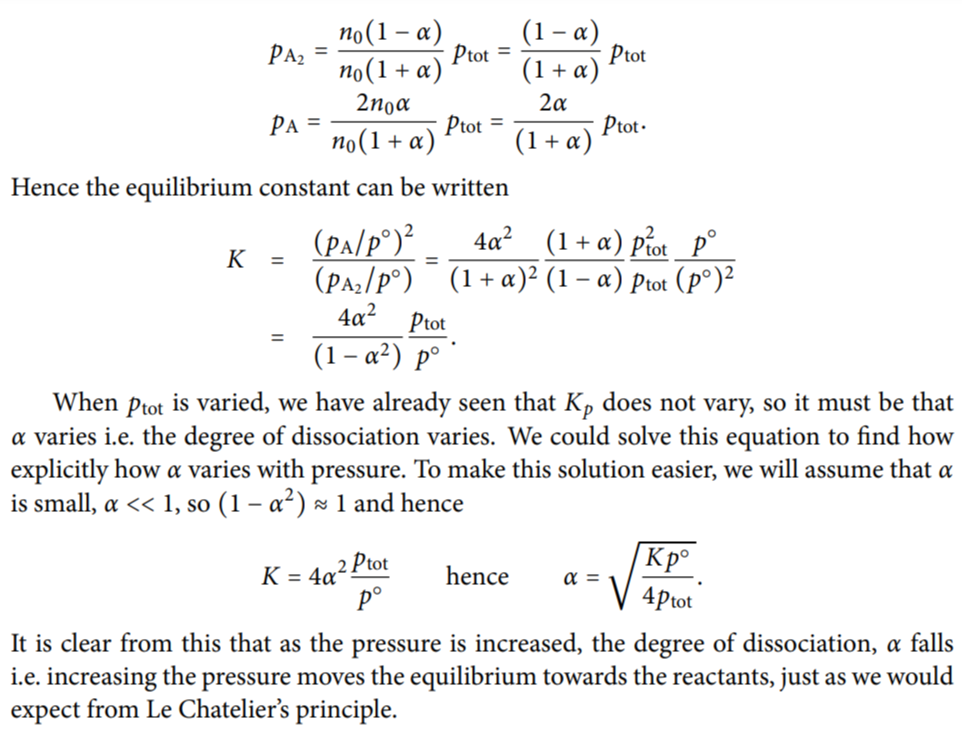
Consider the following equilibrium: A2(g) ⇔ 2A(g) Use the concept of the degree of dissociation to determine the pressure-dependence of the equilibrium composition.
Let α = degree of dissociation of dimer A2, i.e. the fraction which have dissociated, where α = 0 means no dissociation and α = 1 means full dissociation. n0 moles of A2 are allowed to reach eq at pressure ptot, giving degree of dissociation α. So neq,A2 = (1-α)no, and neq,A = 2αno, and therefore neq,total = (1+α)n0. Partial pressure of a species i: pi = xiptot Then write out the partial pressures of each species and derive the eq constant, then rearrange for α (image from here on).
How do biological systems drive thermodynamically unfavourable reactions?
• Couple an unfavourable reaction (ΔrGo > 0) to a favourable one (ΔrGo > 0) such that overall (ΔrGo > 0), so the reaction can occur • Coupling occurs physically through connecting reactions closely, eg via an enzyme • Examples: • ATP hydrolysis is often the favourable reaction used to drive another, e.g. protein synthesis • ATP synthesis is therefore unfavourable; it is coupled to glucose oxidation • Photosynthetic production of glucose is not favourable, so is coupled to light energy