Chapter 21 Buffers
No description yet. This curated deck is ready for daily study.
Card preview (23)
what are buffer solutions ?
• Buffer solutions are systems that minimise pH changes with the addition of small ammounts of acid or base • they are made of weak acids and their conjugate bases • HA removes alkali, A- removes acid
what do bufffers contain?
• HA and A- act as 2 idependent reservoirs that are capable of reacting with added acid and alkali • Buffer is no longer effective when 1 reservoirs is used up
how to prepare a buffer from a weak acid and salt ?
• mixing ethanoic acid (weak acid) with solution of one of its salts e.g sodium ethanoate in solution • salt of weak acid is conjugate base and since ionic they completely dissociate to provide [A-] • dissociation of weak acid is small so [HA] is the same
how to prepare a buffer by partial neutralisation of weak acid ?
• aqueous solution of alkali is added to excess weak acid • weak acid is partially neutralised forming conjugate base • some weak acid remains so solution contains conjugate base and weak acid
how do buffers work ?
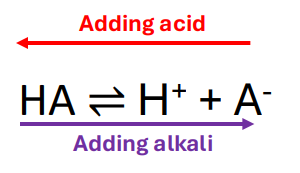
• as buffers have 2 independent reservoirs a reaction with one will cause a shift in equilibrium to negate the change
what happens when an acid is added to a buffer?
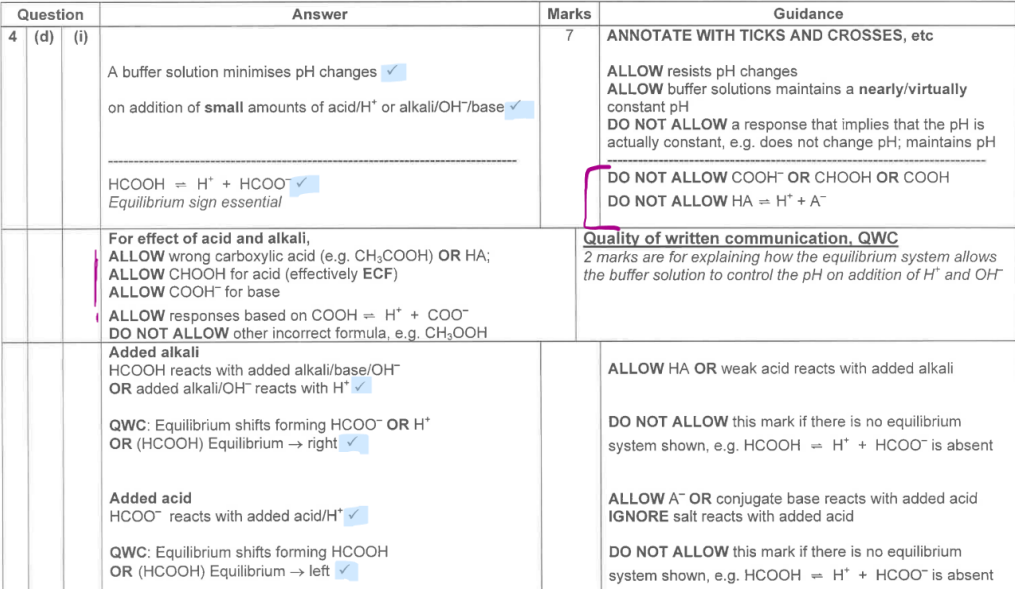
• adding acid increases the ammout of H+ ions • the extra H+ ions react with A- to form HA • the equilibrium position shifts to the left to reduce [H+] • this limits decreases in pH
what happens when a base is added to a buffer?
• adding base increase the ammount of OH- ions • the extra OH- reacts with H+ to form water • [H+] decreases shifting equilibrium to the right • more HA discociates to replace H+ reducing change in pH
when are buffers most effective
• most effective when [HA] = [A-] • different weak acids form buffer solutions that work over different ranges • the pH of a buffer = pKa of HA • Operating range often +- 1 pH about pKa
Why does [H+] not equal [A-] in buffers?
• A- has been added as one of the components of the buffer
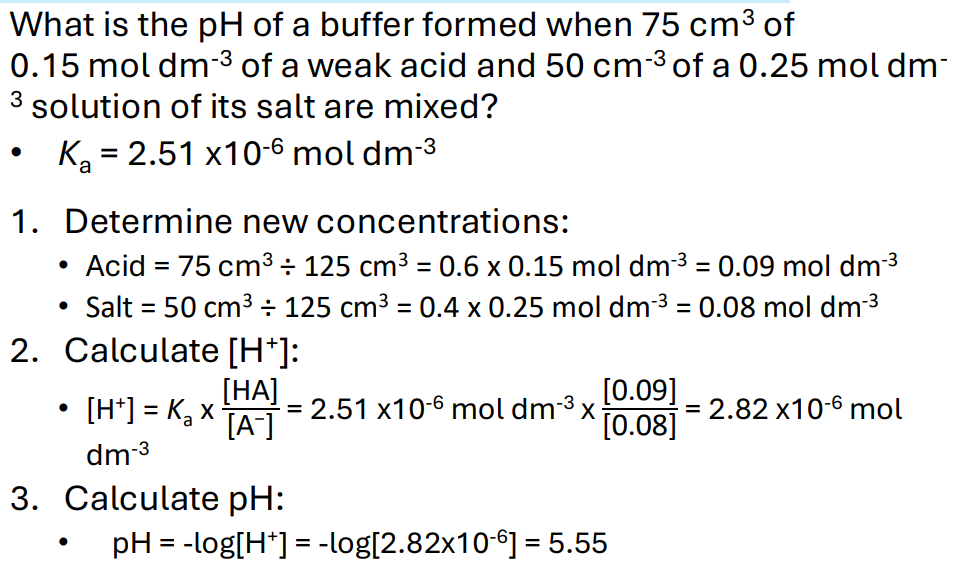
an example of calculating pH of a buffer weak acid and its salt
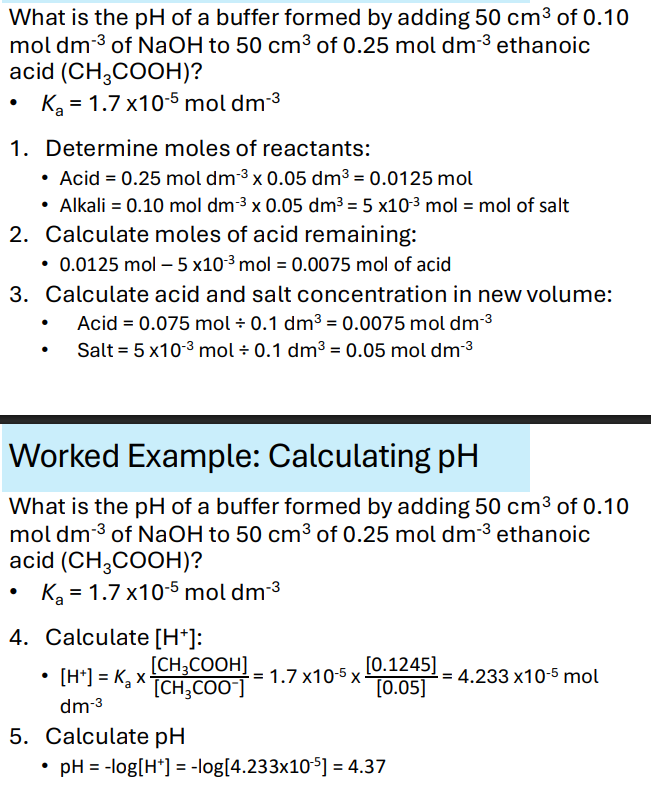
an example of calculating pH of a buffer partial neutralisation of weak acid
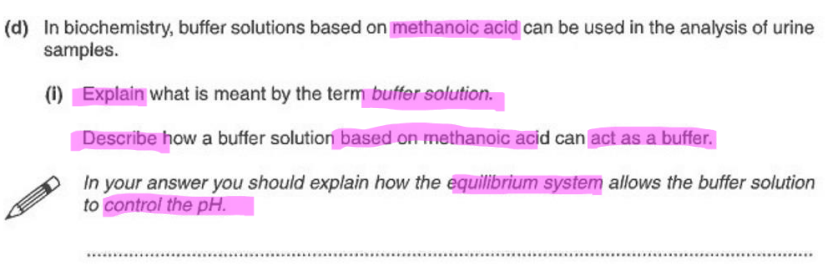
typical buffer 7 marker
what buffer is found in blood plasma?
• Carbonic acid [HA] and hydrogencarbonate [A-] • Blood plasma has a pH of 7.35-7.45

what happens when the pH in blood plasma is below 7.35 ?
• pH below 7.35, can lead to acidosis • acidosis - fatigue, shortness of breath and potential death
what happens when the pH in blood plasma is above 7.45 ?
• pH above 7.45 can lead to alkalosis • alkalosis - spasms, light-headed, and nausea
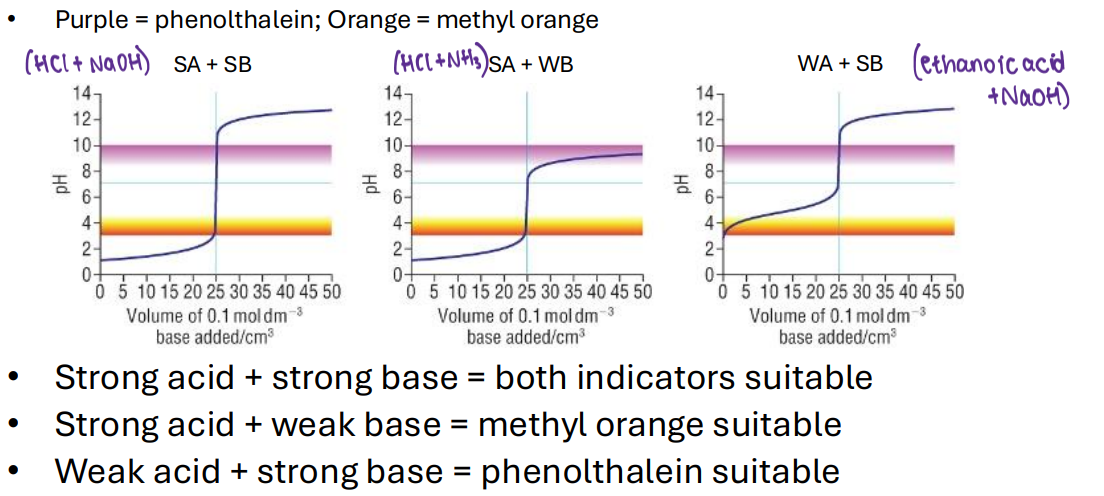
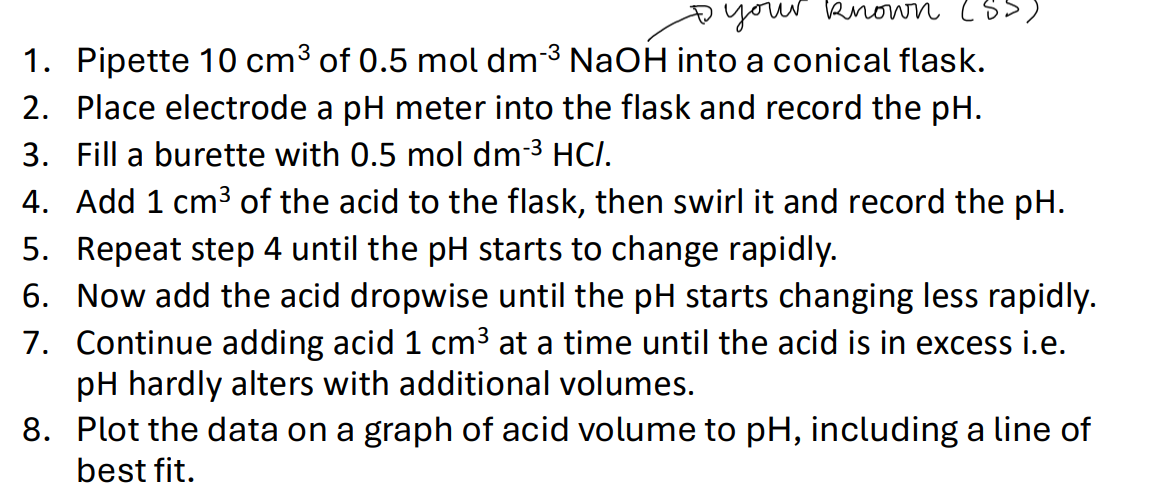
how to conduct a strong acid-base titration with a pH meter ?
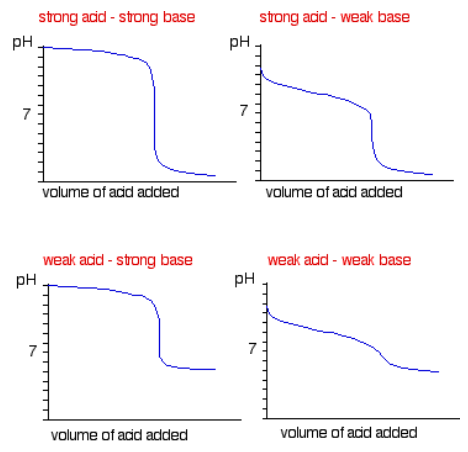
what affects the shape of a titration curve?
• substance being titrated, e.g acid or base and which one starts in the buerette • the type of acid or base, weak or strong
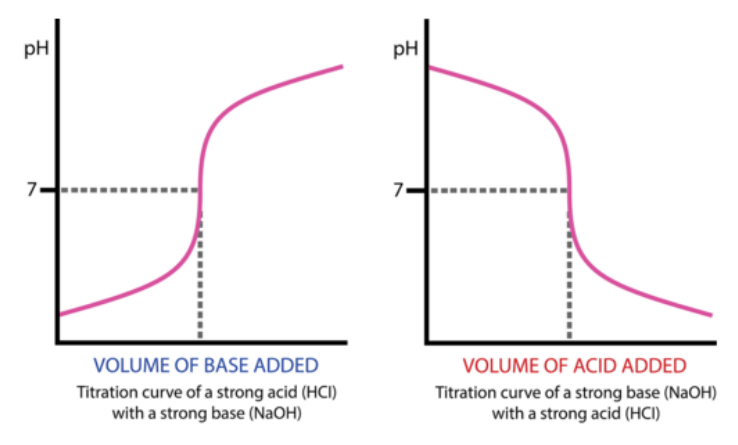
what are the 4 key features to pH titration curves ?
• excess of base • vertical section • equivilance point • excess of acid
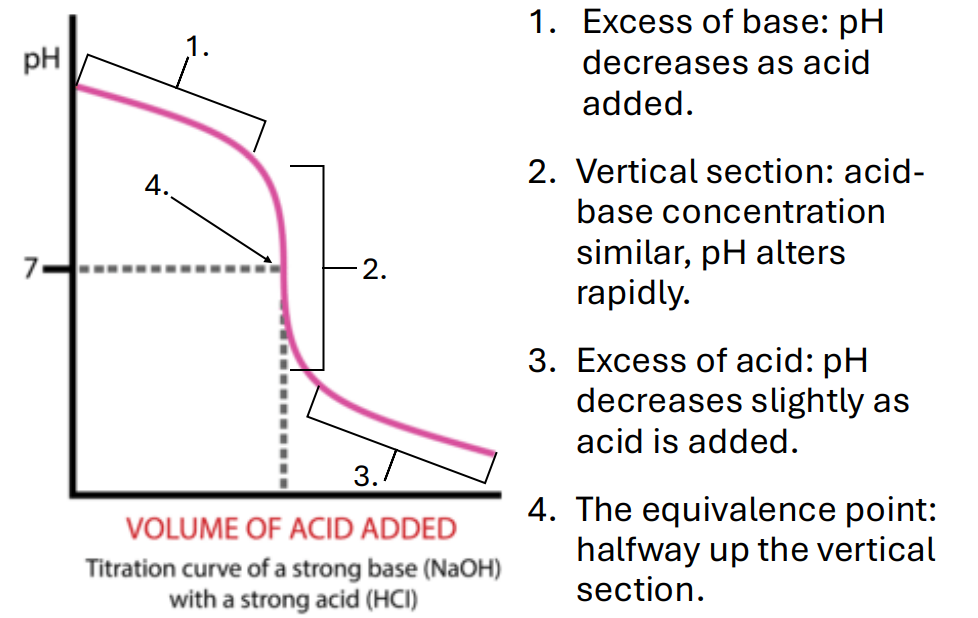
what is the equivalence point ?
• the equivalence point is the volme required to have completely reacted the acid and base together • the pH at the equivalence point depends on the type of acid and base • strong acid + strong base = pH 7 • Strong acid + weak base = pH < 7 • weak acid + strong base = pH > 7
what are acid-base indicators and how do they work ?
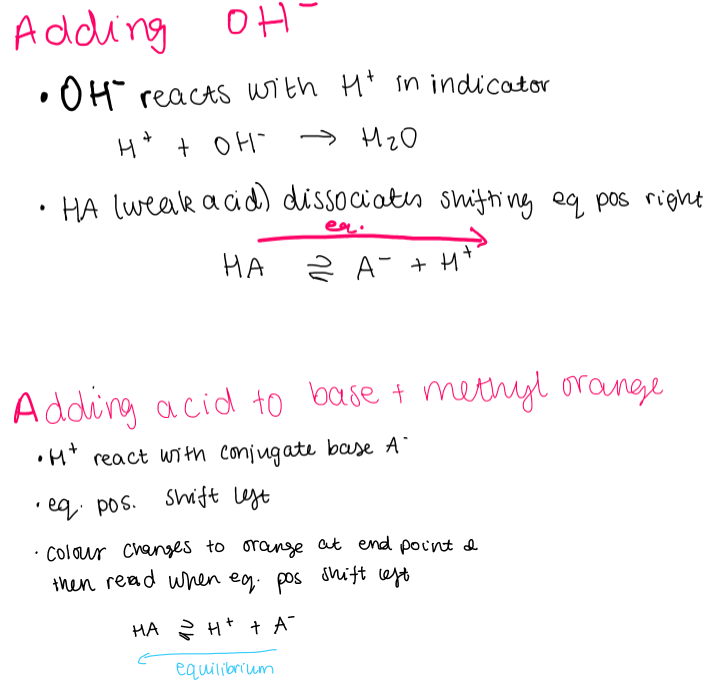
• acid base indicators are weak acids that have different coloured conjugate bases • in acidic conditions the indicator equilibrim is shifted towards the weak acid (HIn) • as the system becomes more basic the equilibrium position shift towards the conjugate base (In-), altering the color
what is the end point ?
• end point is when [HA] = [A-] • the colour will lie between both extremes • each indicator will have a different pH value for the end point as they have different Ka values
how to determine pH of endpoint ?
• the pH can be found from pKa value of HA at end point • [HA] = [A-], This means Ka = [H+]
how to choose a suitable indicator for titrations?
• need to choose an indicator that has a colour change that coincides with the vertical section of the pH curve • due to small vertical section for weak acid + weak base there is NO SUITABLE INDICATOR