Chapter 8: Alkenes
No description yet. This curated deck is ready for daily study.
Card preview (12)
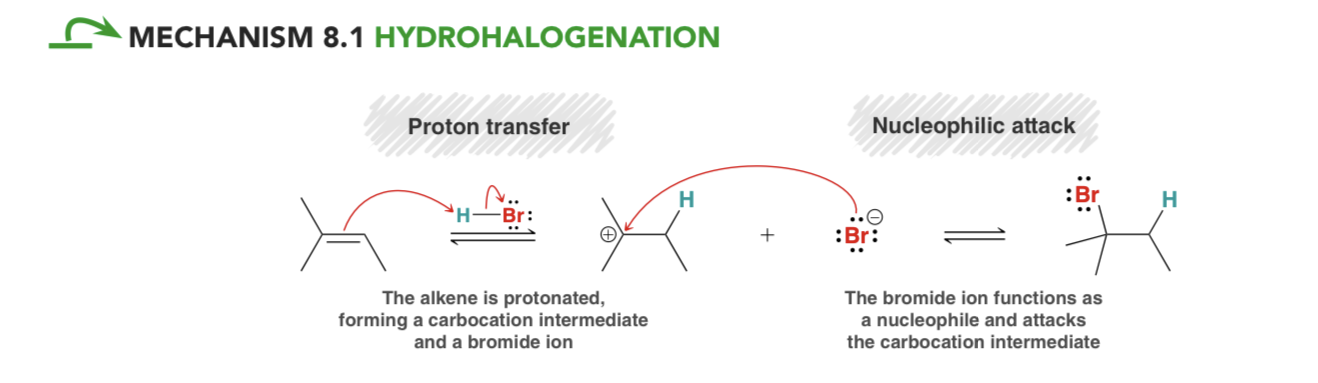
Markovnikov Hydrohalogenation Alkene
Reagent HX (hydrogen halide) HCl, HBr, or HI Mechanism The treatment of alkenes with HX results in the Markovnikov addition of HX across the an alkene Favors low temperatures Stereospecificity Halogen can attack the carbocation from either side; results in a pair of enantiomers If carbocation rearrangement is posible a mixture of products is possible with the major product resulting from the more stable arrangement
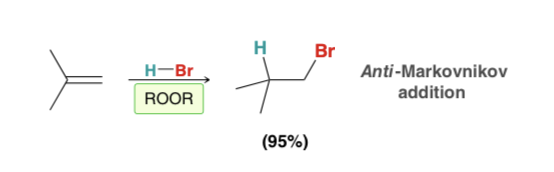
anti-Markovnikov Hydrohalogenation Alkene
Reagent HX & ROOR HCl, HBr, or HI & ROOR Mechanism Even trace amounts of alkyl peroxides (ROOR) will cause HX to add across an alkene in an anti-Markovnikov fashion Stereospecificity Halogen can attack the carbocation from either side; results in a pair of enantiomers
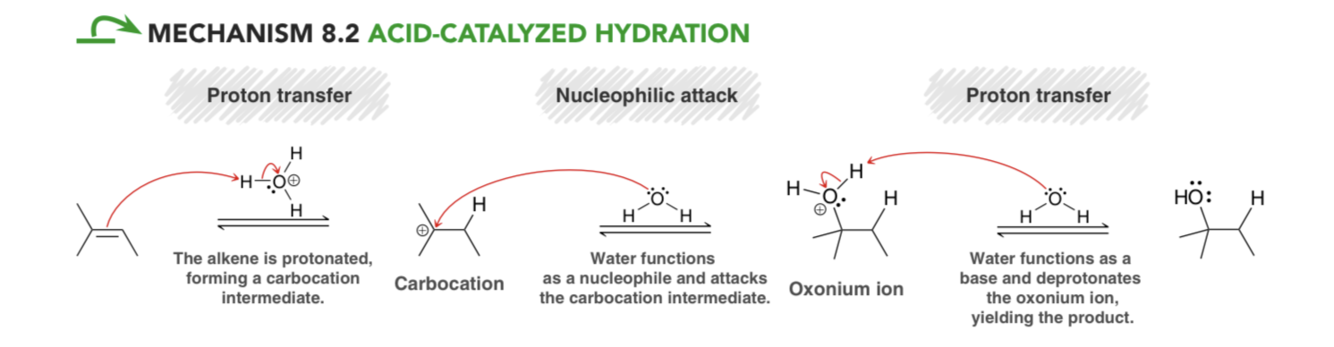
Acid-Catalyzed Hydration Alkene
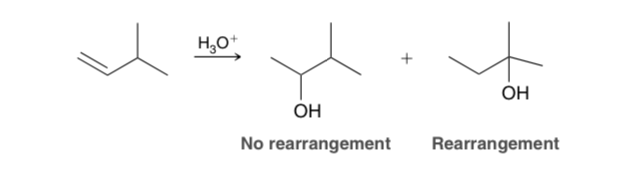
Reagent H3O+ H2SO4 & H2O Mechanism Markovnikov addition of a water molecule across a π bond in the presence of and acid Proceeds via a carbocation intermediate followed by an intermediate with an oxygen atom exhibiting a positive charge called an oxonium ion Nucleophiles other than water such as MeOH or EtOH can also attack the carbocation resulting in the addition of a different group Stereospecificity Water can attack the carbocation intermediate from either side; results in a racemic mixture of products when a chiral center is present
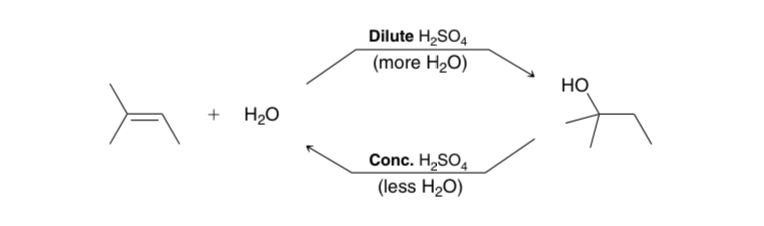
Position of equilibrium in acid-catalyzed dehydration
The concentration of acid will dictate whether an addition reaction is favored or an elimination reaction A dilute acid will favor an addition reaction because more water is present A concentrated acid will favor and elimination reaction because less water is present
Oxymercuration-Demurcuration Addition Alkene
Reagent • Hg(OAc)2 (mercuric acetate) & Nuc • NaBH4 (sodium borohydride) Mechanism Mercuric acetate [Hg(OAc)2] dissociates to form a mercuric cation which attacks the π bond and forms a mercurinium ion intermediate that prevents carbocation rearrangement Regioselectivity Markovnikov- H is installed at the less substituted vinylic position while the Nuc is installed at the more substituted vinylic postion
Hydroboration-Oxidation Alkene
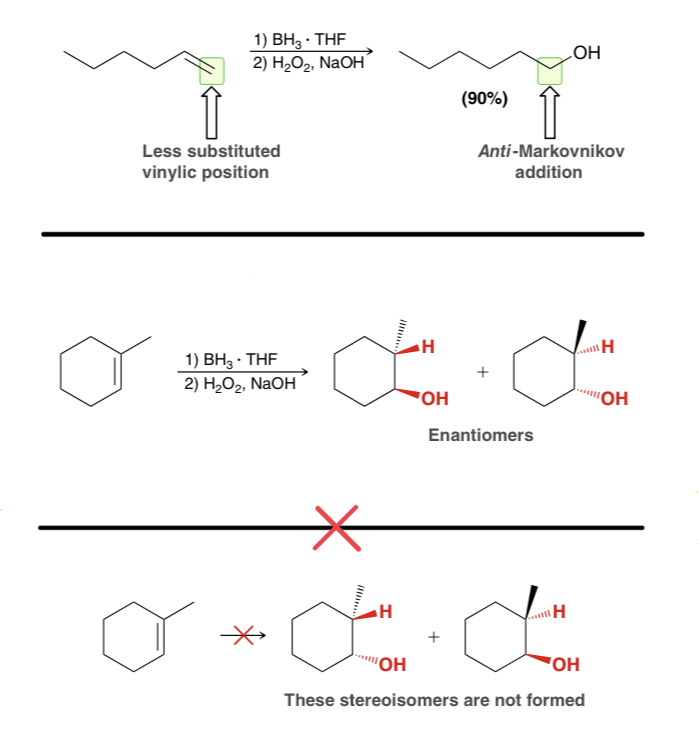
Reagents • BH3 (borane) & THF (tetrahydrofuran) • H2O2 (hydrogen peroxide) & NaOH Mechanism Anti-Markovnikov addition of a water molecule across a π bond Stereospecificity Syn addition- when a chiral center is present; produces a pair of enantiomers
Catalytic Hydrogenation Alkene
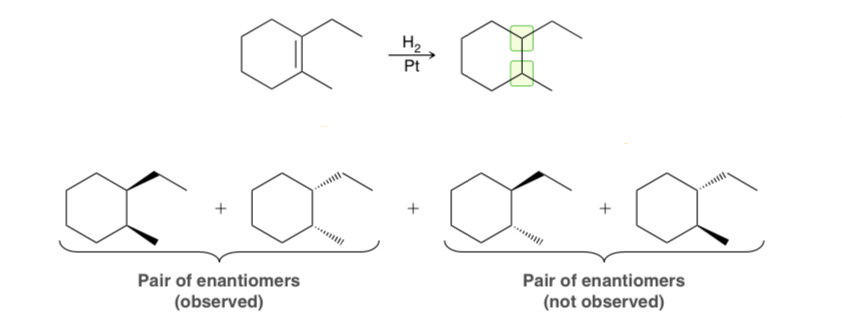
Reagents Heterogenous catalysts- do NOT dissolve in the reaction medium H2 & Pt, Pd, or Ni or Homogenous catalysts- are soluble in the reaction medium H2 & Wilkinson’s catalyst Mechanism Involves the addition of molecular hydrogen (H2) across a π bond in the presence of a metal catalyst Regioselectivity Irrelevant as hydrogen is added to both sides of the π bond Stereospecificity Syn addition- when a chiral center is present; produces a pair of enantiomers Asymetric hydrogenation is possible if a chiral catalyst is used such as BINAP; produces only ONE enantiomer
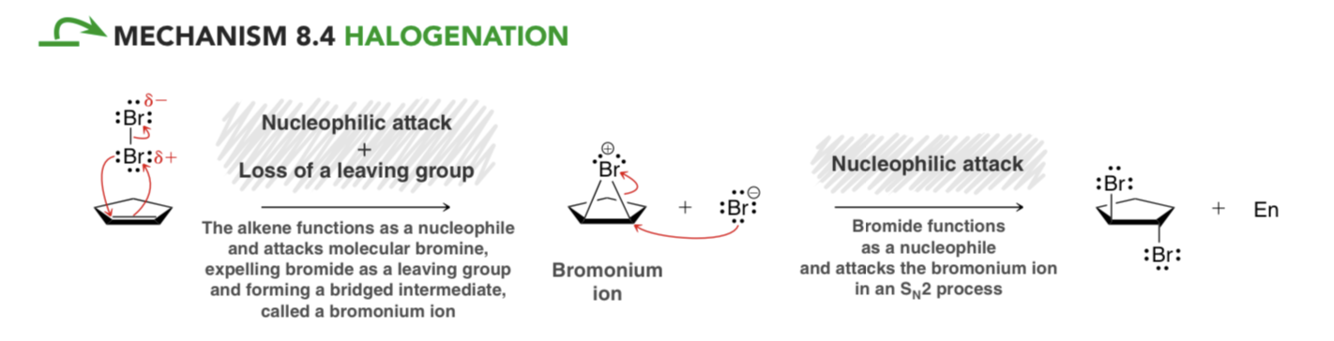
Halogenation Alkene
Reagents X2 Br2 or Cl2 Mechanism Two halogen atoms are added to both vinylic positions of a π bond via a bromonium ion or a chloronium ion intermediate Regioselectivity Irrelevant as halogens are added to both sides of the π bond Stereospecificity Anti addition- when a chiral center is present; produces a pair of enantiomers
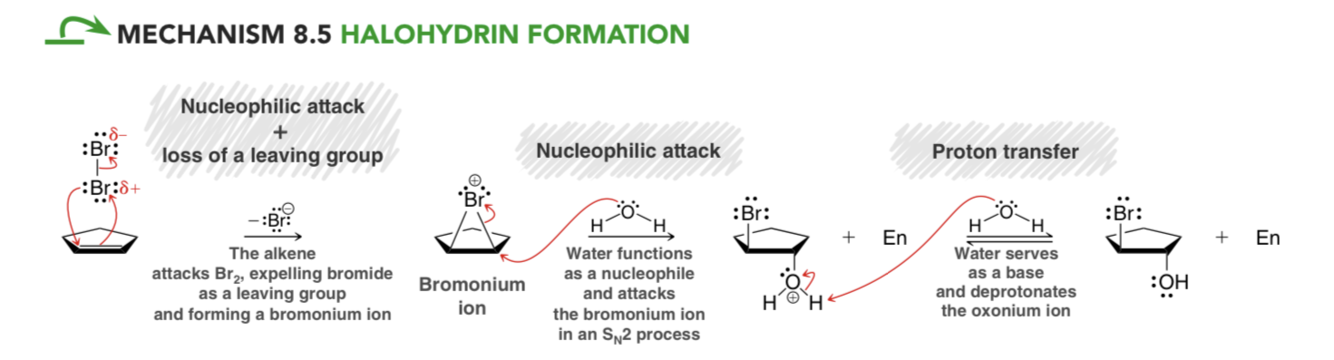
Halohydrin formation Alkene
Reagents X2 & H2O Br2 or Cl2 Mechanism Similar to halogenation however when water is present the water replaces the second halogen as the nucleophile and installs an OH group to the other side of the π bond Regioselectivity The OH group is installed at the more substituted position Stereospecificity Anti addition- when a chiral center is present; produces a pair of enantiomers
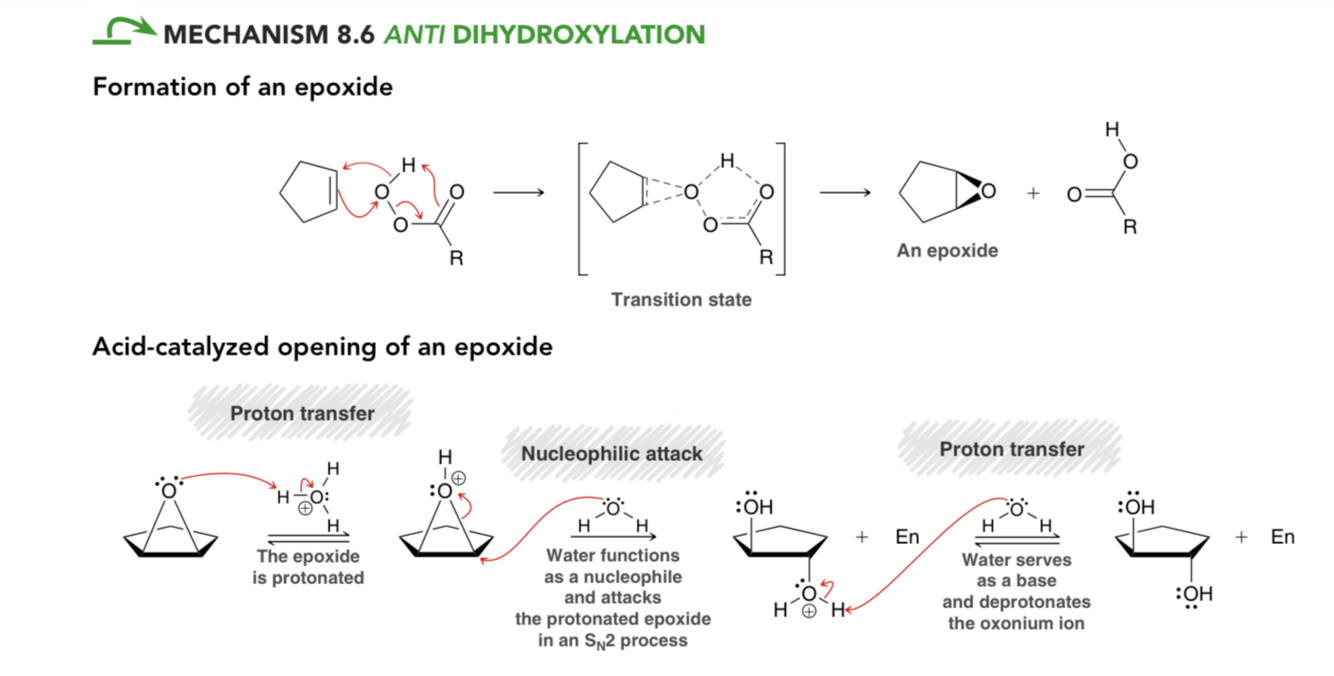
Anti Dihydroxylation Alkene
Reagents RCO3H (peroxy acid) & H3O+ CH3CO3H (peracetic acid) or MCPBA Mechanism Adds OH groups to BOTH sides of a π bond through the formation of an epoxide- a three-membered cyclic ether Under acid-catalyzed conditions epoxides can be opened by a variety of other nucleophiles such as MeOH or EtOH; will attack at the Markovnikov position Stereospecificity Anti addition- when a chiral center is present; produces a pair of enantiomers
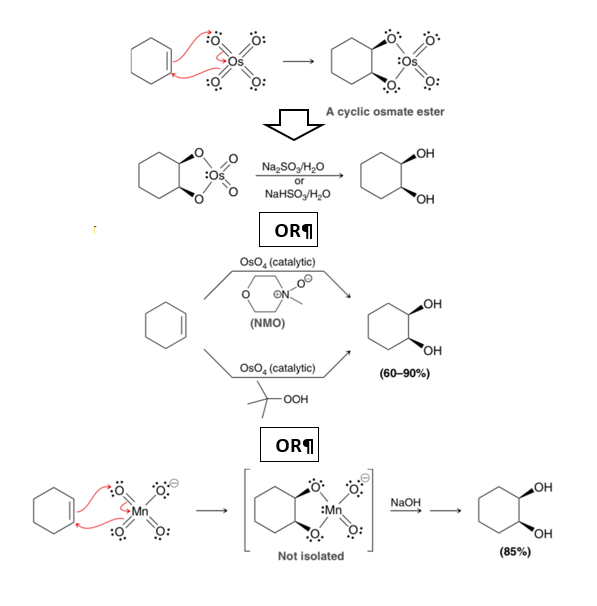
Syn dihydroxylation Alkene
Reagents • OsO4 (osmium tetroxide) • Na2SO3 or NaHSO3 (Sodium sulfite or bisulfite) or OsO4 & NMO or tBuOOH (tert-Butyl hydroperoxide) or Cold KMnO4 (potassium permanganate) & NaOH Mechanism Osmium tertoxide or cold potassium permanganate are added across a π bond in a concerted process Regioselectivity Irrelevant as OH groups are installed at both vinylic positions Stereospecificity Syn addition- when a chiral center is present; produces a pair of enantiomers
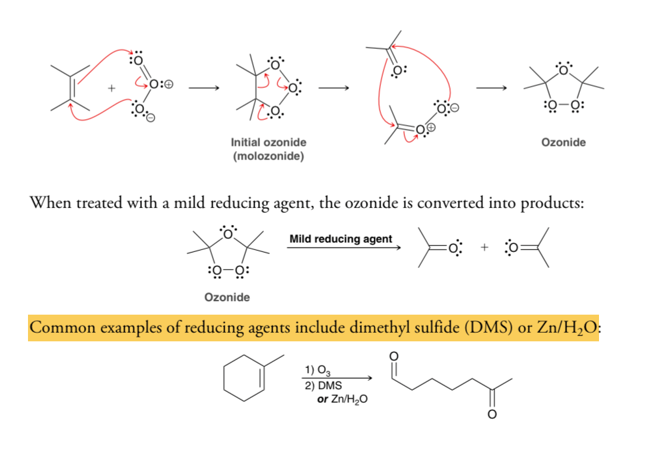
Ozonlysis Alkene
Reagents • O3 • DMS or Zn/H2O Mechanism π bond is completely split apart to form two C=O bonds through an ozonide intermediate which is then treated with a mild reducing agent Regioselectivity and stereospecificity are both irrelevant