Intro to dental material science
No description yet. This curated deck is ready for daily study.
Card preview (21)
what 5 things do you need to consider before choosing a dental material?
• selection: adequate/best type • preparation: cavity design, tooth surface • placement: technique • perfomance: quailty of fit, longevity • patient expectations: aesthetics, durability
give examples of some retorative materials 5
alamgam composite glass ionomer cements compomers porcelain
give examples of impression materials 4
impression compound impression paste hydrocolloids - alginate elastomers - polyethers, silicones, polysulphides
give examples of matals/alloys 5
amalgam cobalt chromium titanium gold stainless steel
what is the definition of stress, strain and young modulus? 3
stress = force/unit area strain = change in length/original length YM = stress/strain
what is fractre stress on the SS curve and what is the value for enamel and dentine?
where the graph stops as the material has fractured enamel: 262MPa dentine: 234MPa
what is proportional limit on the SS curve and what is the value for enamel and dentine?
the highest stress that the stress-strain curve is a straight line enamel: 235MPa dentine: 176MPa
what is elastic modulus on the SS curve and what is the value for enamel and dentine?
EM/YM is the initial straight gradient of the curve enamel: 33.6GPa dentine: 11.7GPa
describe the difference between enamel and dentine as shown on the graph
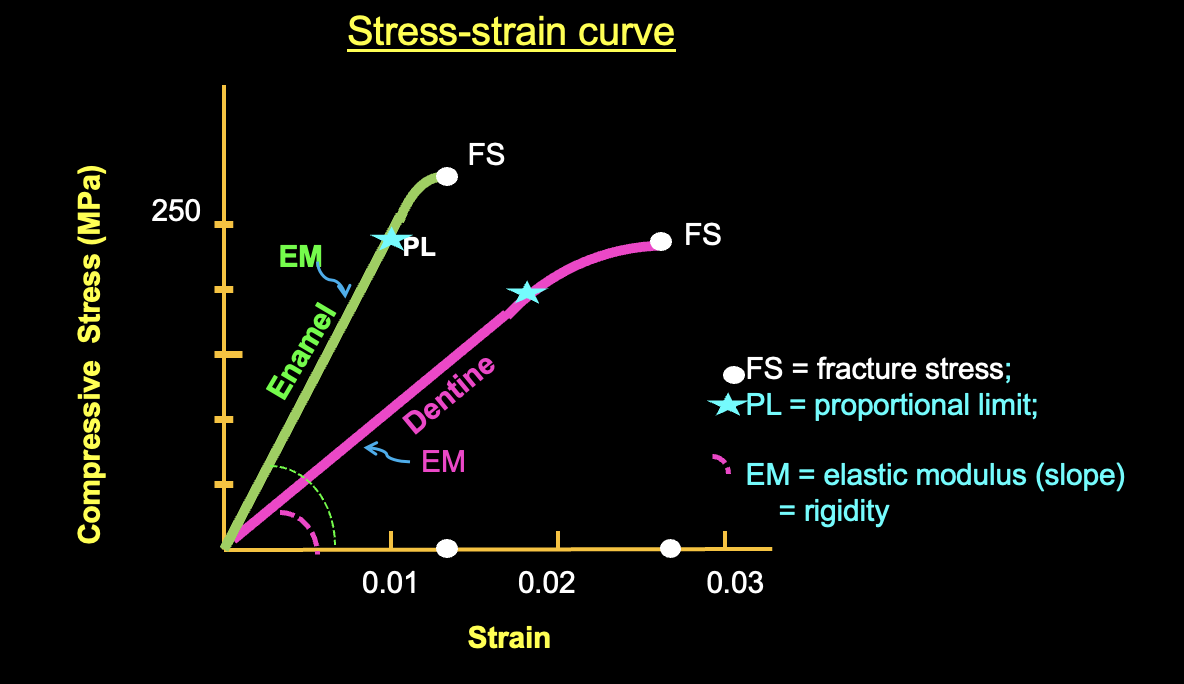
enamel * steep initial slope = high stiffness / YM * low elasticity as fractures suddenly after PL * brittle as sharp drop off at breaking point dentine * gentler slope = lower stiffness / YM * higher elastricity as greater elongation after PL * tougher as longer region before failure
what is the difference between amalgam and composite cavity preparation and how is it retained?
amalgam: undercut design, mechanical retention composite: minimal design, adhesive retention
define fracture
large force causes catastrophic destruction of material’s structure
define hardness
ability of a surface to resist indentation
define abraision
material surface removal due to grinding
define abrasion removal
ability to withstand surface layers being removed, compromising surface integrity
define fatigue
repetitive “small” stresses cause material failure
define creep
gradual dimensional change due to small repetitive forces e.g. amalgam
define deformation
applied stress causes permanent change in material’s dimensions but does not fracture it
define de-bond
applied forces suffient to break the material-tooth bond
define impact
large, sudden force causes fracture e.g. denture hitting floor
what are chemical properties to consider with materials 3
setting mechanism setting time corrosive potential
what are physical properties to consider with materials 5
viscosity thermal conductivity thermal expansion density radiodensity