Metal-Carbon π-Bonds Part 3 & Catalysis
No description yet. This curated deck is ready for daily study.
Card preview (24)
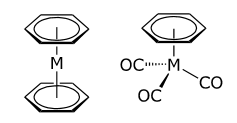
What is the core differences between a metal-Cp and a metal-arene complex?
• The bonding in arene-metal complexes is qualitatively very similar to metallocenes, but since the arene is neutral, all the bonding electrons comes from the arene • Because there is no charge to the arene, there is less electrostatic contribution to the bonding and hence metal-arene complexes are LESS stable than metallocenes/Cp complexes
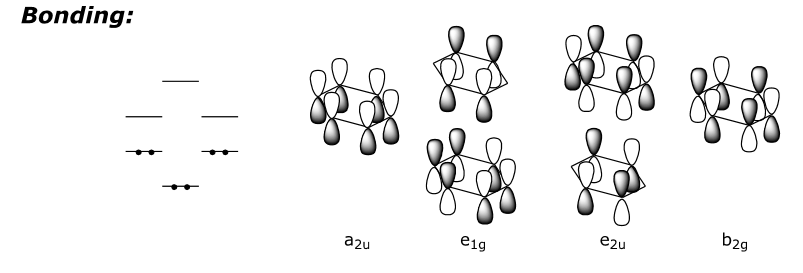
There is 6 molecular orbitals in benezene, hence which types of interactions can occur?
• σ-bonding (1 nodal plane) • π-bonding (2 nodal planes) • δ-bonding (3-nodal planes)
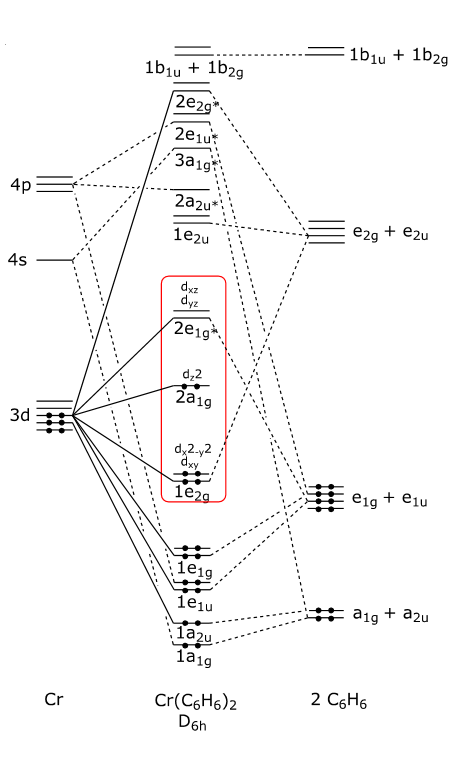
Arenes are relatively good deta acceptors compared to Cp, why?
• The 6MR aligns better with the metal d-orbitals, resulting in much better orbital overlap between d-orbitals on metal and p-orbitals on carbon • resulting in stronger back donation • Resulting in the arene being electron rich and the metal being δ+
What can we react a metal halide salt with to form a bis-(arene) complex?
Reduce a metal halide salt in the presence of benzene to for the bis-(benzene) complex

What is metal vapour synthesis to form bis-(arene) complexes?
Co-condensation of metal and ligand vapours allows access to bis-(arene)metal complexes inaccessible by other mean We can vaporise our metal and introduce an aromatic ring in the gas phase
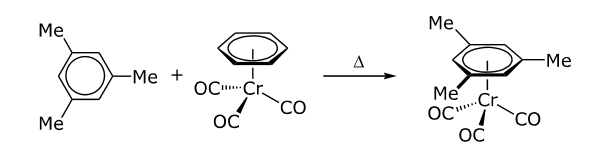
What types of ligands can we displace for arene ligands?
We can replace two free electron donor with an aromatic ring

True or false Different arenes can be displace one another
True We can exchange arene rings if the displacing arene is more electron donating (e.g. with Me substituents)
Reacting a metal-carbonyl-halide with benzene and aliminium trichloride results in….
an arene half-sandwhich complex and aliminium tetrachloride (from the chloride which is displace)
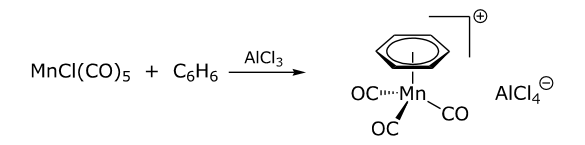
Why is nucleophilic substitution and the following complex really fast? How does it also affect the protons on the aromatic ring?

• The Cr(CO)₃ fragment is strongly electron withdrawing • Which renders the arene electron poor (electrophilic) • Hence nucleopilic substitutions reactions are fast (and electrophilic substitutions are slow) • Also results in protons on the aromatic ring becoming more acidic, so deprotonation becomes easier
Why does the formation of the following cycloheptatrienyl (C₇H₇) occur so easily from the cycloheptatriene complex (C₇H₈)
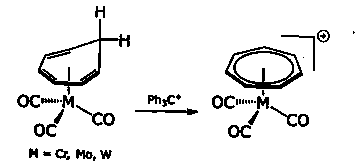
• Cyloheptatriene is η6, hence has 6 pi-electrons corresponding it to an aromatic system • Hence treating it with the following carbocation will remove a hydrogen • The formed cycloheptatrienyl formed with cordinate η7 to the metal centre
Why is the formation of this cycloheptatrienyl not as favourable
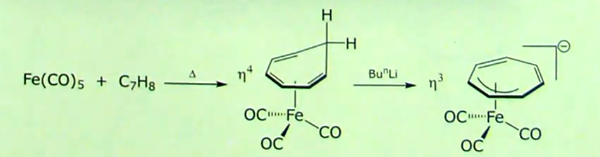
• treating it with butyl lithium will deprotonate it, which pushes the electrons into the ring • Forming an C₇H₇⁻ complex which has 8 pi-electrons and is not an aromatic system • Can be stabilised by binding η3 to a metal centre however
Is the following cyclooctatetraenyl complex aromatic

• It has 8 pi-electrons • doesn’t obey the 4n+2 rule
How can cyclooctatetraenyl become aromatic?

• By reduction using 2e- forming C₈H₈²⁻ • Meaning it has 10 pi-electrons and is aromatic • When aromatic is can coordinate through all 8 of the carbons
Cyclooctatetraenyl will favourable coordinate to a
Large metals Due to its own large size (e.g. this uranium-cyclooctatetraenyl complex due to uranium being a large metal) It is also not an 18e species because it is an f-block element
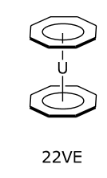
How may two cyclooctatetraenyl complexes bind to a smaller metal
• One will coodinate η8 • and one will coodinate η4 (neutral/non-aromatic species)
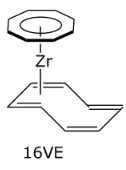
Define fluxionality and the impact it has on NMR
• Sometime organic ligands are continuously reorganising their position at a metal centre • At higher temperature NMR they covert so fast they cannot be distinguished but at lower temperature you can maybe distinguish multiple positions
True or False…. Fluxionality usually involves π-bound ligands because they are bound less rigidly to a metal centre than σ-bound ligands
True
What are the two types of dynamic equilibria for fluxional complexes?
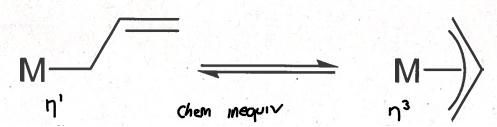
• Interchange of two or more configuations which are chemically inequivalent (e.g. η5 → η1 in Cp complexes or η3 → η1 in metally allyl complexes) • Interchange of two or more configurations which are chemically eqivalent e.g. 1,2- or 1,3-shifts of η1-Cp ligands
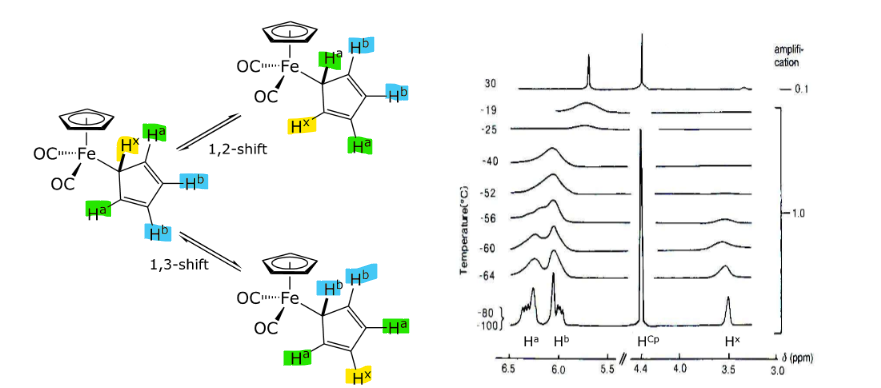
Describe a 1,2-shift and a 1,3-shift for the following compound And hence the effect it has on the NMR
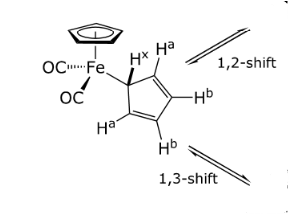
With increasing temperature, there can be a switch from C1 to C2 (1,2-shift) or C1 to C3 (1,3-shift) being found to the metal centre (results in the NMR signal start to broaden out)
What occurs in step 1 of this reaction involving the hydrogenation of an alkene
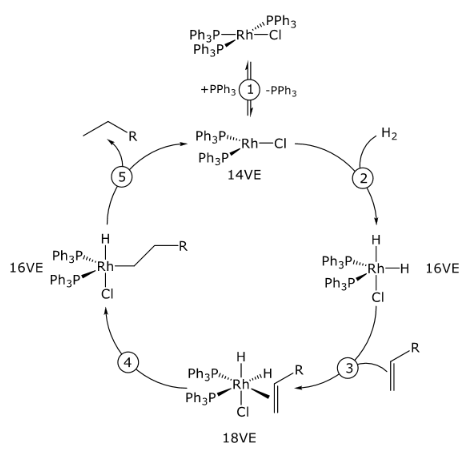
• Ligand dissociation • Triphenylphosphate is lost
What occurs in step 2 of this reaction involving the hydrogenation of an alkene
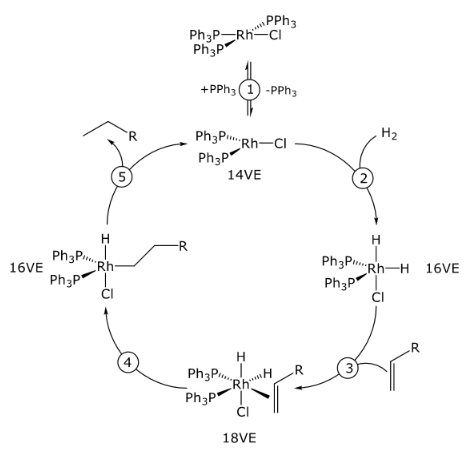
• Oxidative addition of H₂ • Going from 14e- to 16e (more stable)
What occurs in step 3 of this reaction involving the hydrogenation of an alkene
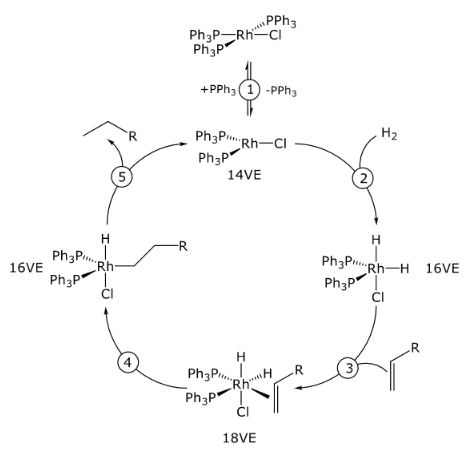
• Coordination of an alkene • Going from a 16e to 18e complex (more stable)
What occurs in step 4 of this reaction involving the hydrogenation of an alkene?
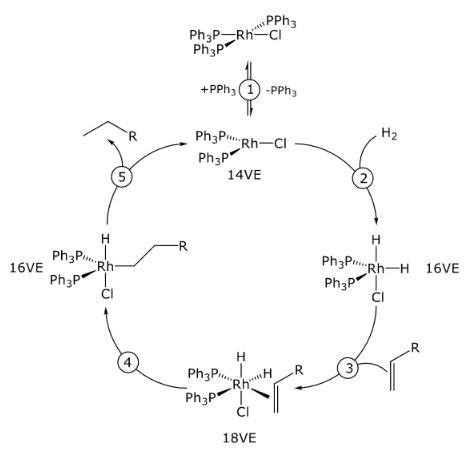
• 1,2-migratory insertion of the alkene • Removal of the C=C bond
What occurs in step 5 of this reaction involving the hydrogenation of an alkene?
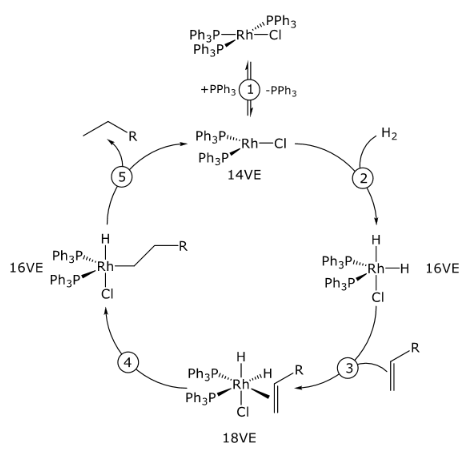
• Reductive elimination of the alkane • Final alkane product has been formed and the 14e Rh complex has been reformed