Isomer
No description yet. This curated deck is ready for daily study.
Card preview (18)
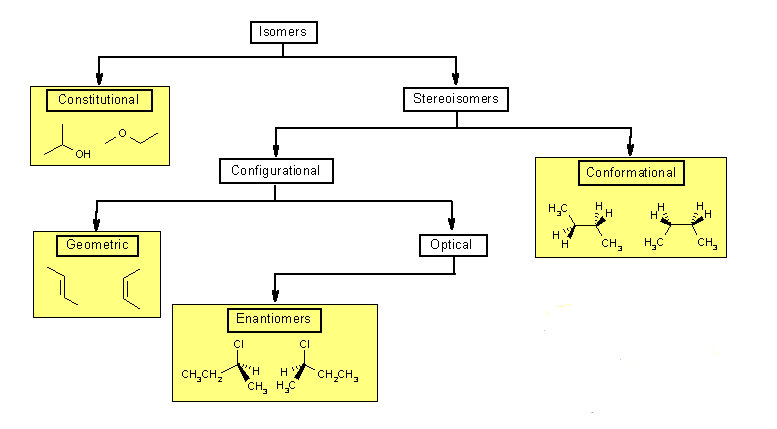
Isomers
same molecular formula, different structural formula
Types of isomers
Structural isomer/constitutional • Different functional group (functional group isomerism) • Same functional group • chain isomer • position isomers -Tautomerism Stereoisomers • cis-trans isomers (geometric isomers) • optical (configurational) isomers • conformational isomers
Constitutional Isomerism
-aka Structural isomerism -Molecules that contain the same atoms but connected in different ways so they contain different functional groups and / or bonding patterns. They have different physical and chemical properites.
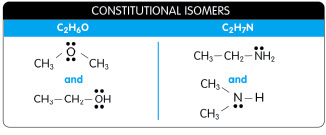
Constitutional isomerism subtypes
• Chain isomerism • Postition isomerism • Functional group isomerism • Tautomerism
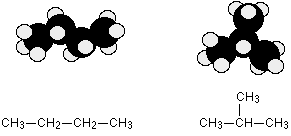
Constitutional isomerism: Chain isomerism
Isomers arise because of the possibility of branching in carbon chains
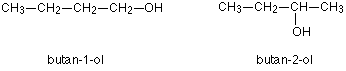
Constitutional isomerism Position isomerism
The basic carbon skeleton remains unchanged, but important groups are moved around on that skeleton.
Constitutional isomerism Functional Group isomerism
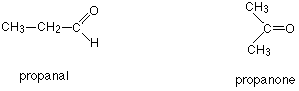
Isomers contain same molecular formula, but different functional groups
Stereoisomerism
The atoms making up the isomers are joined up in the same order/connectivity, but still manage to have a different spatial arrangement.
Stereoisomerism subtypes
• Conformational isomerism • Configurational isomerism • Geometric isomers (E/Z or cis/trans) • optical isomerism
Conformational isomerism
• Stereoisomers produced by rotation about the sigma bonds • Typically can interconvert at room temperatrure • represented by newman progection
Configurational isomerism
stereoisomers that can cannot be converted into one another by rotation around a single bond.
Configurational isomerism subtypes
• Geometric isomerism • Optical isomerism
Configurational isomerism Geometric isomerism
Stereoisomers whose substituents are arranged differently relative to each other around a double bond or ring.
Configurational isomerism Geometric isomerism subtypes
• cis-trans isomerism • E-Z isomerism
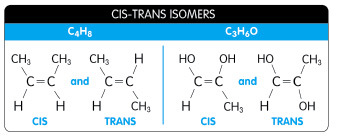
Configurational isomerism Cis-trans isomer
Geometrical isomers in which two identical substituents (or two pairs of two identical substituents) are bonded differently to carbon atoms participating in a double bond or ring bond.
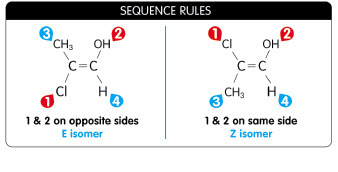
E-Z naming system
higher atomic number, higher priority If the higher-priority substituents (“1” and “2”) are on the same side of the double bond, then the substituents are arranged in Z configuration; if the higher-priority substituents are on opposite sides of the double bond, then they are arranged in E configuration.
Configurational isomerism: Optical isomerism
aka. chiral isomer Optical isomers are named like this because of their effect on plane polarised light. mirror image=enantiomers
Biological significance of enantiomers chirality
• a pair of enantiomer shows similar reactivity with achiral molecule • can show completely opposite behavior with other molecules • Thus a pair of enantiomers may react differently with a receptor site