2. Coeliac Plexus
No description yet. This curated deck is ready for daily study.
Card preview (7)
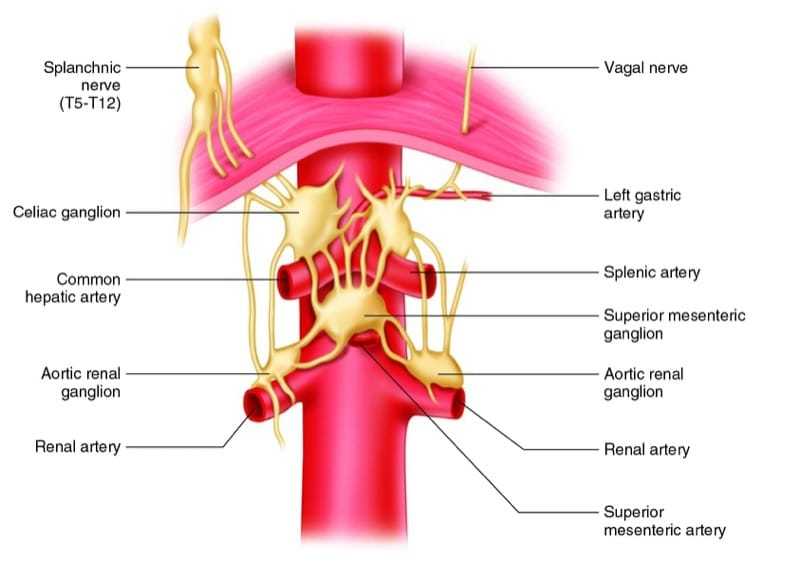
The coeliac plexus
The coeliac plexus is the largest sympathetic plexus and lies anterior to the abdominal aorta where, as a dense network of nerve fibres, it surrounds the root of the coeliac artery at the level of L1. It is a bilateral structure. There are two ganglia, right and left, which are closely related to the crura of the diaphragm The plexus receives the greater splanchnic nerve (fibres from T5 to T9 or 10) and the lesser splanchnic nerve (fibres from T9/10 or T10/11).
Relations
Superiorly lie the crura of the diaphragm; posteriorly is the abdominal aorta; laterally are the adrenal glands in the superior poles of kidneys anterior relation is the pancreas
Plexus block Dx
Diagnostic: coeliac plexus block using local anaesthetic alone can be used for diagnostic purposes, and for attempting to break a sympathetically mediated acute pain cycle.
Plexus block
Therapeutic: the plexus can be blocked in conjunction with intercostal nerves to provide analgesia for intra-abdominal surgery. This technique does not have many enthusiasts. More commonly it is used for the relief of malignant visceral pain, typically that due to carcinoma of the pancreas. Neurolytic blocks give good analgesia in up to 90% of patients, although the effect may only last for a number of months
Non malignant pain
Non-malignant pain: the commonest such condition is chronic pancreatitis. Many clinicians are reluctant to use coeliac plexus block in such patients both because of the risks of paraplegia (1–2 per 1,000 owing to acute ischaemia at the watershed area of the cord) and because its effective duration is limited.
Technique of Coeliac Plexus Block
The patient lies prone. The procedure should be done under X-ray control. The spinous process of T12 forms the apex of a flattened triangle whose base is a line joining the twelfth ribs, and which ends 7–8 cm from the midline. A 10–15 cm 20G needle ( Directed towards 1st lumbar vertebrae Encounters body - redirected walked off anterolateral side of vertebrae + further advanced 2cm The diffuse nature of the para-aortic plexus means that 20–25 ml of local anaesthetic will be required on each side. Neurolytic agents should be injected only under X-ray control, after needle placement has been confirmed by contrast media. All neurolytic drugs lead to indiscriminate neural destruction. Alcohol (50–100%) is usually preferred to phenol (5–8%) for coeliac plexus block. It can be very painful on injection, but does not cause the vascular injury that is associated with phenol The duration of effective action may be limited to 1–6 months. The neuritis that can accompany the regeneration of nerves may be as severe as the original symptoms
Complications
: these include hypotension (it is a sympathetic block); anterior spinal artery syndrome (see under ‘The Blood Suppply to the Spinal Cord’); subarachnoid, epidural and intrapsoas injection; intravascular injection (the aorta is very accessible on the left, the inferior vena cava is less vulnerable on the right); retroperitoneal haemorrhage; and visceral puncture. The kidney is the organ that is most vulnerable. The neurolytic agent may also spread unpredictably, causing paresis, paralysis and dysaesthesia.