Topic 17.4 Benzene
No description yet. This curated deck is ready for daily study.
Card preview (24)
Arenes
Ring compounds in which there are delocalised electrons (based on benzene)
Aromatic
The bonding in a compound which has delocalised electrons forming pi bonding in a hydrocarbon ring
Aliphatic
Molecules have chains atoms and with rings that are not aromatic (openchain)
Reactions of benzene: as a hydrocarbon
-Hydrogenation Heat under pressure with a nickel catalyst C6H6 +3H2 –> C6H12
Reactions of benzene: combustion
-Benzene burns with a smokey flame C6H6 + 7.5O2 –> 6CO2 + 3H2O
Reactions of benzene: bromination
Heated under reflux with a catalyst (a halogen carrier)

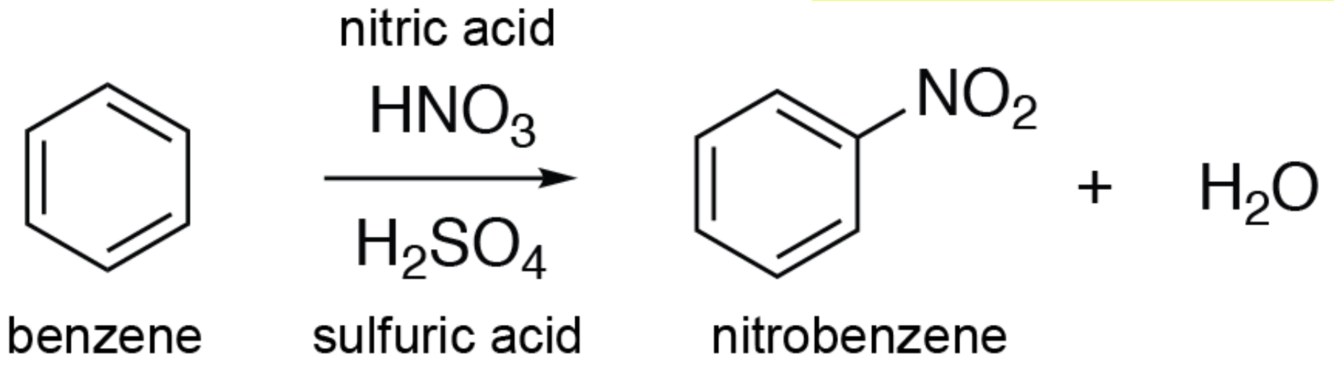
Reactions of benzene: nitration
Reagents- concentrated nitric acid + sulfuric acid Conditions- warm (not about 50°C)
Reactions of benzene: Freidel-Crafts alkylation
Organic product is methylbenzene (touline) Adding alkyl group
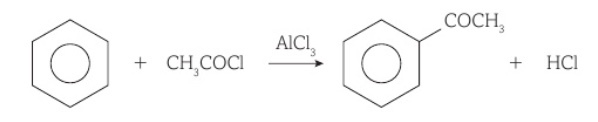
Reactions of benzene: Freidel-crafts acylation
-Delocalised electrons in ring act as nucleophile -Attack acyl chlorides -Reactive intermediate needed -AlCl catalyst: R-COCl + AlCl3 –> R-CO^+ + AlCl4^- (Anhydrous conditions (dry) as water would react with the catalyst)
Electrophile
An electron pair acceptor – an atom or group of atoms that is attracted to a region of high electron density and can accept a pair of electrons.
Nucleophile
An electron-rich species that can donate a pair of electrons
Substitution
A reaction in which a functional group in a compound is replaced by (or is substituted by) another.
Addition
Chemical reaction wherein two or more reactants come together to form a larger single product.
Four main things that led to Kekule’s structure being disproven: One
Benzene isn’t very reactive, so if Kekulé’s model were to be correct, there would be 3 double bonds in benzene, and so it would react with bromine and decolourise it –> Benzene doesn’t decolourise bromine
Four main things that led to Kekule’s structure being disproven: Two
The bond lengths in benzene are all the same length. If Kekulé’s model was correct, there would be 2 different bond lengths, corresponding to the double bonds and the single bonds in the ring.
Four main things that led to Kekule’s structure being disproven: Three
The hydrogenation enthalpy of benzene is expected to be three times that of cyclohexene, if it were Kekulé’s model. However, it is smaller, and less energy is produced than expected, meaning that the actual model of benzene is a lot more stable than Kekulé’s model.
Four main things that led to Kekule’s structure being disproven: Four
Should be 4 isomers however only 3 are known to exist
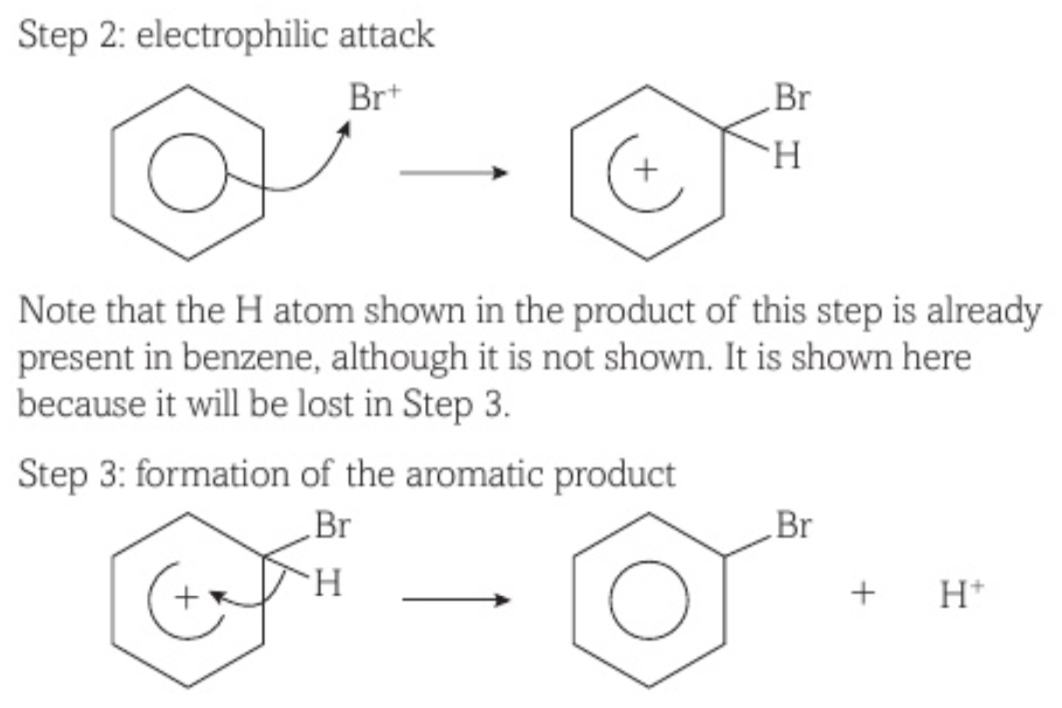
Mechanisms: Bromination of benzene
Step 1: Formation of the electrophile Bromine reacts with the catalyst to form Br+: AlCl3 + Br2 –> Br+ + AlCl3Br- Step 2: Electrophilic attack Step 3: Formation of the aromatic product Step 4: Formation of the inorganic products AlCl3Br- + H+ –> AlCl3 + HBr
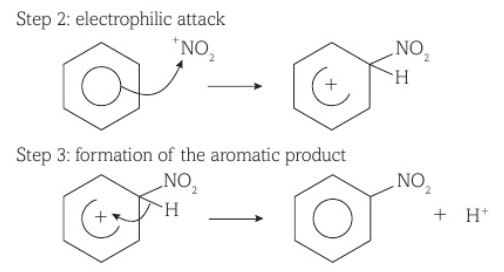
Mechanisms: Niration of benzene
-NO2 + ion = electrophile Step 1: formation of electrophile (conc.) nitric acid and (conc.) sulphuric acid to form NO2^+: HNO3 + H2SO4 –> NO2^+ + HSO4^- + H2O Step 2: Electrophilic attack Step 3: Formation of aromatic product Step 4: Formation of inorganic products HSO4^- + H^+ –> H2SO4
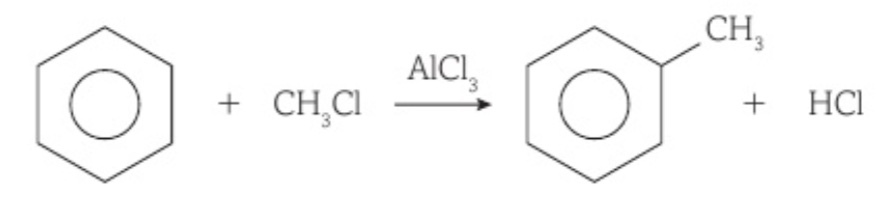
Mechanisms: Friedel-Crafts alklyation of benzene with chloromethane
-Alkalyation means the substitution of one of the hydrogen atoms of benzene by an alkyl group. -The reagent is a halogenoalkane, and the products are an alklybenzene (methylbenzene) and hydrogen chloride. -The equation for the reaction with chloromethane:
Mechanisms: Friedel-Crafts with acetyl chloride
Why does benzene undergo substitution reactions rather than addition reactions?
Because that would involve breaking the delocalisation and losing that stability.
Show the general reaction and reagents for bromination of phenol
In the absence of a catalyst (cold conditions) reagents: Aqueous bromine (?)
Explain why bromination happens more readily with phenol than benzene
The increased reactivity compared to benzene is due to the lone pair of p-orbital electrons on the oxygen atom in the phenol group.