M3/M5 - Equilibrium
No description yet. This curated deck is ready for daily study.
Card preview (24)
Dynamic equilibrium exists in a closed system. State two other key features of dynamic equilibrium.
• The rate of the forward reaction is equal to the rate of the reverse reaction • The concentration of reactants and products do not change
Which letter represents the moment the reaction has reached equilibrium
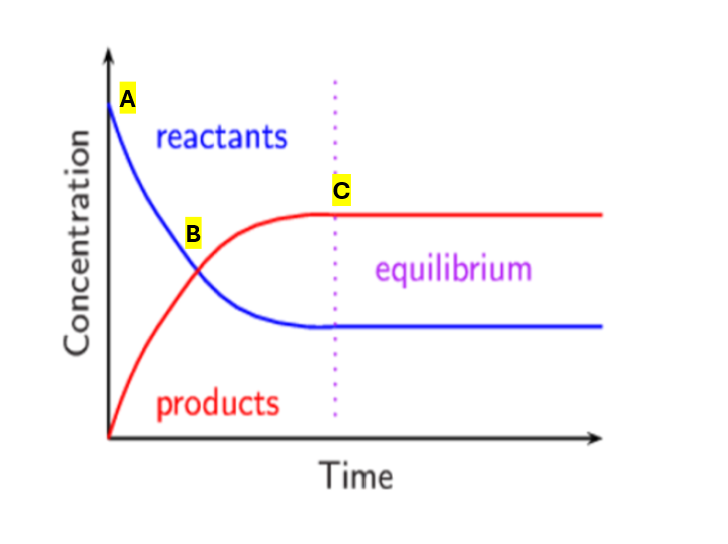
C Concentrations no longer changing
State Le Chatelier’s Principle
When a system in dynamic equilibrium is subjected to a change, the equilibrium position will shift to minimise the effects of the change
If you increase the pressure, what will equilibrium do?
Shift to the side with less moles of gas!
If you decrease the pressure, what will equilibrium do?
Shift to the side with more moles of gas!
If you increase the temperature, what will equilibrium do?
Shift in the endothermic direction (innuendo!)
If you decrease the temperature, what will equilibrium do?
Shift in the exothermic direction
State what would happen to the equilibrium position if the temperure was increased

• Equilibrium position would shift to the RIGHT to minimise the increase in temperature • The forward reaction is endothermic so absorbs heat energy • More products at new equilibrium
State what would happen to the equilibrium position if the pressure was increased

• Equilibrium position would shift to the LEFT to minimise the increase in pressure • There are less moles of gas on the left • Less products at new equilibrium
State what would happen to the equilibrium position if excess methane was used. Could you also think how this would affect your amount of each chemical??

• Equilibrium position would shift to the RIGHT to minimise the increase in Methane conc • More products at new equilibrium There would be more hydrogen, more CO and less steam because of the shift right BUT there would still be more methane! Change is only MINIMISED
State what would happen to the equilibrium position if a catalyst was added

• No shift • Catalyst increases the rate of both the forward and reverse reaction equally
State what would happen to the equilibrium position if the pressure was increased

• No shift! • Same moles of gas on each side (2 –> 2)
State the best conditions for pressure and temperature for high yield

• Need to shift equilibrium to the right • **Low temperature **as forward reaction is exothermic • High pressure as less moles of gas on the right hand side
Low temperature and high pressure is best for yield. But why would industrial conditions differ?

Low temperature would be too slow! So need a slightly higher temp (but higher temp would lower yield and have high energy demand) **High pressure is too dangerous! **(& expensive) So need a slightly lower pressure (but lower pressure would lower yield and lower rate)
Why is an Iron catalyst used?

• Doesnt affect yield as no shift • Lowers activation energy • Faster rate • Can use lower temperature (less fossil fuels used and less carbon dioxide emissions)
What would be the benefits of using excess nitrogen and hydrogen?

• Would shift equilibrium to the right and increase yield • Would speed up rate of reaction
Explain the term heterogeneous equilibrium
reactants and products are in different states
Explain the term homogeneous equilibrium
reactants and products are in the same state
Is this reaction homogeneous or heterogeneous

Homogeneous Reactants and products same state (gas)
Is this reaction homogeneous or heterogeneous

Heterogeneous Reactants are a different state to the products
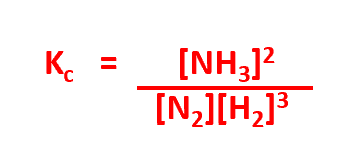
Write the Kc expression for this equilibrium and state the units for Kc

Units = dm6mol-2 Allow units in any order!
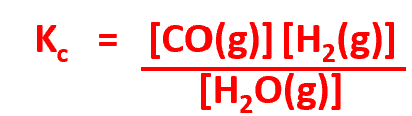
Write the Kc expression for this equilibrium and state the units for Kc

Units = Moldm-3 Allow units in any order!
Kc has the value of 0.05 Would this be to the left or right?
Kc < 1 Lies to the left! remember Less Left
Kc has the value of 100 Would this be to the left or right?
Kc > 1 Lies to the right remember moRe Right