AQA A Level Chemistry - Reactions Of Aqueous Ions
No description yet. This curated deck is ready for daily study.
Card preview (10)
• What is the definition of a coordinate bond?
• A coordinate bond is a shared pair of electrons which have both come from the same atom
• What is the definition of a Ligand?
• A ligand is an ion or molecule with a lone pair of electrons which can form a coordinate bond with a metal ion
• What is the definition of the the complex ion?
• The complex ion is a central atom or ion surrounded by ligands
• What is definition of the Coordination number?
• The coordination number is the number of coordinate bonds a transition metal ion forms
• Why are the 3+ ions more acidic than the 2+ ions?
• The 3+ ions are more acidic than the 2+ ions because: • Fe3+ is smaller and more highly charged than Fe2+ • So Fe3+ is more polarising (overall pulls electrons towards itself) • This means Fe3+ strongly attracts the lone pair on the Oxygen of the water ligands • In turn this weakens the O-H bond strength • This means the Fe (III) complex more easily releases H+ ions making the solution acidic • The Fe(II) complex does not release H+ ions
• What are the equations which represent the Fe(III) complex acting as an acid?
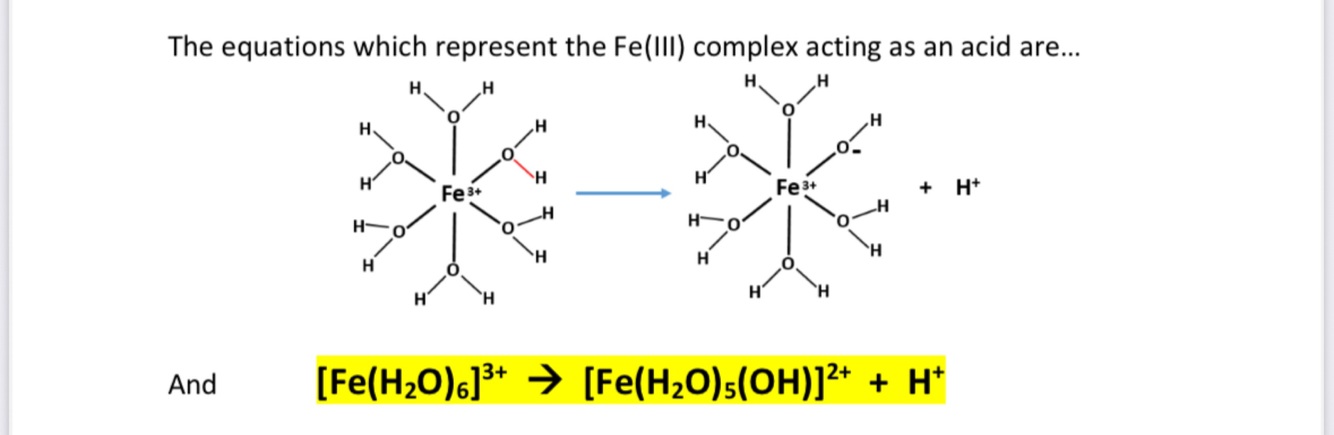
• How does the Al3+ complex ion act as an acid?

What is the equation and observation for the reaction of [Fe(H2O)6]2+ with Na2CO3?
• Observation: Green solution to green precipitate

• What is the equation and observation for the reaction of [Fe(H2O)6]2+ with NaOH • And what is the observation with the action of an excess of NaOH (aq) ?
• Observation: green solution to green precipiate (green precipiate goes brown on standing in air) • With an excess of NaOH (aq) there is no further change

• What is the equation and observation for the reaction of [Fe(H2O)6]2+ with NH3? • And what is the action of an excess of NH3 (aq) ?
• Observation: green solution to green precipiate (green precipitate goes brown on standing in air) • As before the green precipitate will turn brown on standing as the oxygen in the air oxidises it from Fe2+ to Fe3+ • In this reaction [Fe(H2O) (OH)2] forms [Fe(H20)3OH)3] • In an excess of NH3 (aq) there is no further change
