3.1.4 Energetics
No description yet. This curated deck is ready for daily study.
Card preview (24)
Define Enthalpy
Heat content in a substance
Define Enthalpy Change (ΔH)
Change in heat energy (of a reaction) at a constant pressure
State the units for enthalpy change (ΔH)
kJ mol-1
What is meant by this symbol ⦵?
Means substances were in their standard states and measurement was under standard conditions
Name the standard conditions
• 1 atm (100 kPa) • 298 K
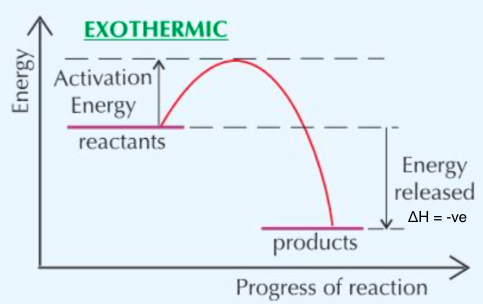
Exothermic: ΔH is ______
negative
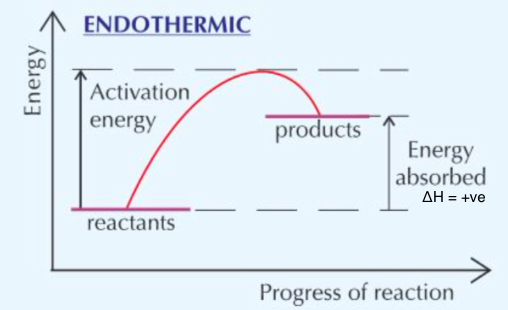
Endothermic: ΔH is ______
positive
Give 2 examples of exothermic reactions
• Neutralisation • Combustion
Give 2 examples of endothermic reactions
• Thermal decomposition • Photosynthesis
Sketch a graph to show an exothermic reaction
Sketch a graph to show an endothermic reaction
Why is bond breaking endothermic (ΔH = positive)?
Need energy to break bonds
Why is bond making exothermic (ΔH = negative)?
Energy released when bonds formed
If more energy is needed to break bonds than is released when bonds made, ΔH is _____
positive (If it’s less = ΔH is negative)
Define standard enthalpy of formation (ΔfH⦵)
Is the enthalpy change when 1 mole of a compound is formed from its constituent elements under standard states & standard condition
Define standard enthalpy of combustion (ΔcH⦵)
Is the enthalpy change when 1 mole of a substance is burnt completely in oxygen, under standards states & standard conditions
Standard enthalpy of formation equation K2Cr2O7(l)
2K(s) + 2Cr(s) + 7/2O2(g) → K2Cr2O7(l)
Standard enthalpy of combustion equation CH4(g)
CH4(g) + 2O2(g) → CO2(g) + 2H2O(l)
How do we use calorimetry to find how much heat is given by reaction?
By measuring temperature change
Describe how you can find the enthalpy of combustion of a flammable liquid using calorimetry
• Burn flammable liquid inside apparatus (e.g. calorimeter) • Then can work out heat energy that’s been absorbed by water (heat given by fuel as it burns = be absorbed by water)
Why is it hard to get an accurate result when using calorimetry? Name 3 reasons
• Heat is always lost to the surroundings • Combustion may be incomplete (less energy given out) • Flammable liquids often volatile = lose some fuel to evaporation
Describe how you can use calorimetry to calculate the enthalpy change for a neutralisation reaction
• Add known volume of acid to insulated container (e.g. polystyrene cup) & measure temperature • Add known volume of alkali and record temp. of mixture at regular intervals over period of time • Stir solution to make sure it’s evenly heated • Find temp change of experiment • Use it to calculate enthalpy change of reaction
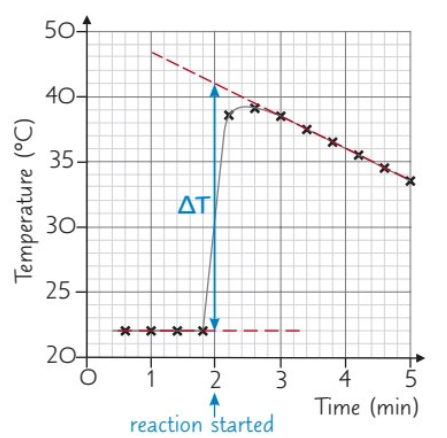
Calorimetry Describe how you can use a graph to find an accurate temperature change
• During experiment, record temp at regular intervals • Start a couple mins before reaction • Plot graph of results • Draw 2 lines of best fit • 1 through points before reaction started • 1 through points after it started • Extend both lies so they both pass time when reaction started • Distance between 2 lines at time reaction (before any heat lost) = accurate temp change (ΔT) for reaction
State what equation (& the units) you can use to calculate the enthaply change in calorimetry
