Chapter 14 (alcohols)
No description yet. This curated deck is ready for daily study.
Card preview (14)
What determines the properties of alcohols ?
• OH functional groups, hydroxyl group • the OH dictates the physical and chemical properties of the alcohol
What are the physical properties of alcohol relative to alkanes ?
• alcohols are less volatile compared to alkanes • Higher melting points • greater water solubility • as the carbon chain length increases, alkanes and alcohols become more similar • these differences are due to the polarity of the OH bond
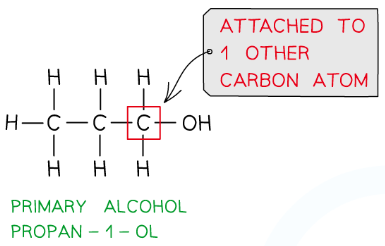
What is a primary alcohol ?
• e.g methanol, ethanol • OH is attached to 2 hydrogens, 1 alkyl group although methanol is also a primary alcohol
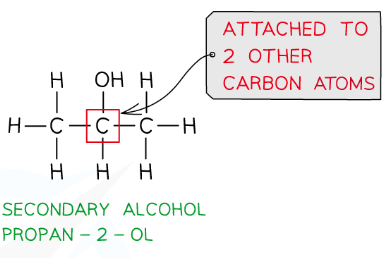
What is a secondary alcohol ?
• OH, is attached to 1 hydrogen, 2 alkyl groups
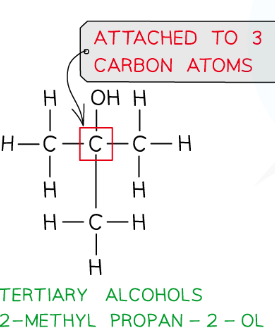
What is a tertiary alcohols ?
• OH, is attached to 0 hydrogens, or 3 alkyl groups
How are primary alcohols oxidised ?
• they can be oxidised by an oxidising agent • this is usually potassium dichromate acidified with dilute sulphuric acid • if alcohol is oxidised, orange dichromate ions are reduced to green solution containing chromium ions
What are the products of the oxidation of a primary alcohol ?
• can be oxidised to either aldehydes or carboxylic acids • the product depends on the reaction conditions used • aldehydes can themselves by oxidised to form carboxylic acids
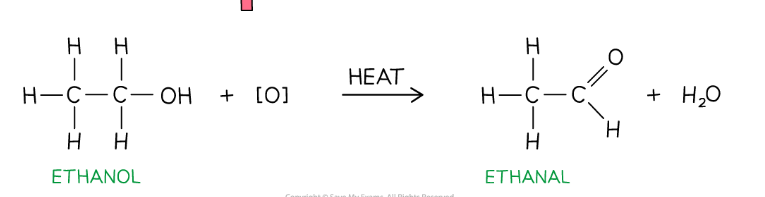
How to make aldehydes ?
• gentle heating of primary alcohol with acidified potassium dichromate an aldehyde is formed • aldehyde is distilled out of the reaction mixture as it forms, this is to stop oxidising further to carboxylic acid • colour change from orange to green • oxidising agents can just be written as [O]
How to make carboxylic acids ?
• primary alcohol is heated strongly under reflux (even distribution of heat energy) • this ensures that any aldehydes formed initially in reaction also undergoes oxidation to the carboxylic acid • excess of acidified potassium dichromate
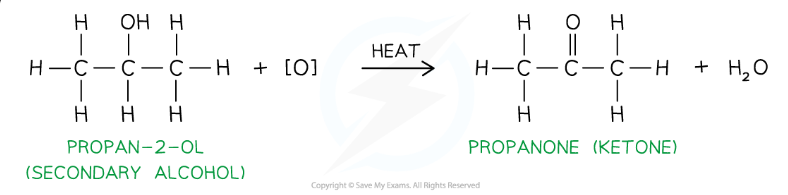
What happens in the oxidation of secondary alcohols ?
• oxidised to ketones • No further oxidation is possible when using acidified dichromate ions • secondary alcohol is heated under reflux • the dichromate ions change from orange -> green
What happens in the oxidation of tertiary alcohols ?
• they do not undergo oxidation reactions • acidified dichromate ions remain orange when added to tertiary alcohols • this is because the carbon atom attached to the OH, is bonded to 3 others carbon atoms
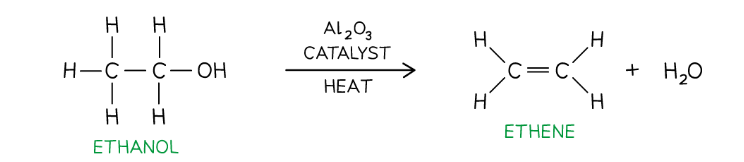
What is the dehydration of alcohols ?
• a water molecule is removed • An alcohol is heated under reflux, in the presence of an acid catalyst (sulphuric acid) • an alkene is formed
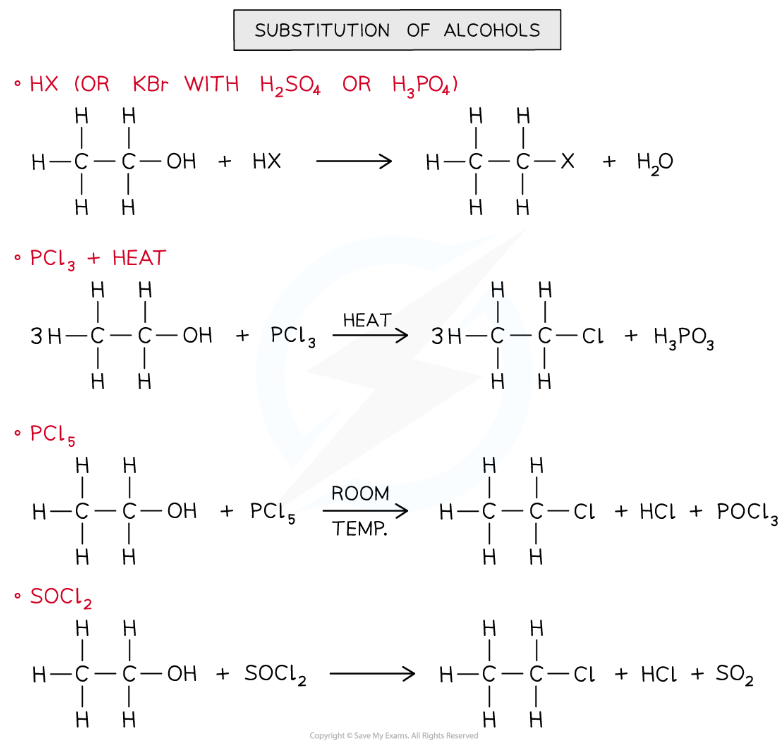
What happens in the substitution of alcohols ? to form haloalkanes
• reaction with hydrogen halide -> haloalkane • Alcohol is heated under reflux with sulphuric acid and sodium halide • hydrogen halide is formed • hydrogen halide reacts with alcohol to produce Haloalkane • overall haloalkane, water is formed
what are all of the possible substitution reactions of alcahols ?