Chapter 20-Carboxylic Acids and their Derivatives
No description yet. This curated deck is ready for daily study.
Card preview (24)
Suffix for Carboxylic Acid (IUPAC Nomenclature)
“-oic acid”
What geometry do carboxylic acids have?
Trigonal Planar
Considering carboxylics are soluble in polar solvents…when do they become amphiphilic (hydrophobic)?
Amphiphilic when chain is longer than 4 carbons.
What is a carboxylate ion? (Hint: Draw it out!)

Suffix for Carboxylate ion (IUPAC Nomenclature)
“-oate”
pKa of Carboxylic Acids
~4-5
True or False: Out of ALL of the organic functional groups carboxylic acids are the WEAKEST acids.
False, they are still weaker acids, but they are the strongest out of all of the functional groups.
Do electron withdrawing groups (EWG) or electron donating groups (EDG) increase the acidity of Carboxylic Acids?
EWGs in crease the acidity.
What are TWO oxidative cleavage routes to make carboxylic acids? (Hint: Think back to Organic Chemistry I!)
-KMnO4 w/ H2O and heat -Ozonolysis (1) O3, 2) H2O)
Name the TWO conditions in STRONG oxidation that an alcohol group must meet in order to form a carboxylic acid? (Hint: Think back to the first unit or two from this semester!)
1) Na2Cr2O7 2) H2SO4, H2O
Name the two reagents used after forming the grignard reagent in order to form a carboxylic acid?
-CO2 -H3O+
Provide a saponification mechanism for the following reaction.
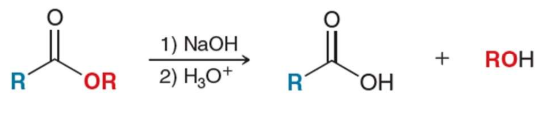

What reagents can be used to reduce a carboxylic acid to an alcohol?
LAH and H3O+
What is the first thing the carboxylic acid can become in reduction? What is the second thing?
1) Aldehyde 2) Alcohol
What is the othe reactant that can be used in place of LAH in reduction? Why is it a good subsitute for the LAH reagent?
BH3 (w/ THF) can be used. BH3 is chemoselctive for the carboxylic acid so therefore it will always react with the acid and will not react with an ester.
Using Fischer Esterfication. Provide the mechanism for the following reaction.

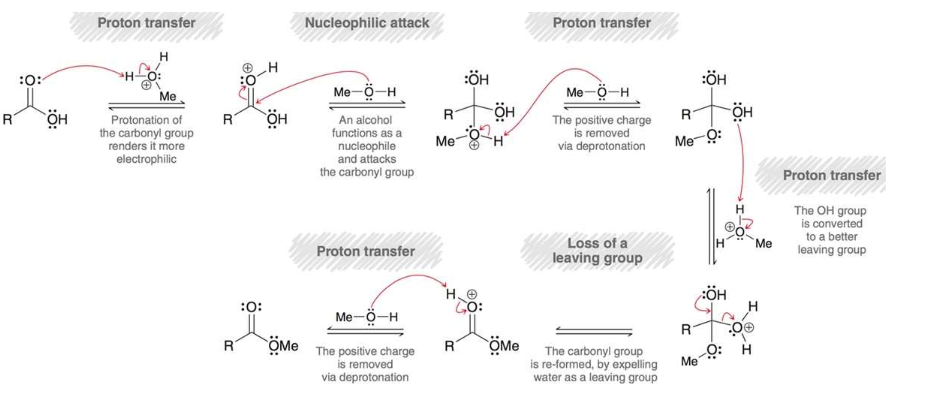
What is the poor route of making an amide from a carboxylic acid?
Forming an ammonium carboxylate salt than heating it to well above 100 degrees Celcius.
What is the better route of synthesizing an amide from a carboxylic acid?
The use of an acid chloride.
Recall: How do you prepare an acid chloride?
Transform a carboxylic acid with SOCl2 to make an acid chloride.
Provide the first part of the mechanism of preparing an acid chloride.
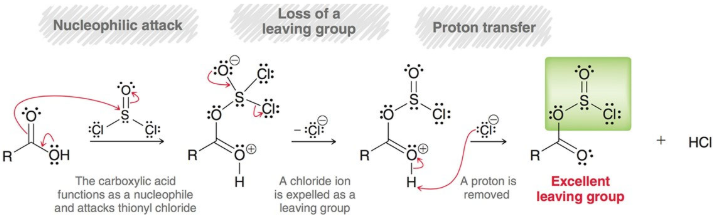
Provide the second part of the mechanism of preparing an acid chloride. What is the mechanism called?
Nucleophilic Acyl Substituion
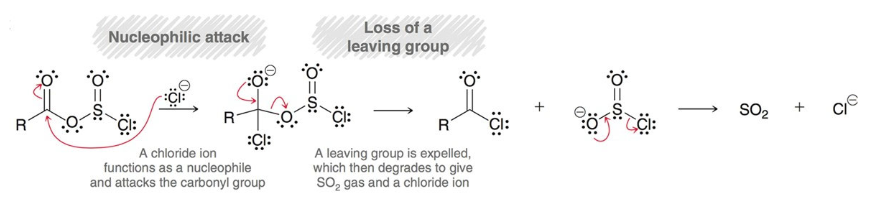
What are the five carboxylic acid derivatives?
-Acid Halide -Acid Anhydride -Ester -Amide -Nitrile
What is the suffix change from a carboxylic acid (“-ic acid”) to an Acid Halide?
“-yl halide”
What is the suffix change from a carboxylic acid (“-ic acid”) to an Anhydride?
“-Anhydride”