Carbonyl Compounds
No description yet. This curated deck is ready for daily study.
Card preview (21)
What are carbonyls?
Compounds with the carbonyl group C=O. Which is aldehydes or ketones
How are carbonyls prepared?
Oxidation of alcohols. Product formed depends on start material and conditions
What is the oxidation product when primary alcohols are heated under distillation and reflux with acidified potassium dichromate?
Distillation - aldehydes (which can then be further oxidised to carboxylic acids by heating under reflux) Reflux - carboxylic acids
What is the oxidation product when secondary alcohols are heated under reflux with acidified potassium dichromate?
Ketones
What is the oxidation product when tertiary alcohols are heated under reflux with acidified potassium dichromate?
No reaction. Tertiary alcohols cannot be oxidised under any conditions
What inter-molecular forces do pure carbonyl molecules form?
Permanent dipole-dipole forces
Why are carbonyls soluble in water?
Can form hydrogen bonds with water molecules
What is the relationship between carbonyl carbon chain length and solubility in water?
Solubility decreases as chain length increases
Why are carbonyls more susceptible to nucleophillic attack?
C=O bond is polarised. Oxygen is more electronegative than carbon. Delta positive carbon atom attracts nucleophiles
What is a nucleophile and what two do you need to know in detail for nucleophillic addition in carbonyl compounds?
A lone pair donor :H- and :CN-
Draw out and name the mechanism for carbonyl compounds
Nucleophillic addition X is the nucleophile
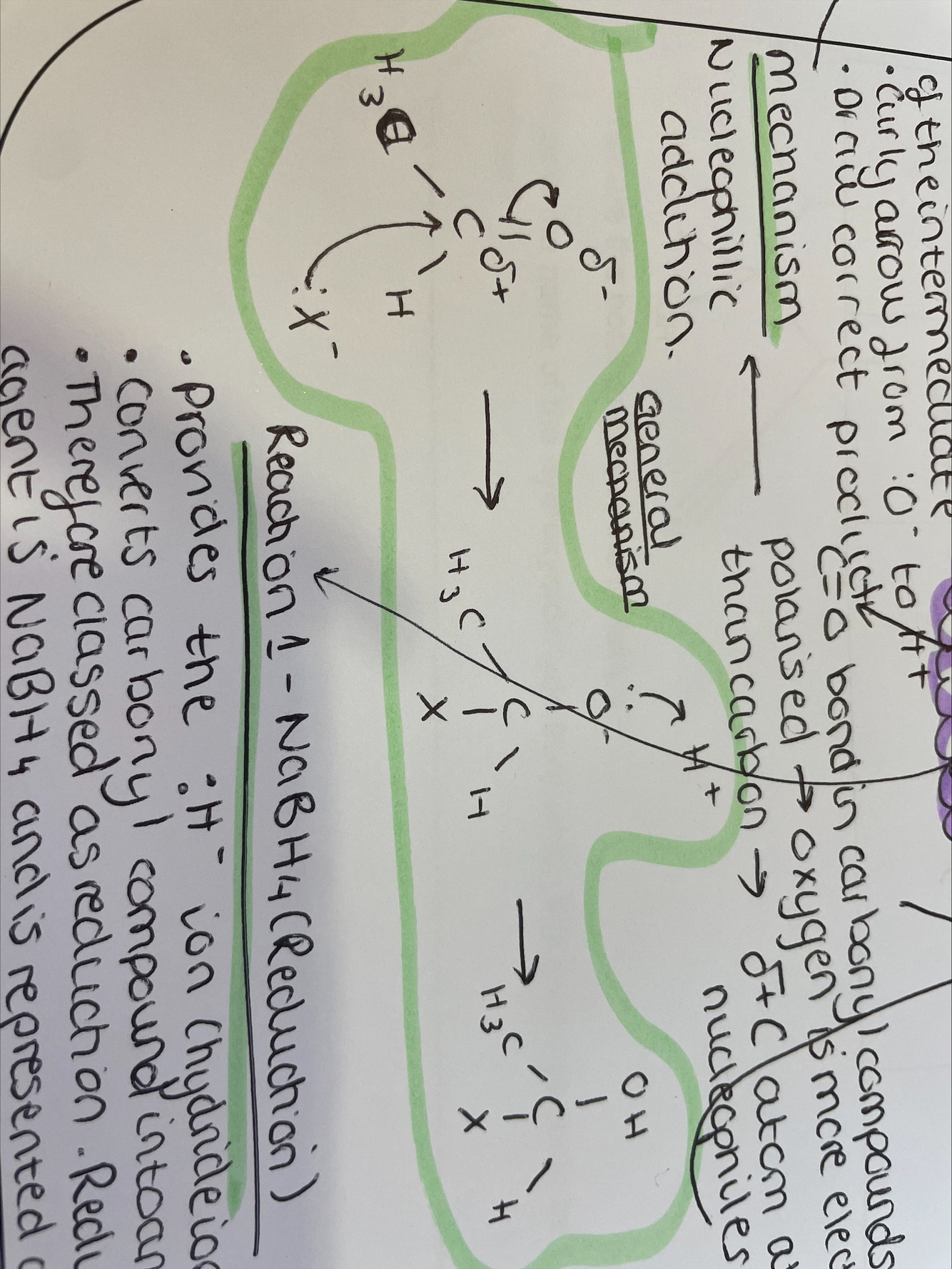
Give 3 points explaining the reaction between carbonyl compounds and NaBH4
• Provides the :H- ion (hydride ion) needed for nucleophillic addition 2. Converts carbonyl compound into an alcohol 3. Therefore classes as reduction - reducing agent is NaBH4 and is represented as [H] in the equation (2[H] needed to balance equation)
Why is HCN formed in situ?
It is an extremely poisonous gas
Is the reaction between carbonyl compounds and HCN a reduction reaction?
No
Give 3 points explaining the reaction between carbonyl compounds and HCN using NaCN and H2SO4
• A carbonyl compound reacts with HCN, which is formed in situ using reagents NaCN and H2SO4 2. Product formed is a hydroxynitrile 3. This reaction is very important in organic synthesis because it increases the carbon chain length by 1
Describe the test to identify carbonyls. Giving reagent and observation with aldehydes and ketones
Reagent: 2-4-DNP (also called Brady’s reagent. Observation with aldehyde: orange ppt. Observation with ketone: orange ppt
How can you use the orange precipitate formed from reacting aldehydes with 2-4-DNP to identify aldehyde and why is it better to test precipitate over aldehyde?
Test melting point of orange crystals formed (the derivative) and compare with known database values. Better to derivatise the compound as the boiling points of aldehydes are very similar so might be hard to match up to database values
Describe the test to distinguish between aldehydes and ketons, giving reagent, observation with aldehyde and observation with ketone
Reagent: Tollens’ reagent [Ag(NH3)2]+ and gentle heat. Observation with aldehyde: silver mirror forms. Observation with ketone: No visible change.
What happens to silver ions when aldehydes are gently heated with [Ag(NH3)2]+?
Reduced. Ag+(aq) + e- –> Ag(s)
Is Tollens’ reagent strong enough to oxidise alcohols?
No
What happens to aldehydes when heated gently with Tollens’ reagent [Ag(NH3)2]?
Oxidised e.g. CH3CHO + [O] —> CH3COOH