Beef And Dairy Cattle Exam
No description yet. This curated deck is ready for daily study.
Card preview (24)
Total Beef cattle in the US Total cows Total Cattle on Feed
Total Beef cattle in the US: 93.6 million Total Cows: 31.2 million cows (90% of cow herds have <100 cows) Total Cattle on Feed: 10.8 million cattle on feed
Top 5 Beef Cattle States (50% of total US $)
1) Texas 2) Nebraska 3) Kansas 4) Colorado 5) Iowa …15) Wyoming 1.3 million cattle 0.7 million beef cattle
Beef Production —> Per Capital Consumption —> Per Capita Spending on Meat
Beef Production -25.8 billion lbs -$78.2 billion —> Per Capital Consumption -65.8 lbs -27.6 lbs of beef 42% —> Per Capita Spending on Meat -Beef: $340 (46.5%) -Pork: $192 -Chicken: $175
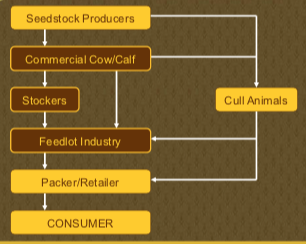
Organization of Beef Production
Nutritional Management
• Feed costs 50-70% of annual costs (15-20% for labor costs) • Maximize the use of roughages, forages, • Pasture, range • crop residues • silage
Emphasis on grazing vs. Harvested forage
• reduced labor, equipment/fuel expense
Pasture and range management
• use animals to manage forage base • stocking rates • forage availability • forage quality
Harvested forages
• minimize losses during storage and feeding • can exceed 20-30% of available forage • protection from exposure to weather • method of feeding can help control losses • haybuster vs roundbale feeders
Creep feeding
• supplemental feed for the calf only • inaccessible to the cows • added 20-50 lbs. weaning wt • Decreased demand on cow • not always economical • cost of supplemental feed • decreased psot-weaning gain • want growth but not fat • Fat heifers –> impaired milk production
Manage Body Condition Too thin? Too fat?
• Too thin • extended post-partum interval • Too fat • not economical (high feed cost) • negative impact on milk production • 1: emaciated (little muscle fat) • 2: very thin (no fat, bones visable) • 3: Thin (Foreribs visible) • 4: Borderline (Forerib not visible, 12th and 13th ribs visible) • 5: Moderate (neither fat nor thin) • 6: Good (smooth appearance) • 7: Very Good (Smooth with fat over back and tail head) • 8: Fat (Blocky, bone over back not visible) • 9: Very fat (tail buried and in fat)
Choice of calving season Spring Calving? Fall Calving?
• Spring Calving (Feb-April) • coordinates forage available for grazing with period of highest nutrient demand • Calving –> lactation –> breeding • Minimize use of harvest forage • Fall Calving (Sep-Oct) • better weather at calving, improved calf survival • takes advantage of seasonal market prices for weaned calves • increased reliance on harvest forage
Calving Management
• Length of calving season • 40-60 days • Uniformity of calf crop, concentration of labor • Observe “close-ups” every few hours • Pelvic ligaments relax
The effects of dystocia
• poor calf survivability • extended post-partum interval
Managing post-calving calf losses
• scours, pneumonia • protection from weather • importance of colostrum in 1st 48 hrs of life
Importance of culling programs
• want to remove unprofitable animals • body condition score • preg. testing
Replacement Heifer Development
• Average 15% of herd culled/replaced annually • Two important factors in heifer development • AGE • breed heifers to calve at 2 yrs of age • heifers need to reach puberty by 15 months • WEIGHT • target= 65% of mature body weight • Medium-frame breeds (Angus, Hereford) 650-750 lbs • Large-frame breeds (terminal crosses) 750-900 lbs
Replacement Heifer Management
• Use low birth weight bulls for heifers • minimize dystocia • birth weight EPD’s • Breed heifers to calve early in calving season • heifers typically have longer post-partum interval • increased dystocia • need to cycle with cow herd at 2nd calving • Keep heifers separated from cow herd if possible • reduced competition for feed • more intensive management
Cow:Bull ratio
• depends on system • length of breeding season • size of pasture, range • heifers vs. cows • US Average • ~ 30:1
Breeding Soundness Exam Checklist
• Physical Examination • feet and legs • eyes • body condition • indications of illness • Rectal Examination • Prostate • Seminal vesicles • Ampullae • Internal inguinal rings • External Examination • Testes • Scrotum • Penis • Prepuce • Semen Evaluation • Volume • Color • Motility • Morphology • Mating Desire • Present
Breeding Program
• Bull Selection • EPD’s etc. • Maximize use of crossbreeding • Crossbred heifers • Higher conception rates • Earlier puberty • Crossbred Calves • more vigorous • faster growth rate
Herd Health Management: Vaccination Program: Bovine Respiratory Disease (BRD) Complex
• IBR (Infectious Bovine Rhinotracheitis) • PI3 (Parainfluenza-3) • BVD (Bovine Viral Diarrhea) • BRSV (Bovine Respiratory Syncytial Virus)
Herd Health Management: Vaccination Program: Brucellosis
• Bang’s Disease • Transmissible to humans –> Undulant Fever
7-way + Blackleg covers which diseases?
• Leptospirosis • Vibriosis (Campylobacteriosis) • Clostridial Diseases • Blackleg • Enterotoxemia • Tetanus