Nuclei with I=1/2 and <100% abundance and quadrupolar nuclei
No description yet. This curated deck is ready for daily study.
Card preview (12)
What does the ¹⁹F NMR spectrum look like for WF₆ (Oₕ symmetry) ¹³⁸W has I = 1/2, abundance = 14.4% Coupling to all other W can be ignored
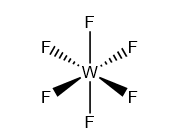
• 100-14.4 = 85.6% of all molecules of WF₆ will not contain ¹³⁸W • Since all fluorines are equivalent and no couplings to W is observed • A singlet in the ¹⁹F NMR will be observed (85.6% spin-inactive W) • The other 14.4% have ¹³⁸W (with I = 1/2) where coupling will be seen as a doublet (satellite peaks)
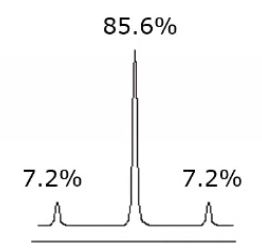
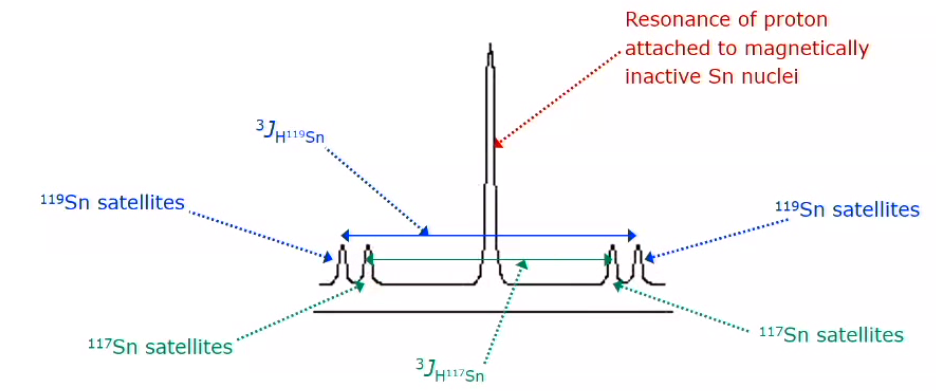
What does the ¹H NMR spectra of Sn[N(CH₃)₂]₄ (Td symmetry at Sn) look like? ¹¹⁷Sn (7.6% abundant) and ¹¹⁹Sn (8.6% abundant), I = 1/2 for both
• 100 - (7.6+8.6) = 83.8% are spin-inactive and will produce a singlet • ¹¹⁷Sn: (2x1x0.5) + 1 = 2 = doublet (7.6/2 = 3.8%) • ¹¹⁹Sn: (2x1x0.5) + 1 = 2 = doublet (8.6/2 = 4.3%)
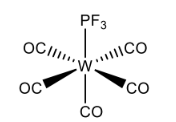
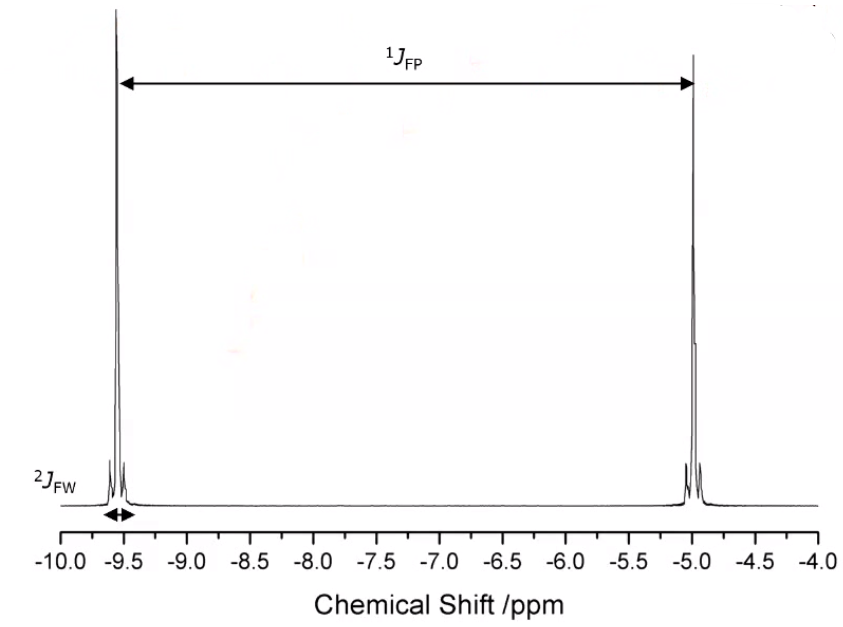
What does the ¹⁹F NMR spectra of W(CO)₅(PF₃) look like? ³¹P (100% abundant), I = 1/2, ¹³⁸W (14.4% abundant), I = 1/2
• 1J FP: (2x1x0.5) + 1 = 2 = doublet • 2J FW: (2x1x0.5) + 1 = 2 = doublet
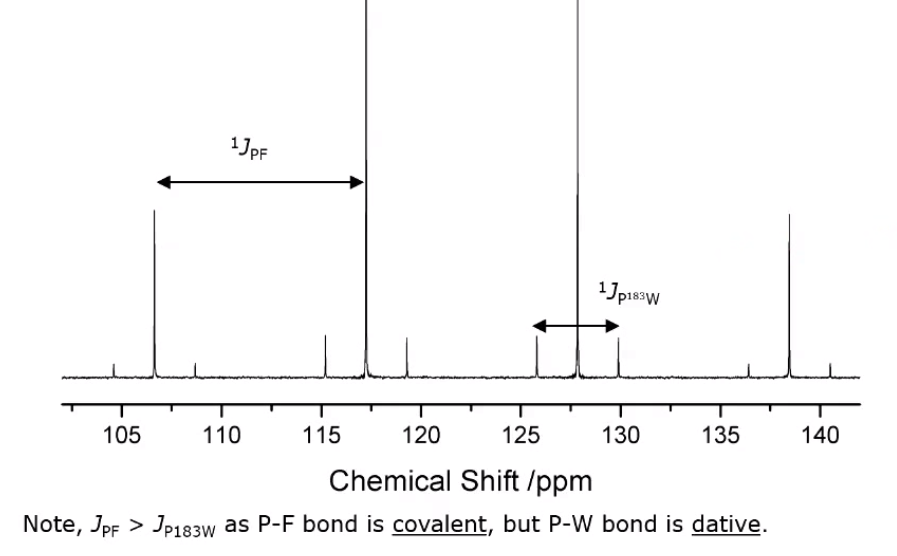
What does the ³¹P NMR spectra of W(CO)₅(PF₃) look like? ¹⁹F (100% abundant), I = 1/2, ¹³⁸W (14.4% abundant), I = 1/2
• 1J PF: (2x3x0.5) +1 = 4 = quartet • 1J PW: (2x1x0.5) + 1 = 2 = doublet
Quadropolar nuclei are where I =
> 1/2
How can we differentiate between planar (sp²) boron (D₃ₕ) and tetrahedral (sp₃) boron (Td) using NMR
• Planar (sp²) boron compounds are more deshielded (higher resonance ppm) compared to the tetrahedral ones • This is due to boron in sp² compounds being electron deficient as it does not have enough valance electrons to fill all of its valance orbitals • e.g. BMe₃ ¹¹B resonance is at +86.2ppm while BH₄⁻ ¹¹B is at -38.2ppm
Explain the following trend
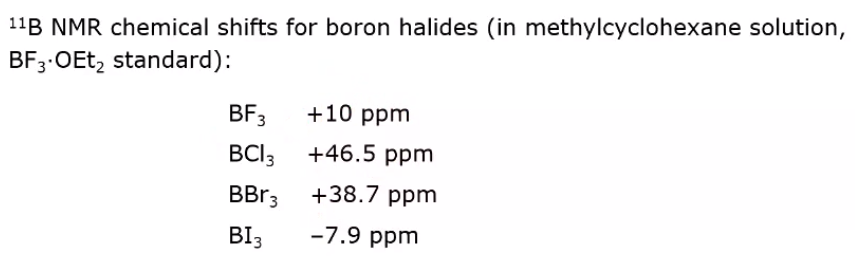
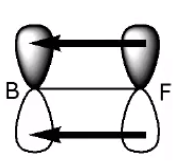
• Consistent with sequence of shielding (hence electron density of B atom): • BI₃ > BF₃ > BBr₃ > BCl₃ • Oder parallels electronegativity of halide, except for BF₃ • Reason for this is that in the B-F bond there is a match in size between the (full) pz orbtial on the F and the (empty) pz orbital on the p • Backbonding of electron density to B leads to greater than expected shielding
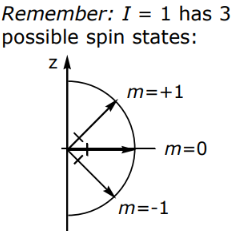
I = 1 has how many spin state
3 possible spin states all with equal intensities
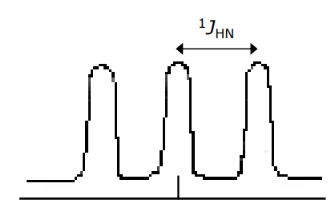
What does the ¹H NMR look like of ¹⁴NH₄⁺ ¹⁴N I = 1
(2x1x1) + 1 = 3 = triplet Intensity of 1:1:1
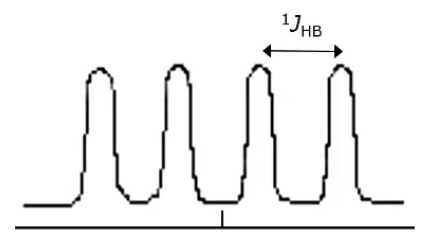
What does the ¹H NMR look like of ¹¹BH₄⁻ ¹¹B I = 3/2
(2x1x3/2) + 1 = 4 = quartet with equal intensities of 1:1:1:1
Coupling to one ¹¹B give the expected equal intensity quartet Interaction with two ¹¹B nuclei with I = 3/2 gives?
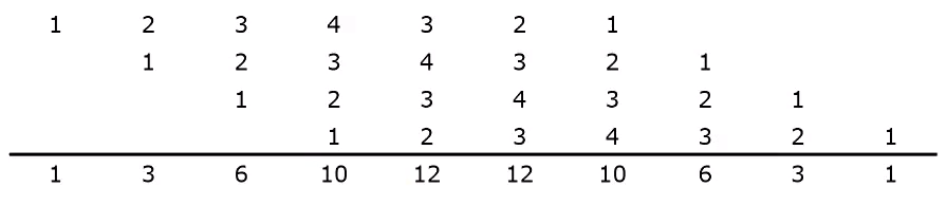
• 7 possible different arrangements, with relative likelihoods in the order: • 1:2:3:4:3:2:1
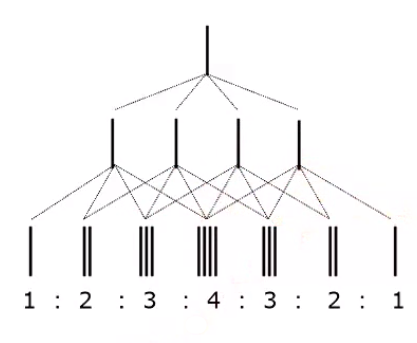
Coupling to two I = 3/2 nuclei gives 7 likelihoods in the order: 1:2:3:4:3:2:1 What does coupling to 3 I = 3/2 nuclei give?
1:3:6:10:12:12:10:6:3:1