Star Death
No description yet. This curated deck is ready for daily study.
Card preview (12)
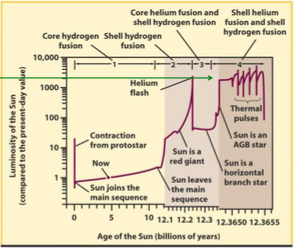
Post Main Sequence evolution of a relatively low mass star (<4MO) like our Sun.
Asymptotic Giant Branch (AGB) star – the star is “asymptotically” approaching the red giant branch of the HR diagram for the second time.
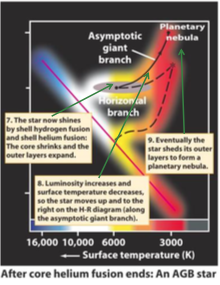
Low mass AGB Star structure and Future of our Solar System
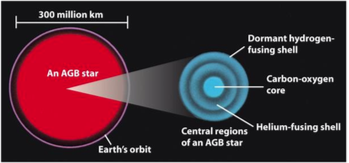
The structure of an old, low-mass AGB star. Thermonuclear reactions in the helium-fusing shell are so rapid that the star’s luminosity is at least 1000 times our present-day Sun. When the Sun becomes an AGB star in 12 billion years the increase in luminosity of factors of 1000 – 10,000 will evaporate most of the planets out to, and including, Jupiter. The outer layers of the star will reach the Earth’s orbit, swallowing up Mercury & Venus on the way….
AGB Shell Ejection
As our star evolves through the AGB phase it ejects shells of material off into space, until all that is left is the hot core. Up to 40% of the stars mass may be lost by this process The result of all this mass ejection is to form a Planetary Nebula (PN)
White Dwarf Stars
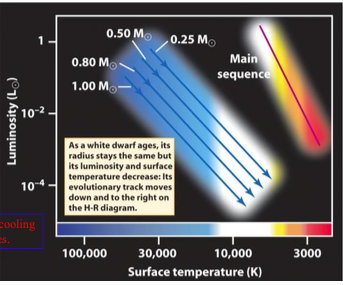
• The residual star of a Planetary Nebula is a white dwarf. • This is a hot carbon-oxygen core, but not hot enough to ignite either element and to undergo further fusion. • The WD will thus gradually cool down leaving a burnt out relic. • Because the core is so dense, the degenerate electron pressure will prevent further collapse.
White Dwarf - Mass-Radius relationship
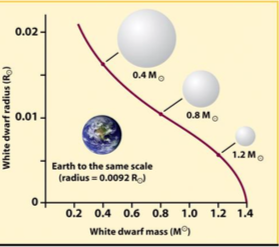
The surprising mass to radius relationship for white dwarf stars: Smaller is more massive! This result is because as you increase the mass, the more degenerate the matter becomes, and hence more compact. The maximum theoretical mass for a WD is 1.4M0 (known as the Chandrasekhar limit).
White Dwarf - cooling curves
Higher Mass stars (>4M0)
• The evolutionary path for massive star (M > 4M0) is somewhat different from low mass stars. • The outcomes from this branch of evolution results in neutron stars and black holes. • Because we now have much more mass available, these stars can continue burning elements beyond the carbon-oxygen limit. As a result we can now have carbon → silicon fusion occurring. With each new stage of core collapse, the temperature rises and the next stage goes even faster.
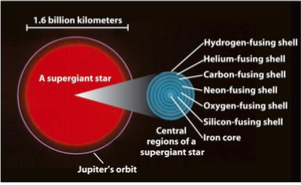
Higher Mass stars - final stage of fusion
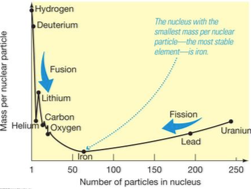
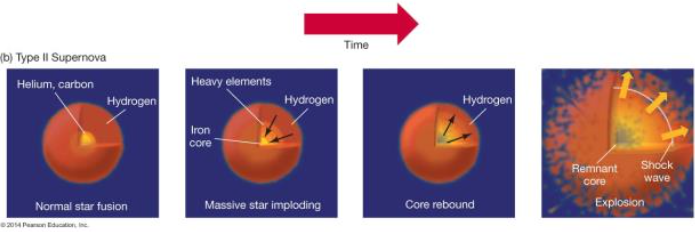
• Ultimately, the final stage of fusion occurs, that of making iron. Beyond iron in the periodic table, the thermonuclear fusion process requires energy rather than liberating energy. • The final extremely rapid stage of collapse–the Super Nova explosion - creates pressures so great that electrons are forced to merge with protons producing a neutron core. e- + p → n + ν (neutrino )
Neutrinos (ν)
• The production of neutrinos is critical in this stage. • They react very weakly with matter and hence are able to carry away most of the heat energy in the final 1⁄4 second. • The loss of heat leads to the final collapse, in which the structure of the core changes to become very rigid at these phenomenally high densities. • This causes the inner core to reflect the collapsing pressure wave and the outer shells of star are propelled into space with the resulting shock wave. • It is the neutrino blast that people search for as one of the signatures of a SN explosion.
Two types of Supernova
Type 1 occurs in binary systems A carbon-rich white dwarf pulls matter onto itself from nearby red-giant or Main Sequence star. Type 2 The second type occurs due to the collapse of a single massive star The core of a high mass star collapses then re- bounds in a catastrophic explosion
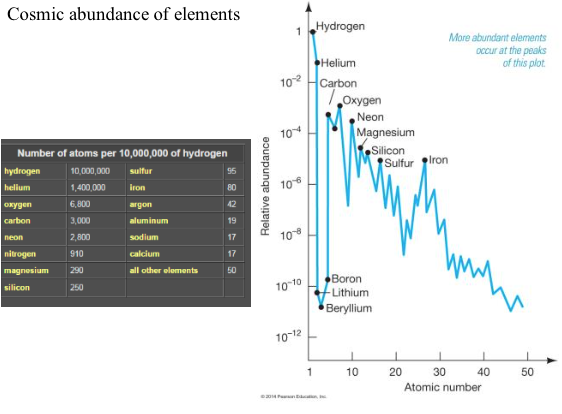
Cosmic Abundance of Elements
Summary of Stellar Evolution Pathways