atoms, elements and compounds
No description yet. This curated deck is ready for daily study.
Card preview (24)
Element
A substance made of atoms that all contain the same number of protons (one type of atom) and cannot be split into anything simpler. There is a limited number of elements and all elements are found on the Periodic Table. E.g. hydrogen, carbon, nitrogen.
Compound
A pure substance made up of two or more elements chemically combined together. There is an unlimited number of compounds. Compounds cannot be separated into their elements by physical means. E.g. copper (II) sulphate (CuSO4), calcium carbonate (CaCO3), carbon dioxide (CO2).
Mixture
A combination of two or more substances (elements and/or compounds) that are not chemically combined. Mixtures can be separated by physical methods such as filtration or evaporation. E.g. sand and water, oil and water, sulphur powder and iron filings.
Metals and nonmetals
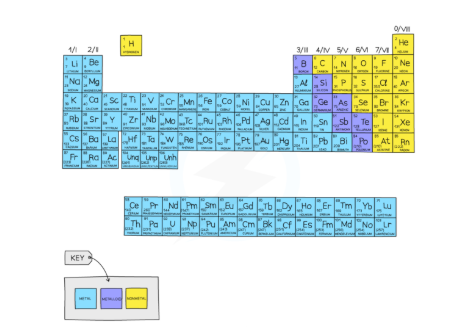
The Periodic Table contains over 100 different elements. They can be divided into two broad types: metals and nonmetals. Most of the elements are metals and a small number of elements display properties of both types. These elements are called metalloids or semimetals.
Properties of metals
Conduct heat and electricity. Are malleable and ductile (can be hammered and pulled into different shapes). Tend to be lustrous (shiny). Have high density and usually have high melting points. Form positive ions through electron loss. Form basic oxides.
Describing Alloys
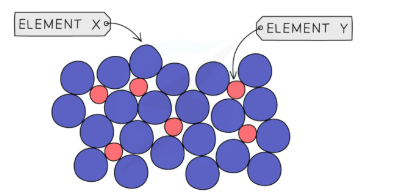
Alloys are mixtures of metals, where the metals are mixed together but are not chemically combined. They can be made from metals mixed with nonmetals such as carbon. Alloys often have properties that can be very different to the metals they contain, for example they can have more strength, hardness or resistance to corrosion or extreme temperatures. Alloys contain atoms of different sizes, which distorts the regular arrangements of atoms. This makes it more difficult for the layers to slide over each other, so they are usually much harder than the pure metal. Brass is a common example of an alloy which contains 70% copper and 30% zinc.
Properties of nonmetals
Do not conduct heat and electricity. Are brittle and delicate when solid and easily break up. Tend to be dull and nonreflective. Have low density and low melting points (many are gases at room temperature). Form negative ions through electron gain (except for hydrogen). Form acidic oxides.
Ionisation of metals and non-metals
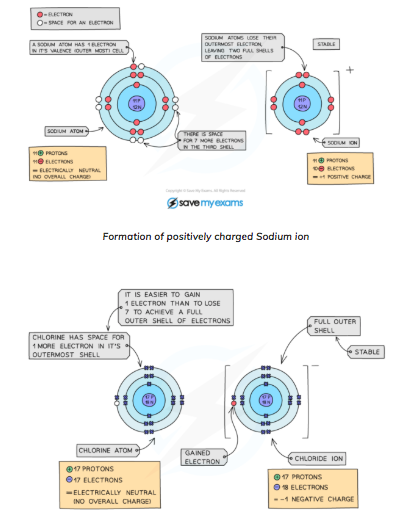
Metals: all metals lose electrons to another atom and become positively charged ions. Non-metals: all non-metals gain electrons from another atom to become negatively charged ions.
Electrostatic attraction
The positive and negative charges are held together by the strong electrostatic forces of attraction between opposite charges. This is what holds ionic compounds together.
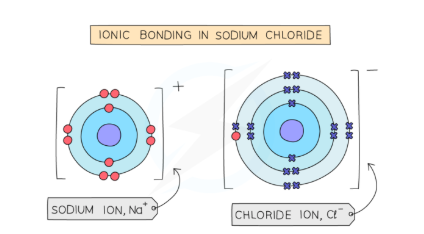
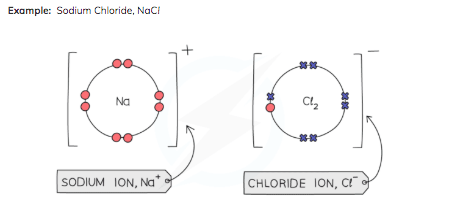
Describe the formation of ionic bonds between elements from Groups I and VII
Explanation Sodium is a group 1 metal so will lose one outer electron to another atom to gain a full outer shell of electrons. A positive ion with the charge +1 is formed. Chlorine is a group 7 non-metal so will need to gain an electron to have a full outer shell of electrons. One electron will be transferred from the outer shell of the Sodium atom to the outer shell of the Chlorine atom. Chlorine atom will gain an electron to form a negative ion with charge -1. Formula of Ionic Compound: NaCl
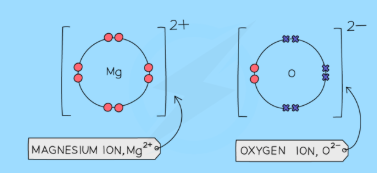
Ionic Bonds between Metallic and Non-Metallic Elements
Explanation Magnesium is a group 2 metal so will lose two outer electrons to another atom to have a full outer shell of electrons. Example: Magnesium Oxide, MgO A positive ion with the charge +2 is formed. Oxygen is a group 6 non-metal so will need to gain two electrons to have a full outer shell of electrons. Two electrons will be transferred from the outer shell of the Magnesium atom to the outer shell of the Oxygen atom. Oxygen atom will gain two electrons to form a negative ion with charge -2. Formula of ionic compound: MgO
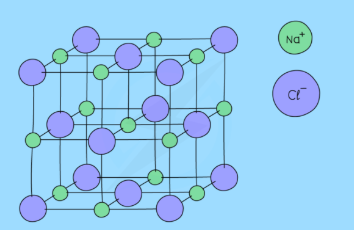
The Lattice Structure of Ionic Compounds
Lattice structure refers to the arrangement of the atoms of a substance in 3D space. In these structures the atoms are arranged in an ordered and repeating fashion. The lattices formed by ionic compounds consist of a regular arrangement of alternating positive and negative ions.
Ions
An ion is an electrically charged atom or a group of atoms formed by the loss or gain of electrons. This loss or gain of electrons takes place to gain a full outer shell of electrons. The electronic structure of an ion will be the same as that of a noble gas – such as helium, neon and argon.
Covalent compounds
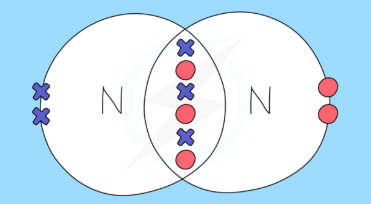
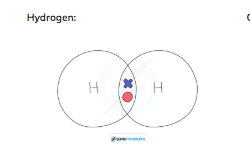
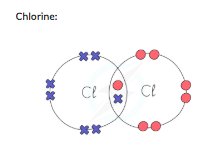
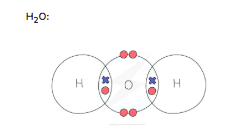
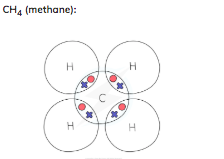
Covalent compounds are formed when electrons are shared between atoms. Only non-metal elements participate in covalent bonding. As in ionic bonding, each atom gains a full outer shell of electrons. When two or more atoms are chemically bonded together, we describe them as ‘molecules’.
draw covalent bonding hydrogen
draw covalent bonding chlorine
draw covalent bonding H2O
draw covalent bonding CH4
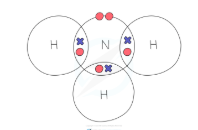
draw covalent bonding NH3
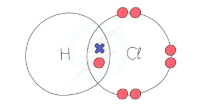
draw covalent bonding HCl
Ionic compounds:
Have high melting and boiling points so ionic compounds are usually solid at room temperature. Not volatile so they don’t evaporate easily. Usually water soluble as both ionic compounds and water are polar (see polarity in Glossary). Conduct electricity in molten state or in solution as they have ions that can move and carry charge.
Covalent compounds:
Have low melting and boiling points so covalent compounds are usually liquids or gases at room temperature. Usually volatile which is why many covalent organic compounds have distinct aromas. Usually not water soluble as covalent compounds tend to be nonpolar but can dissolve in organic solvents. Cannot conduct electricity as all electrons are involved in bonding so there are no free electrons or ions to carry the charge.
draw Electron Arrangement Nitrogen