Exam Review III
No description yet. This curated deck is ready for daily study.
Card preview (24)
Kitchen safety and hygiene
• wash hands before handling food and after handling meat, poultry or fish • tie hair back • knives in wooden block or drawer • avoid burns and scalds • wipe up spills • electrical appliances away from water • avoid fires • avoid cross contamination
Storage: fruit and vege
minimise heat, light and oxygen exposure Aim to buy the freshest produce at point of sale
Storage: eggs
refrigerate can stay fresh in fridge for about a month
storage: canned foods
• Most have storage life of 2-4 yrs • Becuase we don’t know how long they were stored at wholesaler/retailer, about one year is recommended • Once opened, should be places in clean plastic or glass container
Food prep: peeling fruit nad veg
• micronutrients, dietary fibre and phytochemicals are concentrated in or close to the skin surface • washing and peeling result in loss of water soluble vitamins • Peeling should therefore be minimised
Food prep: soaking
• reduces levels of phytates in grains, legumes, nuts and seeds • phytates inhibit mineral absorbtion
Food prep: germination
• germination of grains and legumes improves the vitamin and mineral content • reduces levels of phytates, tannins and oxalates • vit C and riboflavin are synthesised during germination
food prep: yeast leavening and phytates
• reduces phytate content of wholemeal bread • may increase mineral absorption *
Food prep: lemon juice
• contains citric acid • presence of organic acids may increase availability of calcium from vegetable foods • citric acid most effective when followed by tartaric, malic or ascorbic acid • Can be used to prevent browning from foods such as apples and avos • Can neutralise fish odour
cooked foods allow for
• the evolutionary selection of smaller teeth and gut evolution • Cooking breaks down the skin, softens cellulose, denatures toxins, and reduces complex proteins while simultaneously enhancing sweetness and increasing the caloric intake of early hominines
cooking: nutrient losses
• Results vary depending on amount of water, length of cooking time, temp • The most unstable vitamins are folate, thiamin (B1) and vit C • More stable include niacin, vit K and D, biotin, B5 *
Cooking methods: blanching
• food plunged in boiling water, removes, plunged into iced water or placed under cold running water • inactivates enzymes which may degrade food
Cooking methods: steaming
• food heated by direct contact with the steam generated by boiling water • good for vegetables as retains texture, colour, taste, nutrients • reduces heated oil intake *
Cooking methods: microwave cooking
• Microwaves cook food by agitating water and other small molecules to produce frictional heat • Advantages • speed, easy clean up, retains water soluble nutrients, food can be taken from freezer and thawed/cooked quickly • Disadvantages • heat food quicker than conventional ovens though produce uneven heating within food • cold spots in food increase risk of foodbourne illness • loss of vit B12
Cooking methods: barbecued meat
• food is in direct contact with flame, pyrolysis of fats in the meat and smoke of hot charcoal generate great amounts of polycyclic aromatic hydrocarbons (PAHs), that mostly accumulate in the outer surface of the barbecued meat
Tips to Minimise Nutrient Loss from cooking
• store food properly • keep vegies in crisper • wash veg not peel • steam veg not boil • use fresh ingredients where possible • cook foods quick and at low temp
Cooking Pots, Pans and Utensils
• made from a variety of materials • can enter the food cooked in them • aluminium poses the most harm • linked to alzheimers and other neurlogical conditions • small amounts of aluminium can be excreted but high levels are harmful
define food additives
• a substance not normally consumed as a food itself • is intentionally added to food for enhancing look, taste, texture or storage life • salt, starch, sugar and water not considered to be additives
Food additives: regulation
• food additives regulated by Food Standards Australia New Zealand (FSANZ) • only additives in Australia New Zealand Food Standards Code may be added to certain foods
Food additives: labelling
• If an additive makes up less than 5% of the complete food and is not considered to perform a technological function in the final food, it doesn’t have to be labelled
Food additives: safety
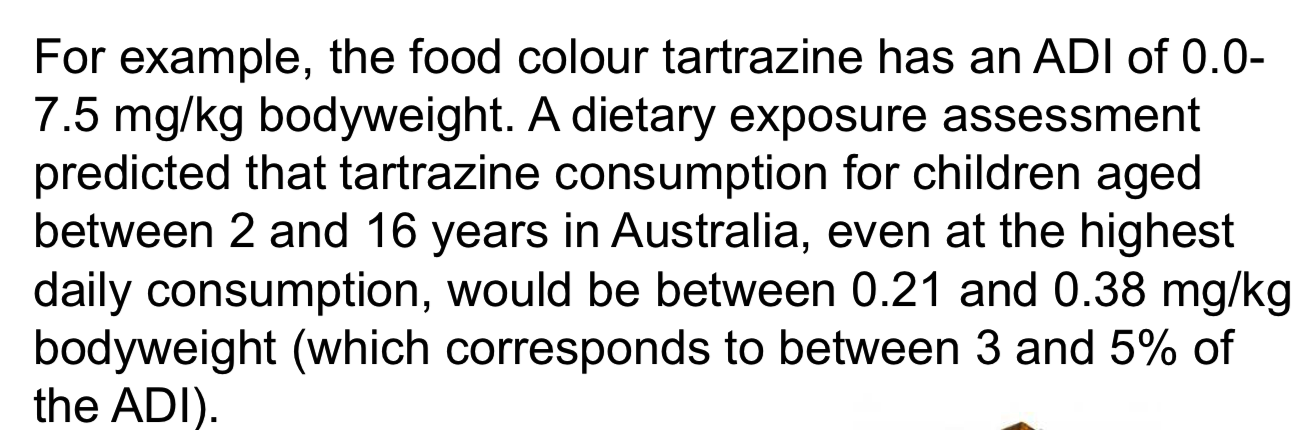
• FSANZ carries out safety assessments on food additives before they can be used • checks whether the food additive is safe and if there is reason for using the additive • safe levels are determined • The ADI is the amount of a food additive that can be eaten every day for an entire lifetime without adverse effect
Food additive examples
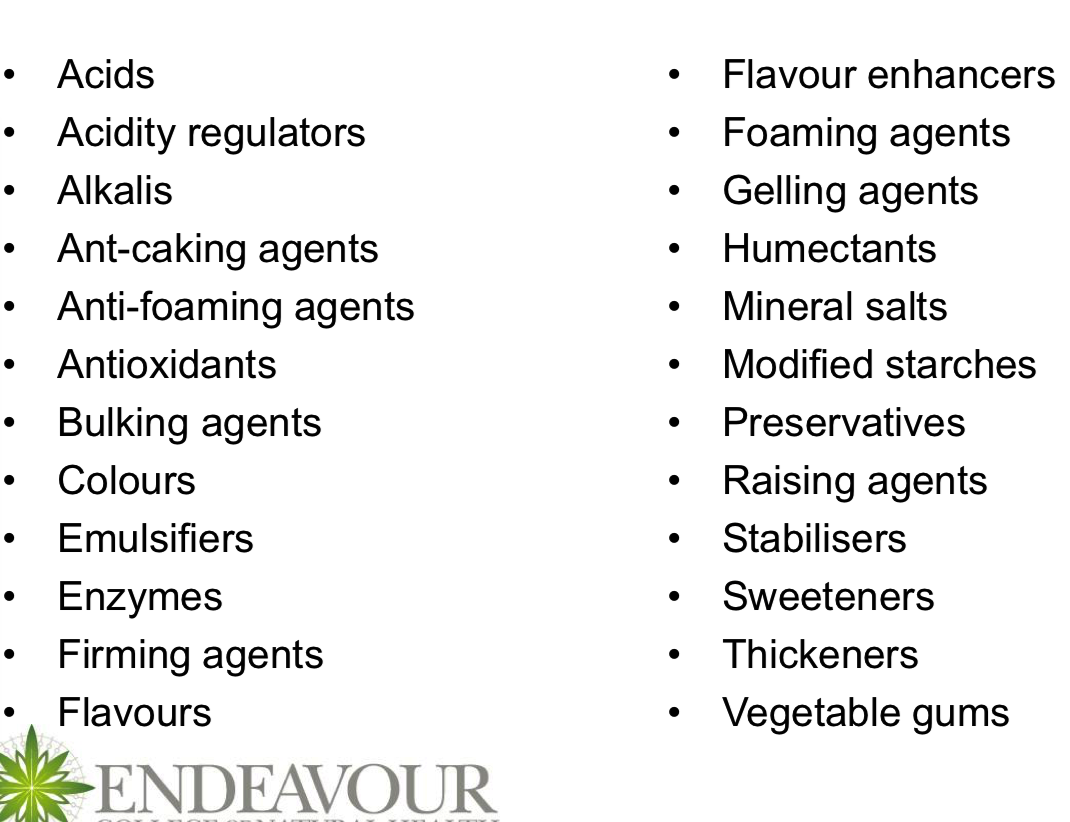
• acidity regulators • substances that lower the pH of foods • metatartaric acid • anti-caking agents • substances that main free-flowing characteristics of powdered foods • anti-foaming agents • antioxidants • retard oxidation reactions in food • artificial sweeteners • provide sweetness without contributing to energy intake • saccharin • bleaching agents • cause breakdown of flour pigments • bulking agents • give bulk or body to food • colours • replace or enhance natural colours • may be naturally occuring eg curcumin • emulsifiers • eg lecithin • flavours • flavour enhancers • MSG • food acids • preservatives
health effects of food additives
• artificial sweeteners • eg saccharin • olestra • a non-absorbable substitute for triglycerides • adverse health effects include diarrhea and loose stools • abdominal cramps • reduces absorption of fat-soluble vitamins and carotenoids • MSG sensitivity • monosodium glutamate is a flavour enhancer • occurs naturally in some foods eg tomato, cured meats, soy sauce • MSG consumption is associated with chinese restaurant syndrome
Food additives: ADHD
• ADHD is caused by both genetic and environmental factors • some artificial colours, flavours, some preservatives and salicylates might have a role to play in hyperactive behaviour and learning disabilities in some children • Artificial Food Colours (AFCs) are not a main cause of ADHD, but they may contribute significantly to some cases, and in some cases may additively push a youngster over the diagnostic threshold Still inconclusive due to differing reports however there is a link between behaviour and additives