Additional Science: Physics (II)
No description yet. This curated deck is ready for daily study.
Card preview (24)
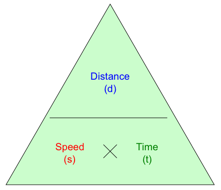
What is the equation for working out speed?
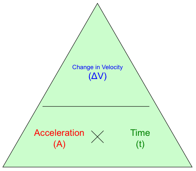
What is the equation for working out acceleration?
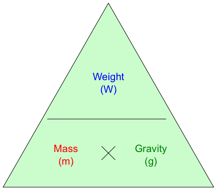
What is the equation for working out weight?
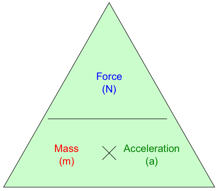
What is the equation for working out force?
What is the equation for working out work done?
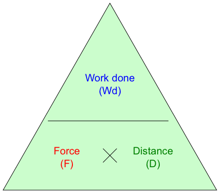
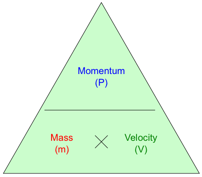
What is the equation for working out momentum?
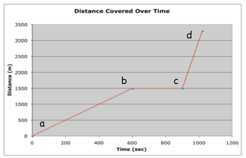
What do the parts of the distance-time graph tell you about movement?
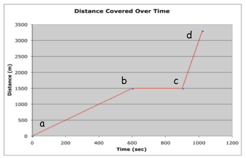
a-b = moving b-c = stopped c-d = moving quicker (than at a-b as line is steeper)
What do the parts of the velocity-time graph tell you about movement?
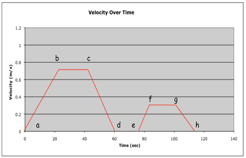
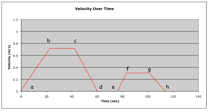
a-b = accelerating quickly b-c = steady speed c-d = decelerating d-e = stopped (steady speed) e-f = accelerating quickly f-g = steady speed g-h = decelerating
How can you work out the distance traveled from a velocity-time graph?
Work out the area beneath the graph
When are the forces of an object balanced?
When it is still or travelling at a steady speed
What do unbalanced forces do to the movement of an object?
It will cause the object to speed up / slow down
What is the force of gravity on Earth?
10N/kg (9.8N/kg)
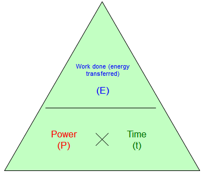
What is the equation for working out power?
Power (P) = work done (or energy transferred) (E) ÷ time take (s)
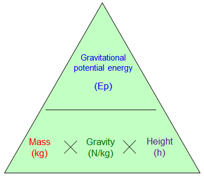
What is the equation for working out gravitational potential energy?
Gravitational potential energy (Ep) = mass (kg) x gravity (N/kg) x height (m)
How is work done to an elastic object stored?
Via elastic potential energy (shape is changed)
What is Hooke’s law?
Extension of an elastic object is directly proportional to force Force (N) = spring constant (k) x extension (m) F = k x e
How would you draw out an example of Hooke’s law in practice?
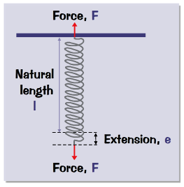
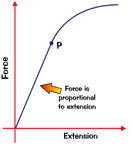
What happens to extension of an object if the force becomes too great?
The directly proportional extension of the object in relation to the force stops…
When stopping a car what can affect the thinking time?
Drugs and alcohol Distractions Tiredness
When stopping a car what can affect the breaking distance?
Speed Mass of vehicle Tyres Brakes Road surface Weather
Why do falling objects reach terminal velocity?
The weight remains constant with gravity causing the object to accelerate Air resistance is small to begin with, but as the object speeds up it increases Eventually the air resistance will equal the weight (as this does not change) Once the forces are balanced there can be no change in speed – terminal velocity
What is resultant force and when is the resultant force on an object zero?
The overall force in one direction – this is zero when the object is stationary
What can be described as a fluid? What happens to the frictional forces as an object accelerates through a solid
Gases and liquids Frictional forces increase as the speed increases, but eventually reach terminal velocity
What is momentum and what affects it?
Momentum is how quickly each kg of the object is moving – objects with great momentum are harder to stop Momentum is affected by mass and velocity