Chapter 25: Amino Acids
No description yet. This curated deck is ready for daily study.
Card preview (15)
Natural configuration of amino acids
Naturally occuring AA are in the L configuration When drawn as a Fischer projection the amino group is located on the left
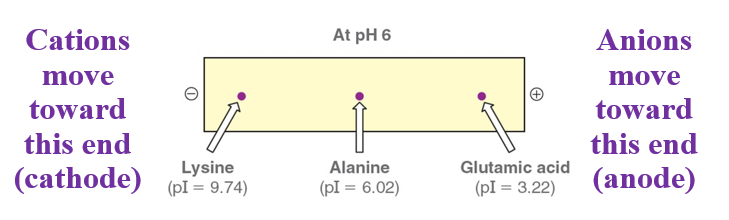
Isoelectric focusing
When pI > pH of solution the amino acid is cationic When pI < pH of solution the amino acid is anionic If two AA have similar pI’s the larger AA will move more slowly
Testing for the presence of an amino acid
Reagents Ninhydrin Mechansim Amino acids are generally colorless, but their presence can often be verified with a ninhydrin color indicator

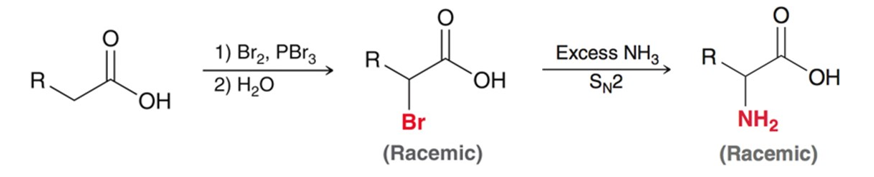
AA syntheses via α-haloacids
Hell-Volhard-Zelinsky Reaction Reagents • Br2, PBr3 • H2O followed by Excess NH3 Mechanism Installs a bromine at the α-carbon which is then subsequently replaced by an amine group Produces a racemic mixture of products
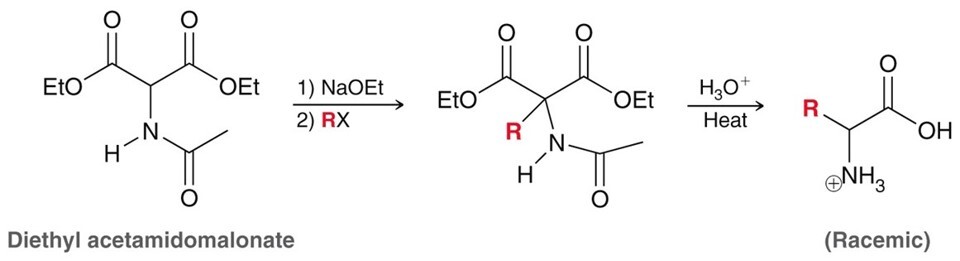
Amidomalonate synthesis
Reagents Starting with diethyl acetamidomalaonate 1. NaOEt 2. RX 3. H3O+ & heat Mechanism Similar to malonic ester synthesis; installs the R group from the alkyl halide as the side chain of the AA Forms a racemic mixture
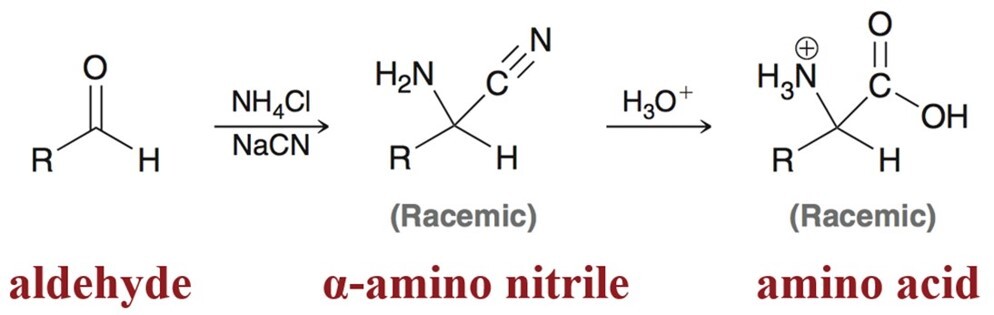
Strecker synthesis
Reagents • NH4Cl (ammonium chloride) & NaCN • H3O+ Mechanism Produces an AA from an aldehyde with the same side chain
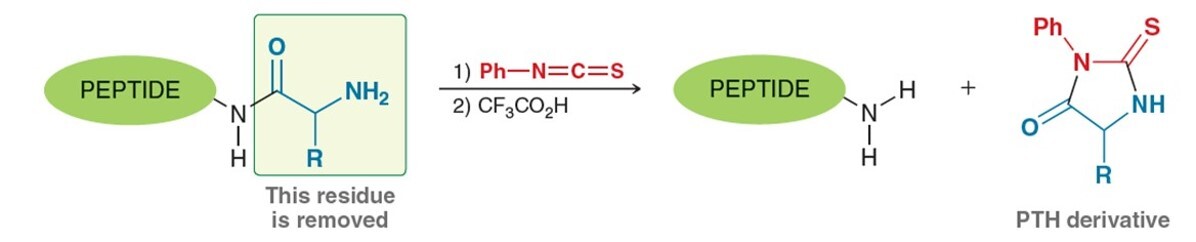
Edman degredation
Reagents • Ph−N=C=S • CF3CO2H (trifluoroacetic acid or TFA) Mechanism Removes an amino acid from the N-terminus of a peptide Residue can then be determined by analyzing the PTH derivative • R-group between the carbonyl carbon and nitrogen on the ring
What bonds does trypsin cleave
Carboxyl side of lysine (K) and arginine (R)
What bonds does chymotrypsin cleave
Carboxyl side of aromatic amino acids (W,Y,F)
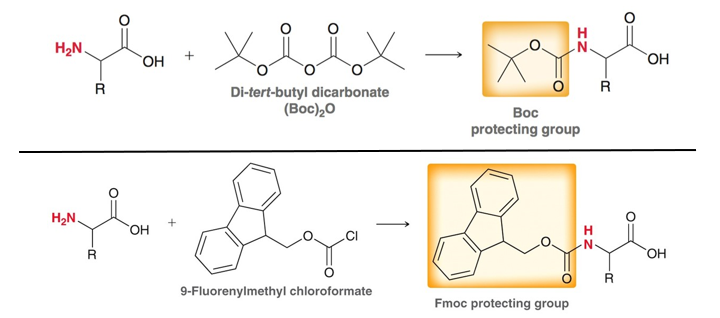
Protecting the amino side of an amino acid
Di-tert-butyl dicarbonate (Boc)2O or Fmoc
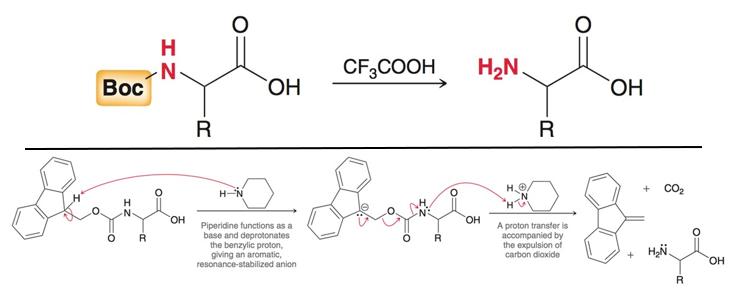
Removal of an amino protecting group
Boc protecting group can be removed with CF3CO2H (trifluoroacetic acid or TFA) Fmoc protecting group can be removed with a strong base such as piperdine
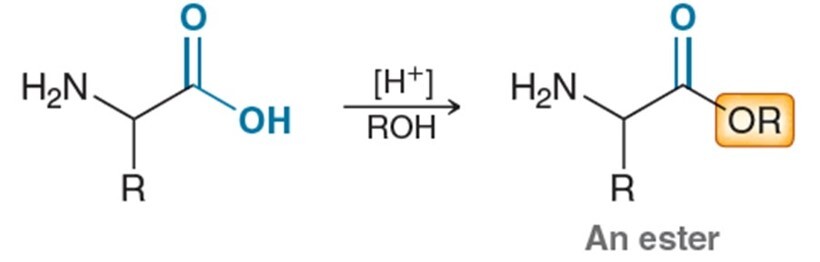
Protecting the carboxyl side of an amino acid
Carboxyl groups can be protected as an ester Methyl and benzyl esters are the most popular
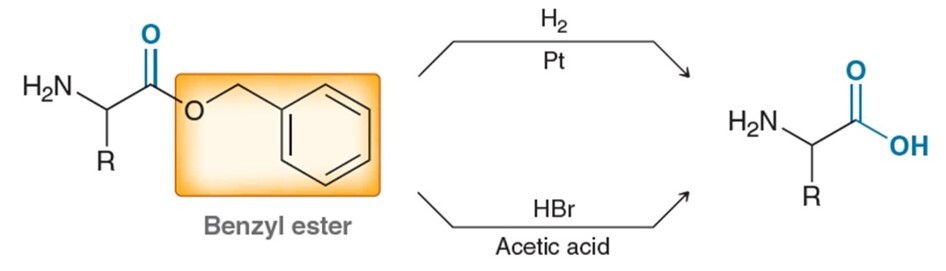
Removal of an carboxyl protecting group
Esters can be removed using acid or basic conditions Benzyl esters can be deprotected via hydrogenation to avoid unintended side-reactions
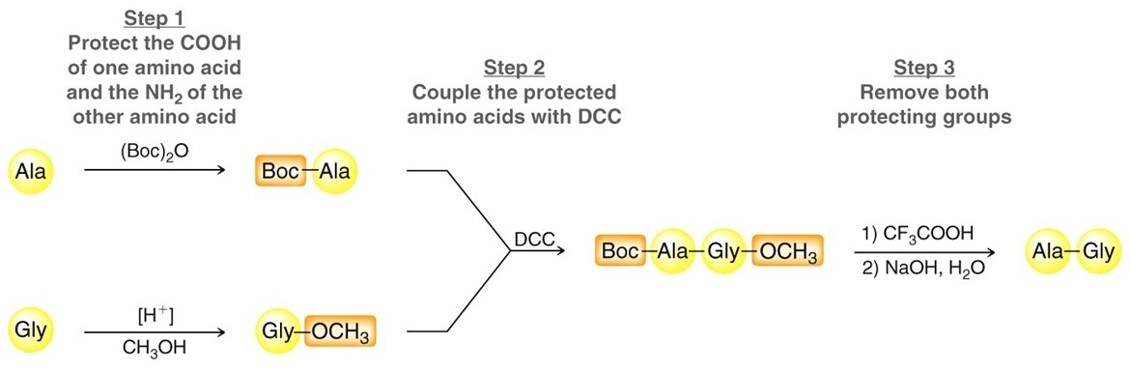
Peptide synthesis
Peptide linkage is accomplished by: • Install the appropriate protecting groups • Couple the protected amino acids using DCC • Remove the protecting groups
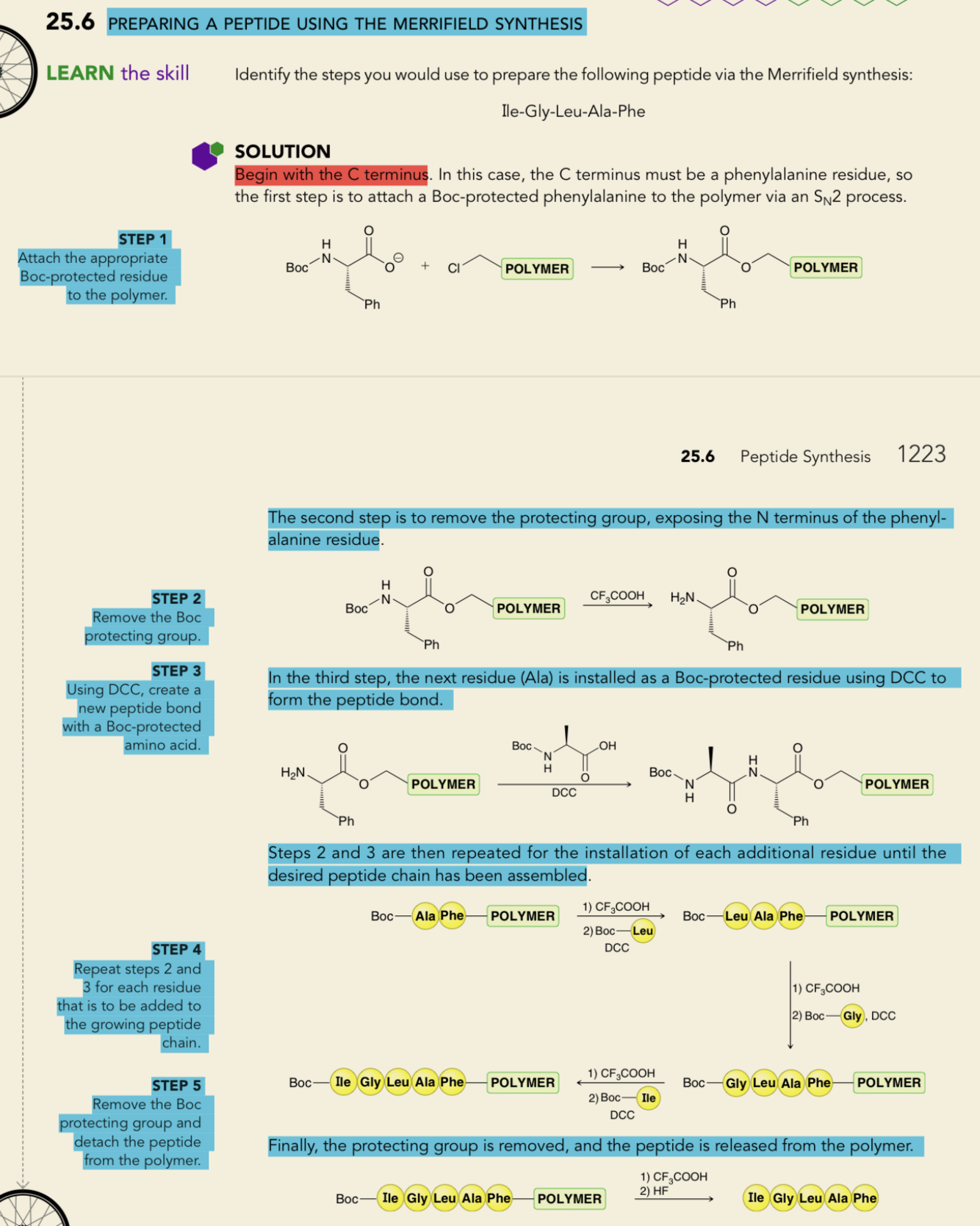
Merrifield synthesis
Also known as solid-phase peptide synthesis (SPPS) Process builds the amino acid starting with the carboxyl terminus • TheC-terminus Boc-protected AA is attached to an insoluable polymer • Boc protecting group is removed • DCC is used to create a new peptide bond with the next Boc-protected AA • These steps are repeated as necessary • Final Boc protecting group is removed • The protein is removed from the polymer with HF (hydrofluoric acid)