Energy transfers - fuel cells
No description yet. This curated deck is ready for daily study.
Card preview (10)
Fuel cells are used in spacecraft for several reasons:
• The water produced is not wasted - the astronauts drink it. • They are lightweight; normal batteries are heavier, so the spacecraft can use the saving to carry a bigger payload. • They are compact. • There are no moving parts.
The car industry is developing fuel cells for a variety of reasons.
• There are no carbon dioxide emissions when fuel cells are used in cars. • Fossil fuels are non-renewable, so car manufacturers are researching alternatives that are renewable and cause less pollution. • The main product of a hydrocarbon-powered fuel cell is water, which is not a pollutant. • There is a large source of hydrogen available by decomposing water.
What are the current mobile sources of electricity?
The battery and internal combustion engine.
What are fuel cells especially useful for?
Mobile energy sources.
Advantages of hydrogen-oxygen fuel cells.
• There is direct energy transfer. Energy is converted directly from chemical energy in the fuel into electrical energy. The energy does not have to be converted into heat first. • There are fewer production stages. Every new stage in any process increases the energy losses. In the fuel cells themselves the energy conversion is all done in a single stage. • They are more efficient as there are fewer stages and almost all the energy is converted. *
However, there are also problems with hydrogen-oxygen fuell cells.
• Poisonous catalysts are used that have to be disposed of at the end of the life-time of the cell. • Fossil fuels are burnt to produce the hydrogen and oxygen needed.
Getting energy from fuel
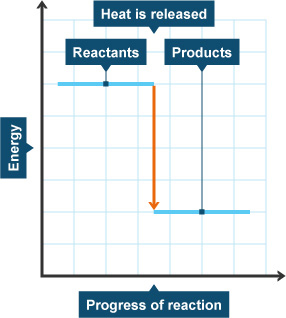
• Energy is only released when the fuel reacts reacts with oxygen in the air. This reaction is endothermic. • If the fuel cell uses hydrogen, the reaction is: 2H2 + O2 ⇒ 2H2O • When hydrogen reacts with oxygen by burning, chemical energy is give out as heat. • A fuell cell converts chemical energy directly into electrical energy. • The overall reaction in a hydrogen-oxygen fuell cell is: 2H2 + O2 ⇒ 2H2O with electrons being exchanged from the cathode to the anode.
What does the fuel contain?
• The fuel (hydrogen) and oxygen have chemical energy as a store inside them. • When the fuel reacts some of the chemical energy is given out. This is shown in an energy-level diagram.
What happens at the electrodes?
• At the negative electrode the hydrogen releases electrons. This is an oxidation reaction: • 2H2 ⇒ 4H+ + 4e-. • At the positive electrode electrons are taken in. This is a reduction reaction: • 4H+ + O2 + 4e-. ⇒ 2H2O
What is a redox reaction?
A reaction where electrons are gained and lost is called of redox reaction.