Chapter 2
No description yet. This curated deck is ready for daily study.
Card preview (21)
What is involved in the process of program development?
Problem description • Input • Result (output) Algorithm • Pseudocode is fine Program • Java, C, Python Machine instructions (executable)
How is pseudocode created?
It’s created from using components of natural language to express algorithms • Pseudocode = “Not real” Code
What are some issues with using natural language to represent algorithms?
• Natural language can be extremely verbose • Lack of structure makes it difficult to locate specific sections of the algorithm • Natural language is too “rich” in interpretation and meaning • Not sufficiently precise to represnt algorithms
Why is using pseudocode beneficial?
• Used to design and represent algorithms • A compromise between the two extremes of natural and formal languages • Will not be unique
Define: Sequential Algorithm
Sometimes called a straight-line algorithm; the order is followed in a linear fashion.
Define: Control Operations
• Conditional and iterative • Allow us to alter the normal sequential flow of control in an algorithm
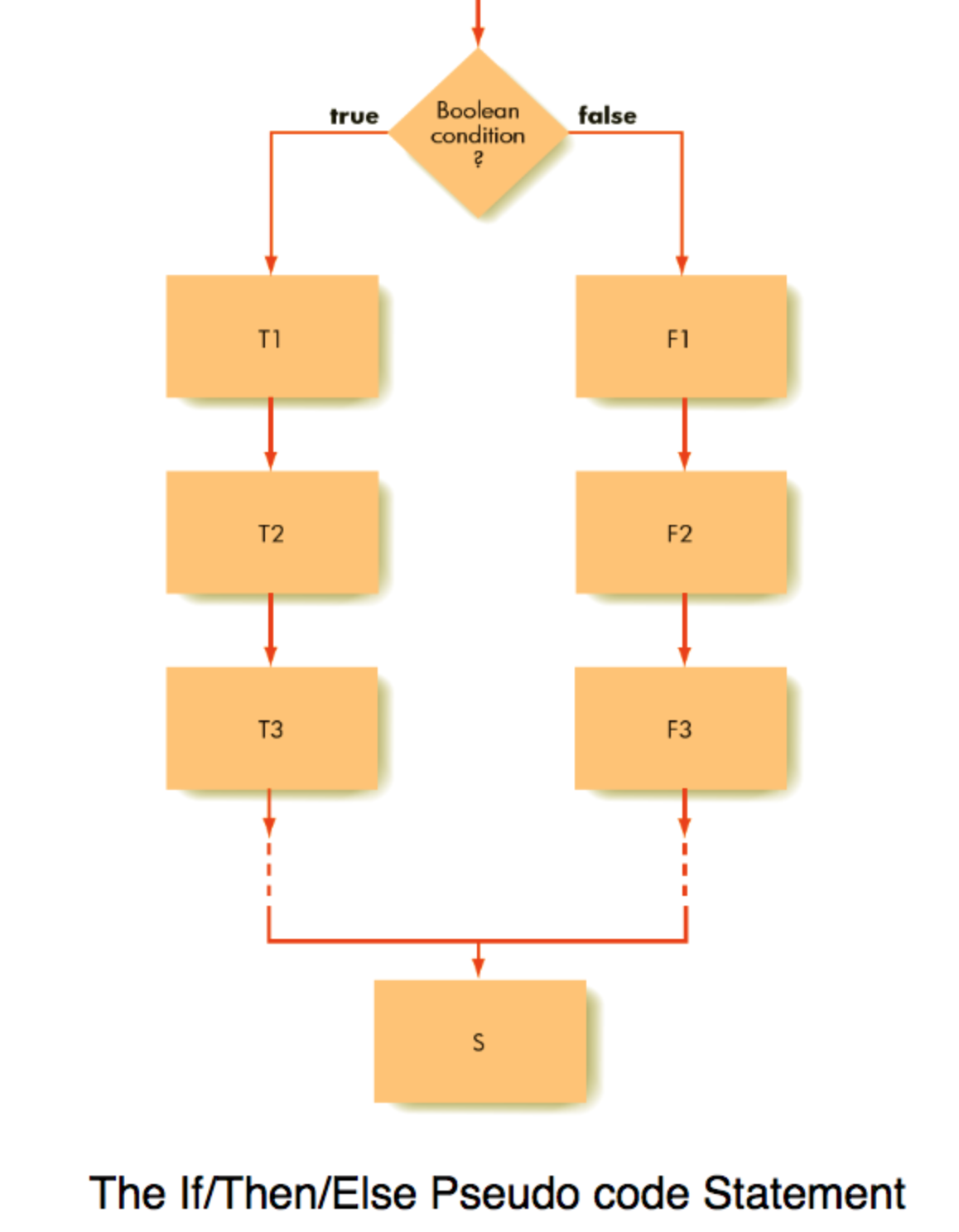
Define: Conditional Statements
• The “question-asking” operations of an algorithm • If/then/else
Define: Loop
• The repetition of a block of instructions • While or For loop statement
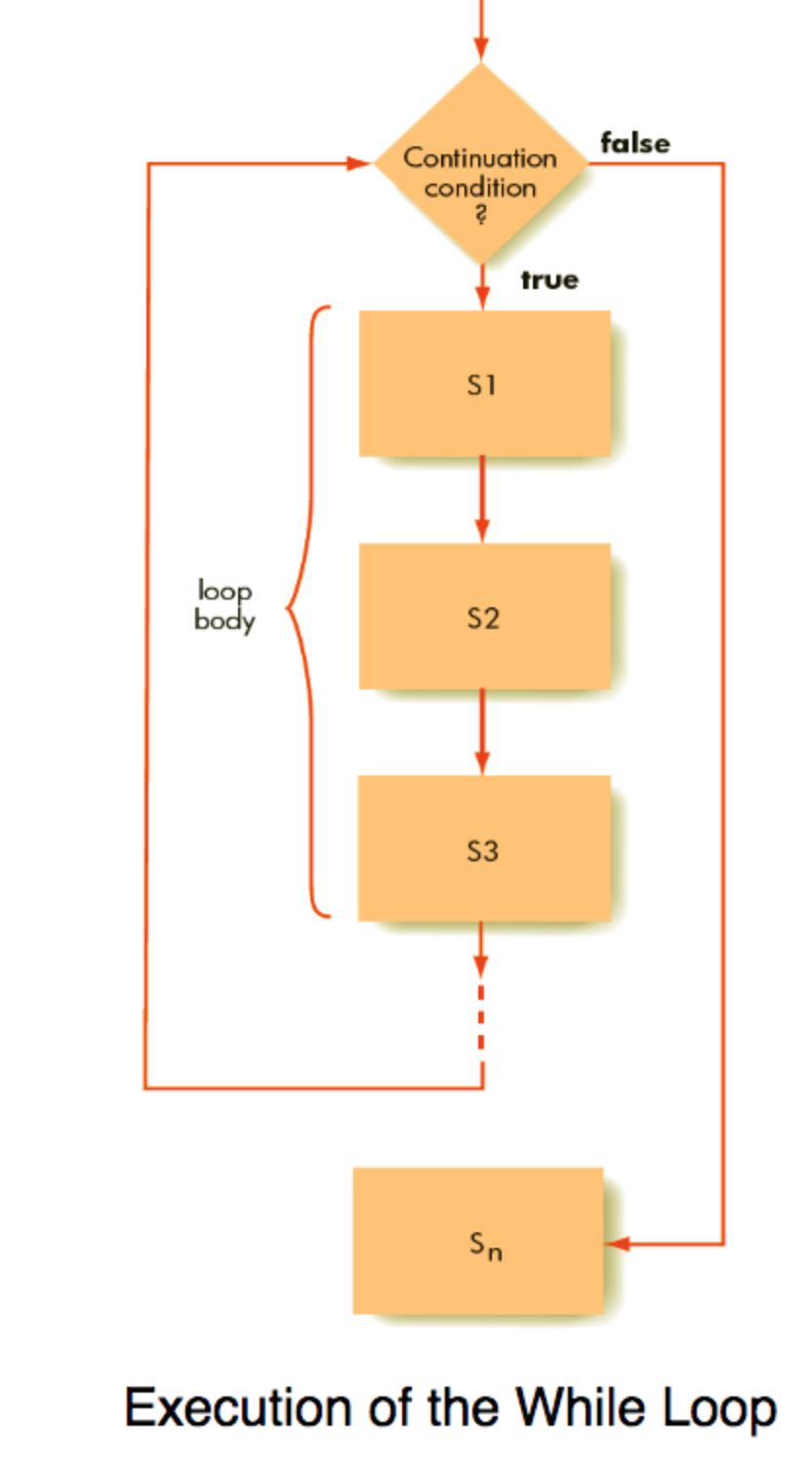
Define: Continuation Condition
Determines if statement is true or false • if/elif statements
Give an example of a loop.
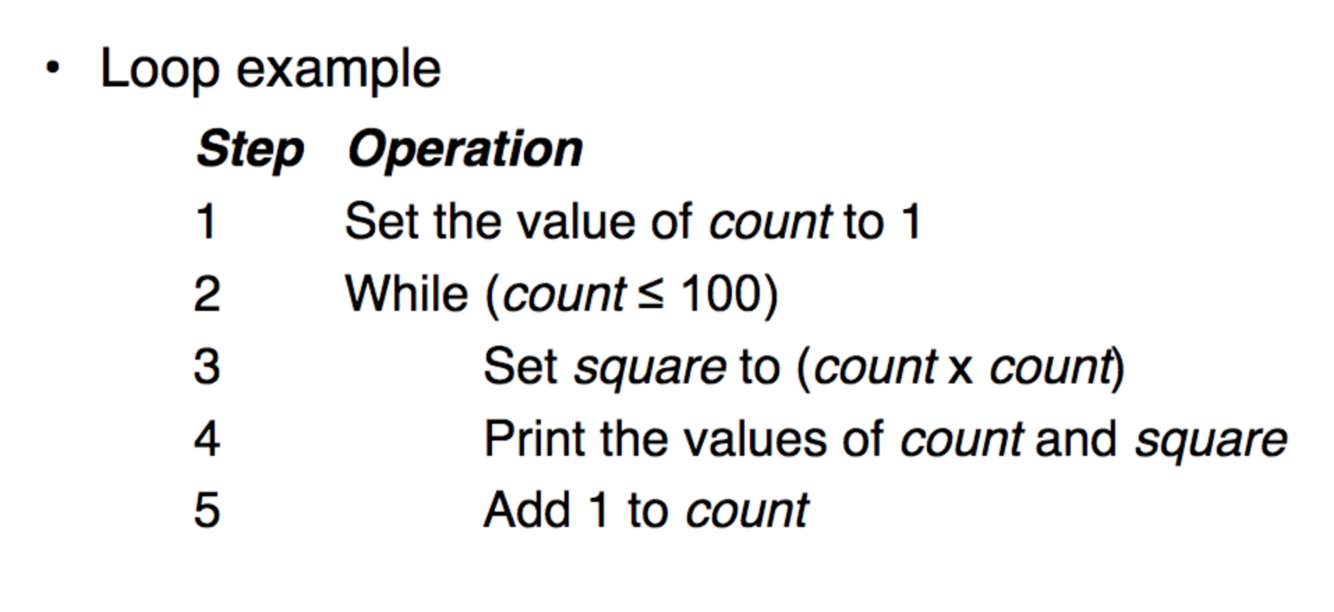
Define: Pretest Loop
Continuation condition is tested at the beginning of each pass through the loop
Define: Posttest Loop
Continuation condition is tested at the end of the loop body, not the beginning.
Define: Primitives
Instructions that computing agent understands and is capable of executing without further explanation.
Define: Pattern Matching
• Process of searching for a special pattern of symbols within a larger collection of information. • Is assisting microbiologist and geneticists studying and mapping the human genome.
Give examples of higher-level constructs.
• Sort the entire list into ascending order. • Attempt to match the entire pattern against the text. • Find a root of the equation.
Define: Abstraction
Use of high-level instructions during the design process
Define: Top-down Design
Viewing an operation at a high level of abstraction
How to test efficiency of algorithms?
Run Time Analysis • Worst Case • Average Case Big Oh • Constant run time O(1) • Logarithmic run time O(logn) • Linear run time O(n) • Linearithmic run time O(nlogn) • Quadratic run time O(n2)
How to test efficiency of direct sequecing algorithms?
For a sequence of instructions, the cost of executing the sequence of instructions is, asymptotically speaking, the same as the maximum cost of the individual instructions. For three instructions a, b and c: • O({a, b, c}) = max (O(a), O(b), O(c)) where {a, b, c} represents direct sequencing of the three individual instructions.
How to test effeciency for conditional execution algorithms?
For a conditional statement, the cost of execution is the maximum of the cost of evaluating the condition and the cost(s) of the alternate instruction sequences • O(if {condition} then {sequence1} else {sequence2}) = max (O(condition), O(sequence1), O(sequence2))
How to test the effeciency of iterative construct algorithms?
Applies to an iterative construct ( e.g., loop, for, while) that will cause the execution of a subset of instructions to be repeated a specified number of times. The trick is to understand how many times the instructions will be repeated. For k iterations, the general rule is: • O(loop (k) {sequence}) = O(k*sequence)