SLR 10
No description yet. This curated deck is ready for daily study.
Card preview (17)
State two benefits of using a relational database instead of a flat file database.
• Relational data allows for less redundancy of data/less repeated data • Relational databases improve the consistency of data • Relational databases allow for complex queries and/or searches to be performed
State the difference between a primary key and a foreign key.
• A primary key will only appear once in a table/is a unique identifier • A foreign key may appear multiple times a table/may not be unique
State two requirements for a database to be in First Normal Form (1NF).
• Each attribute name is unique • Primary key identified • No repeated attributes • All data in attributes must be atomic (cannot be further split up) / by example
Describe what is meant by a transaction being durable.
• (Committed) data/transaction is not lost… • …in case of power / system failure
Give one way that durability can be achieved for a completed transaction.
• Completed transactions stored in secondary storage / data not stored long-term in RAM/cache
Explain how record locking can be used to ensure that the ACID principle of isolation is achieved when carrying out multiple transactions.
• The outcome of concurrent transactions is the same as if transactions were completed sequentially. • Record locking allows one user/process to access/modify record level data at any one time • So data that is being used elsewhere cannot be modified / data that is being modified elsewhere cannot be used
Give one disadvantage of using record locking.
• Can cause delays (as users wait for access) • Can cause deadlock
State what is meant by the term ‘primary key’
• Field that is unique/does not repeat
When new customers join the streaming service, their name, email address and contact details are captured so that they can be entered into the database. Identify one method of capturing a new customer’s personal data, describing why this method is suitable.
• Form / web form • Can use validation to check for common errors… • Can check for duplicate values • Data can be entered direct into the database / limited manual processing • Can be done from remote locations
Describe one problem that would arise with the flat file database structure if a customer wanted to insure more than one car at the same time.
• Only one customer entry allowed (because of key field) • …so would not be able to add second entry • Customer data already present/would be repeated • ….resulting in redundant data/wasted space • …resulting in inconsistencies should changes be made
Identify two methods of exchanging data with other computer systems.
• CSV • JSON • XML • SQL • APIs • EDI • RSS • SOAP
Describe how the flat file database structure could be altered to efficiently allow each customer to insure multiple cars at the same time. (You may assume each car is insured to only one customer.)
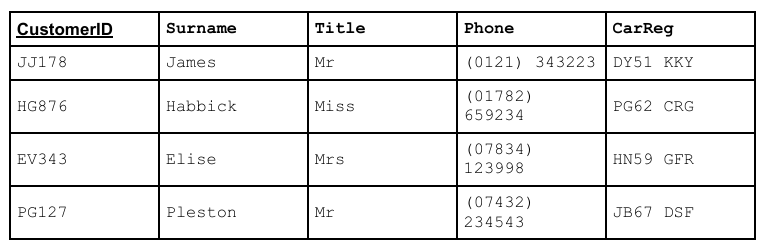
• Add in second table • …for the cars / splitting up cars/customers • The primary key of customer is used as a field in the car/vehicle table • … as a foreign key of cars • Create one to many relationship. Accept many to one.
A hotel uses a computer system to keep track of room bookings. The hotel staff are able to query a database to discover which rooms are booked or which rooms are free. The hotel’s computer network uses a client-server model. Describe what is meant by the term ‘client-server’ in this context.
• Client computers connect to server • Server provides access to a resource/service • In this case hotel staff use client computers to connect to database on server (or other sensible example).
Give two advantages of client-server compared to peer-to-peer.
• only one point of failure • easier to manage users/access • Easier to backup • Easier to keep data secure. • Technicians can more easily remotely install / monitor.
Explain the purpose of a network switch.
• Joins computers/devices together on a LAN • Receives packets/data • Recipient’s address is given in packet header/it uses the mac address • Send packets/data • Out the correct port /to the specific computer device
The hotel stores data about rooms, customers and bookings in a database. Each customer can book multiple rooms and each room can be booked multiple times. Describe two different ways that hashing could be used in this database.
• Hashing for security • …e.g. hash passwords in database • …to make sure they cannot be read if they are stolen • Hashing for direct access • Customer/Room/Booking records can be quickly accessed • …by using hash of index as address
The hotel booking database enforces referential integrity. Explain what is meant by the term ‘referential integrity’ and how this could potentially be broken.
• Database/relationships are consistent / each foreign key links to an existing/valid primary key • Suitable example of being broken (e.g. if primary key is deleted/updated, foreign keys are no longer valid / changes should be cascaded)