M2 - Redox
No description yet. This curated deck is ready for daily study.
Card preview (24)
Explain (using examples) when the oxidation number is zero?
For elements on their own (e.g. Na, K & Fe) or bonded to atoms of the same element (e.g. H2, N2 & Br2)
What is the oxidation number of Oxygen in a compound generally?
-2 (except in peroxides such as H2O2, where the oxidation no. of O is -1)
What is the oxidation number of Hydrogen in a compound generally?
+1 (except in metal hydrides such as NaH or CaH2, where the oxidation no. of H is -1)
What is the oxidation number of Fluorine in a compound generally?
-1
What is the common oxidation number of Na or K in a compound?
+1
What is the common oxidation number of Mg or Ca in a compound?
+2
What is the common oxidation number of Halides in a compound?
-1
Provide an example for when oxygen can have an oxidation number of +2?
In the compound F2O
In ions, what must the overall oxidation number be equal to?
The sum of the oxidation numbers is equal to the total charge, e.g. SO4 2- (S = +6 & O = -2 x 4)
What do roman numerals mean in the use of iron(II) chloride or iron(III) chloride?
Iron(II) represents Fe2+ with oxidation number +2 Iron(III) represents Fe3+ with oxidation number +3
What is the systematic name for TiCl4?
Titanium(IV) chloride
What is the systematic name for Fe2O3?
Iron(III) oxide
What is the formula for Bromate(V)?
BrO3-
What is the formula for Dichromate(VI)?
Cr2O72-
What is oxidation in terms of electron transfer & oxidation number?
The loss of electrons / increase in oxidation number
What is reduction in terms of electron transfer & oxidation number?
The gain of electrons / decrease in oxidation number
Mg + CuSO4 → Cu + MgSO4 Explain, in terms of numbers of electron transferred, the redox processes taking place in this reaction [2].
Magnesium (atoms) has been oxidised AND Because it has lost two electrons ✓ Copper (ions) has been reduced AND Because it has gained two electrons ✓
3Mg + 2H3PO4 → Mg3 (PO4)2 + 3H2 In terms of the number of electrons transferred, explain whether magnesium is being oxidised or reduced [1].
Oxidised AND (Mg) transfers/loses/donates 2 electrons✓
MnO2 + 4HCl → MnCl2 + 2H2O + Cl2 Using oxidation numbers, show what has been oxidised and what has been reduced in this reaction [2].
Cl (has been oxidised) from Cl = –1 to Cl = 0 ✔ Mn (has been reduced) from Mn = +4 to Mn = +2 ✔
What is meant by the term disproportionation? [1]
Oxidation and reduction of the same element ✓
2Cl2 + 2Ca(OH)2 → CaCl2 + Ca(OCl)2 + 2H2O This is a disproportionation reaction. State what is meant by disproportionation and use oxidation numbers to show that disproportionation has taken place [3].
Oxidation AND reduction of same element/chlorine OR Chlorine/Cl has been oxidised AND chlorine/Cl has been reduced ✓ Oxidation from 0 in Cl2 to +1 in Ca(OCl)2 OR ClO- ✓ Reduction from 0 in Cl2 to –1 in CaCl2 OR Cl- ✓
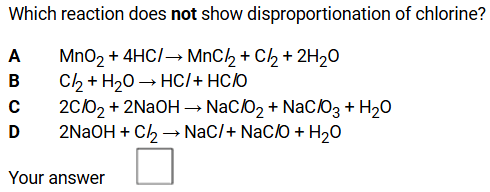
A
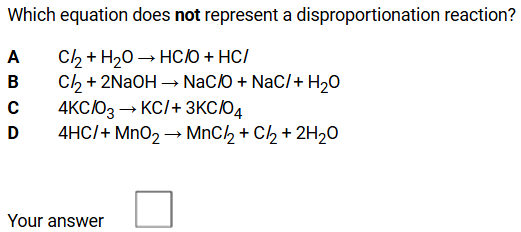
D
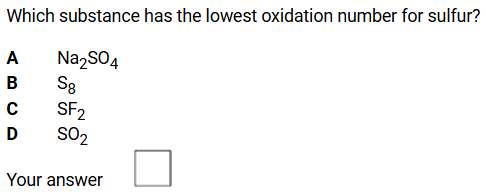
B