metals
No description yet. This curated deck is ready for daily study.
Card preview (24)
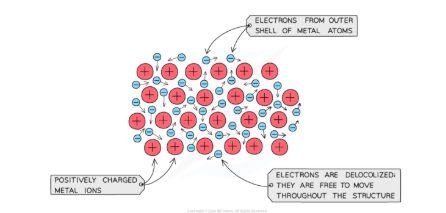
List the general physical properties of metals
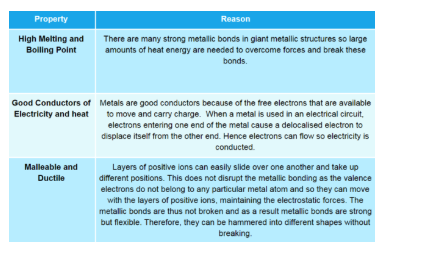
Diagram showing bonding and structure in metals
General chemical properties of Metals
The chemistry of metals is studied by analysing their reactions with water, dilute acid and oxygen. Based on these reactions a reactivity series of metals can be produced.
Reactivity with water
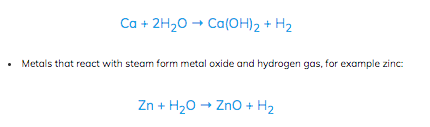
Some metals react with water, either warm or cold, or with steam. Metals that react with cold water form a metal hydroxide and hydrogen gas, for example calcium:
Reactivity with acids
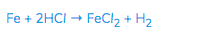
Most metals react with dilute acids such as HCl. When acids and metals react, the hydrogen atom in the acid is replaced by the metal atom to produce a salt and hydrogen gas, for example iron:
Reactivity with oxygen
Unreactive metals such as gold and copper do not react with acids. Some reactive metals such as the alkali metals react with oxygen. Copper and iron can also react with oxygen although much more slowly. When metals react with oxygen a metal oxide is formed, for example copper:

Alloys
An alloy is a mixture of two or more metals or a metal and a nonmetal. Alloys often have properties that can be very different to the metals they contain, for example can have more strength, hardness or resistance to corrosion or extreme temperatures. Alloys contain atoms of different sizes, which distorts normally regular arrangements of atoms in metals. This makes it more difficult for the layers to slide over each other, so alloys are usually much harder than the pure metal.
Alloys arrangement of a metal lattice structure
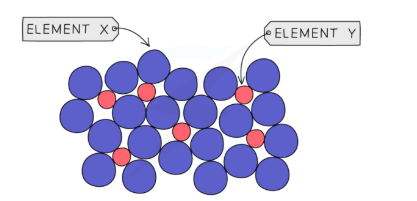
Alloys are mixtures of… They are not …combined. An alloy is not a…
• substances. • chemically • compound.
Common alloys and their uses
Brass is an alloy of copper and zinc and is much stronger than either metal. Alloys of iron with tungsten are extremely hard and resistant to high temperatures. Alloys of iron mixed with chromium or nickel are resistant to corrosion. Aluminium is mixed with copper, manganese and silicon for aircraft body production as the alloy is stronger but still has a low density.
The Reactivity Series
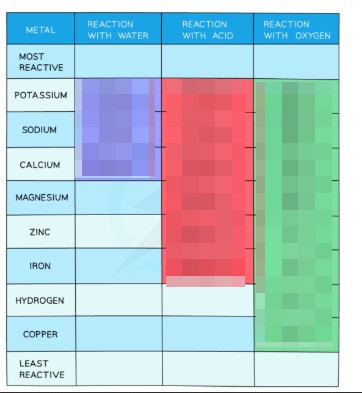
The chemistry of the metals is studied by analysing their reactions with water, dilute acid and oxygen. Based on these reactions a reactivity series of metals can be produced. The series can be used to place a group of metals in order of reactivity based on the observations of their reactions with water, acid and oxygen.
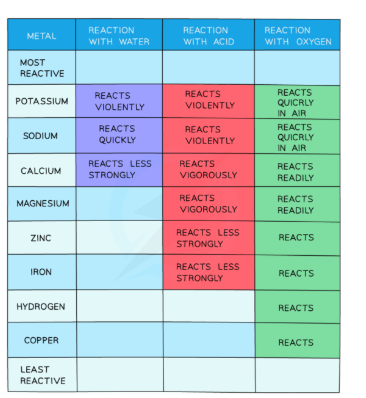
The reactivity series mnemonic
“Please send lions, cats, monkeys and cute zebras into hot countries signed Gordon”.
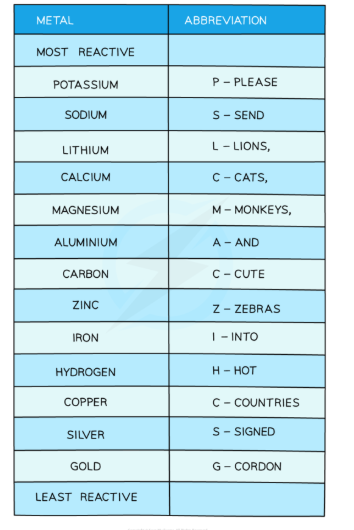
Displacement reactions between metals and metal oxides
The reactivity of metals increases going up the reactivity series. This means that a more reactive metal can displace a less reactive metal from its oxide by heating. Example: Copper(II) Oxide It is possible to reduce copper(II) oxide by heating it with magnesium. As magnesium is above copper in the reactivity series, magnesium is more reactive so can displace copper. The reducing agent in the reaction is magnesium:

they are all
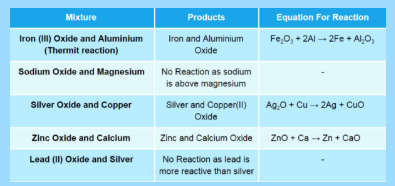
Displacement reactions between metals and metal oxides
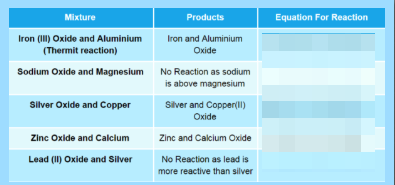
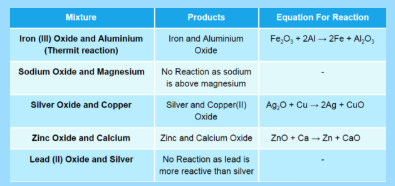
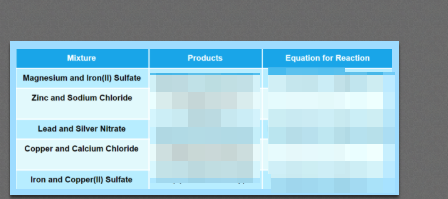
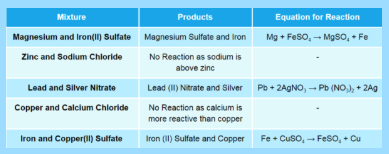
Displacement reactions between metals and aqueous solutions of metal salts
Any metal will displace another metal that is below it in the reactivity series from a solution of one of its salts. This is because more reactive metals lose electrons and form ions more readily than less reactive metals, making them better reducing agents. The less reactive metal is a better electron acceptor than the more reactive metal, thus the less reactive metal is reduced. (OIL-RIG: reduction is gain of electrons).
expalin example and write an equation for it Example: Zinc and copper(II) sulfate
As Zinc is above copper in the reactivity series, zinc is more reactive so can displace copper from copper(II) sulfate solution:

these are all…
Displacement reactions between metals and aqueous solutions of metal salts
Thermal decomposition reactions
Some compounds decompose or breakdown when they are heated to sufficiently high temperatures. These reactions are called thermal decomposition reactions. A common example is the thermal decomposition of calcium carbonate (limestone), which occurs at temperatures above 800ºC:

Thermal decomposition of metal hydroxides
Most metal hydroxides undergo thermal decomposition. Water and the corresponding metal oxide are the products formed, for example zinc hydroxide thermally decomposes as follows: Group II metal hydroxides decompose similarly but the Group I hydroxides (apart from lithium) do not decompose due to their having a higher thermal stability.

Thermal decomposition of metal carbonates
Most of the metal carbonates and hydrogen carbonates undergo thermal decomposition. The metal oxide and carbon dioxide are the products formed, for example magnesium carbonate thermally decomposes as follows: Group I carbonates (again apart from lithium carbonate) do not decompose when heated. This is due to the high thermal stability of reactive metals; the more reactive the metal then the more difficult it is to decompose its carbonate. CuCO3 for example is relatively easy to thermally decompose but K2CO3 does not decompose.

Thermal decomposition of metal nitrates
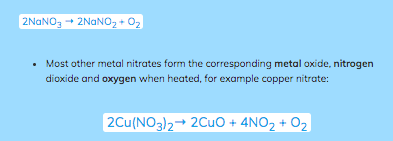
All of the metal nitrates decompose when they are heated. Group I nitrates decompose forming the metal nitrite and oxygen, for example sodium nitrate decomposes as follows:
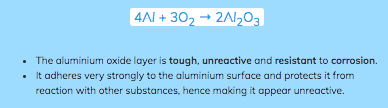
Aluminium and its apparent lack of reactivity
Aluminium is a curious metal in terms of its reactivity. It is placed high on the reactivity series but it doesn’t react with water or acids. This is because the surface of aluminium metal reacts with oxygen in the air forming a protective coating of aluminium oxide: