M6 Aromatic Compounds Q&A
No description yet. This curated deck is ready for daily study.
Card preview (5)
Describe, using diagrams, the bonding and structure of benzene
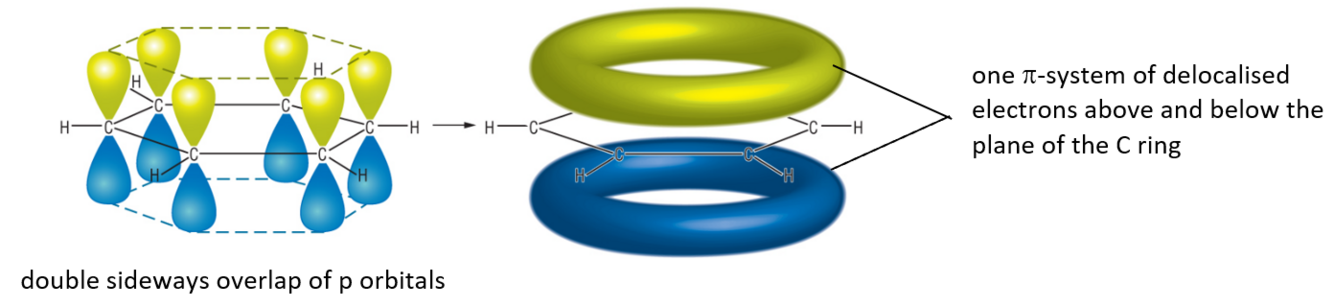
What is the evidence for the delocalised model of benzene structure?
• The delocalised electrons make benzene resistant to reaction; when it does react it is by substitution rather than addition • It only reacts with bromine (or chlorine) in the presence of a halogen carrier • in benzene all the carbon-carbon bond lengths are equal and intermediate between single and double bonds • the enthalpy of hydrogenation is less exothermic than expected
Why is benzene less reactive than cyclohexene?
• Benzene has (6) delocalised pi electrons spread over the six carbon atoms • This has lower electron density • Cyclohexene has (2) localised pi electrons spread over the two carbon atoms • This has higher electron density • Electrophiles are less readily polarised and less strongly attracted to benzene
Why is phenol more reactive than benzene?
• In phenol the lone pair of electrons on the oxygen atom (p orbital) is donated • Becomes (partially) delocalised into the pi-system (8 electrons) • This has higher electron density (than benzene) • Electrophiles are more readily polarised and more strongly attracted to phenol • The pi-system is sufficiently electron dense to induce a dipole in electrophiles more (e.g. in the Br2 molecule) and so attracts electrophiles more strongly (more susceptible to electrophilic attack)
What is the mechanism of arenes?
• Electrophilic substitution