topic 13- further energetics
No description yet. This curated deck is ready for daily study.
Card preview (24)
standard enthalpy change of lattice ΔlatticeH
The energy change when one mole of an ionic solid is formed from its gaseous ions The value of the lattice energy depends on: -Magnitude of charge of ions -Ionic radii -Lattice structure -Extent of covalent character in the bond.
Standard enthalpy change of atomisation: ΔatH
The standard enthalpy change when one mole of gaseous atoms are formed from an element in its standard state, at a stated temperature and 100kPa. In equation form: Mg(s) → Mg(g) S8(s) → 8S(g) ½ N2 (g) → N(g) ½ Cl2(g) → Cl(g)
First electron affinity: Eea(1)
The first electron affinity Eea(1) is the energy change when each atom in a mole of atoms in the gaseous state gains an electron and forms a 1- ion. In equation form: N (g) + e → N- (g) S (g) + e → S- (g) First electron affinity is negative (exothermic) except for noble gases, where the ‘new’ electron must go into an new shell
Second electron affinity: Eea(2
The second electron affinity is when a mole of 1- ions gains a second electron and forms a 2- ion. In equation form: N- (g) + e → N2- (g) S- (g) + e → S2- (g) Second electron affinity is positive (endothermic) due to the already negatively charged ion repelling the incoming electron.
theoretical lattice energy
Assume: - ions are in contact - ions are perfect spheres - even distribution of charge throughout the volume
poor agreement
ionic bonding model is not sufficient due to the extent of covalent character bigger discrepancy the bigger the extend of character
entropy
measure of the degree of randomness or disorder of particles higher entropy - highest disorder moles of products > moles of reactants - positive entropy for feasible reaction -both entropy of surroundings and system is positive because more way the particles can be arranged
barium hydroxide and ammonium chloride
endothermic reaction Ba(OH)2.8H2O (s) + 2NH4Cl (s) → BaCl2 (s) + 10 H2O (l) + 2 NH3 (g) entrophy change is positive thermodynamically spontaneous
ammonium carbonate and ethanoic acid
endothermic 2 CH3COOH (l) + (NH4)2CO3 (s) → 2 CH3COONH4 (aq) + H2O (l) + CO2 (g) entrophy change is positive thermodynamically spontaneous
magnesium and oxygen
exothermic reaction 2 Mg (s) + O2 (g) → 2 MgO (s) entropy is positive as the surroundings overpowers thermodynamically spontaneous
total entropy
entropy of surroundings + entropy of system

entropy of a system
products - reactants

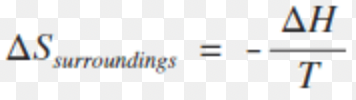
entropy of surroundings
-enthlapy change / temperature
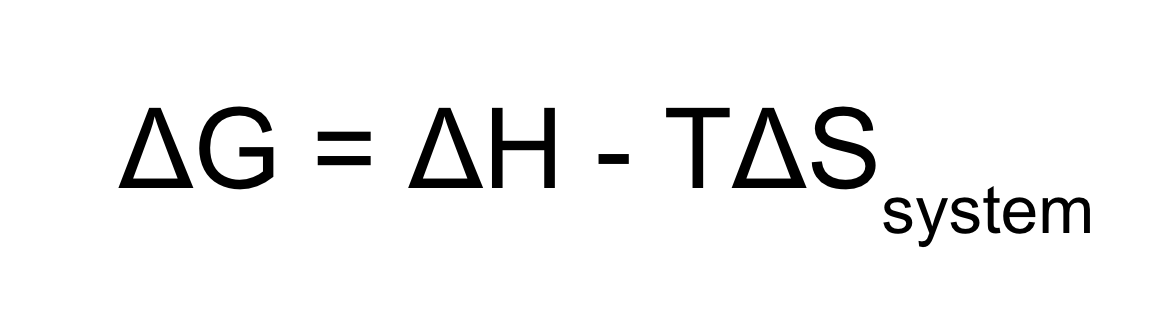
gibbs free energy
Calculate whether a reaction is feasable (spontaneous): - If feasible gibbs is -ve - If not feasible its +ve - If equilibrium its 0 enthlapy change - temp(entropy change)
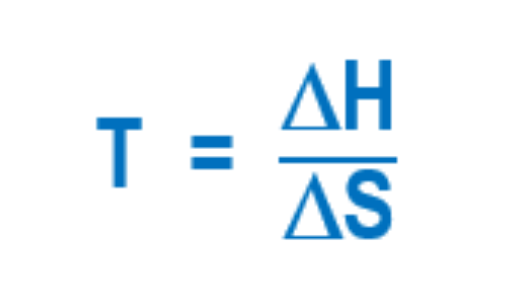
calculate temp when feasable
Make ΔG=0 Rearrange equation enthlapy change / entropy of system
properties of ions that affect enthlapy change
• charge • ionic radius
close lattice energy values
mostly 100% ionic
different lattice energy values
differing charges and ionic radius so one polarises the other so bonding has covalent character
why expect entropy of system to be positive
increase number of moles change of state - s - l - g
enthalpy change of solution
the enthlapy change when one mol of an ionic solid dissolves in water to form an infinitely dilute solution
enthlapy change of hydration
enthlapy change when one mole of an ion in its gaseous state is completely hydrated by water
equation of equilib constant and gibbs
ΔG = -RTlnK
speical cases of gibbs free energy
kintetic stability -if thermodynamically feasable dosent necisary mean it will occur activation energy too high non standard conditions -may not happen at standard conditions may need to be heated
solubility of salts
if gibs of solution is negative the products are favoured at equilibrium and the salt is soluble if the gibs of solution is positive than the solid salt is favoured at equilibrium so the salt is insoluble