Titrations
No description yet. This curated deck is ready for daily study.
Card preview (15)
Reaction in a titration.
acid + alkali → salt + water
Describe the pH curve
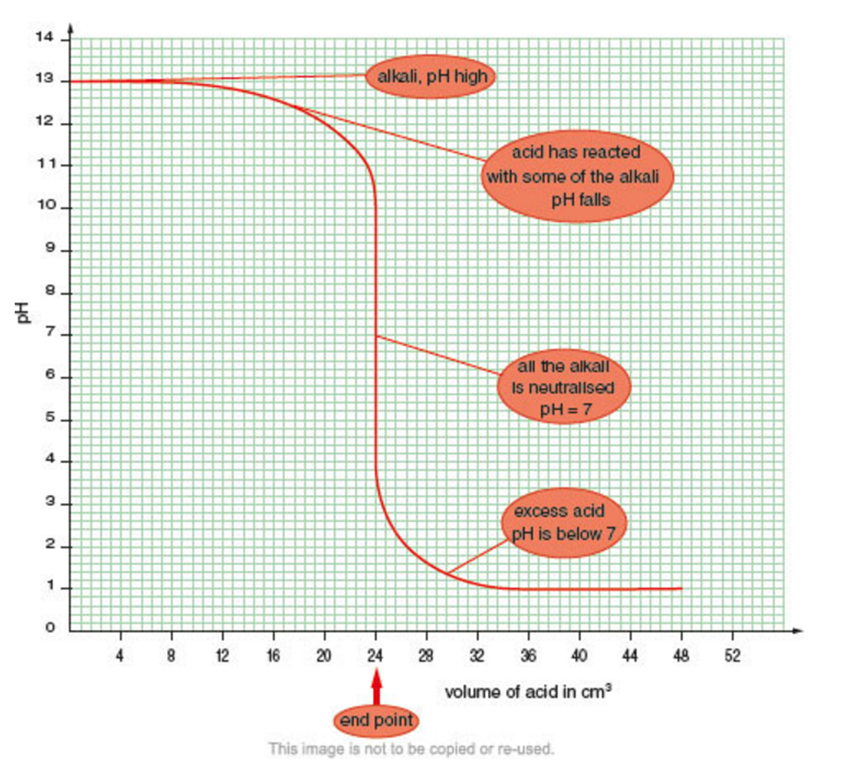
• Only alkali is present at the beginning of the experiment so the pH is high. • As acid is added it starts to neutralise the alkali and the pH drops slowly at first. • The point where all the acid reacts with all the alkali is called the endpoint. • At the end point, pH changes suddenly.
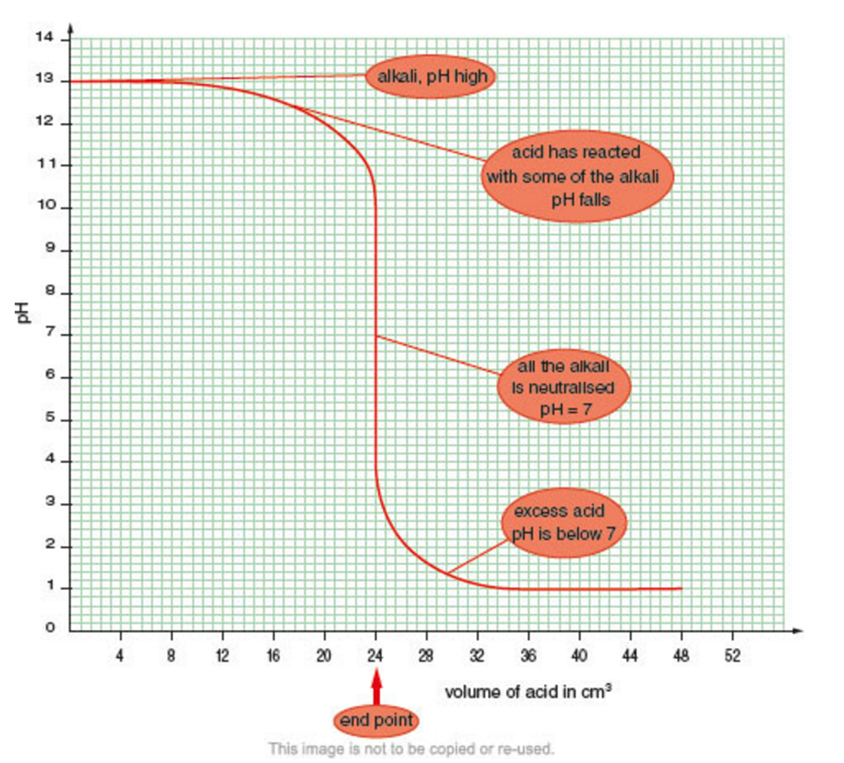
It is often useful to sketch a pH titration curve. For many acid and alkali titrations the shape is always the same, but you make the curve the right size it is useful to know:
• The starting pH • The end pH • The endpoint (the most vertical section of the curve) • The pH range over which the sudden change occurs.
Why are indicators chosen?
• Indicators are chosen as they give sharp colour changes at specific pHs.
Different types of indicators.
• Indicators such as phenolphthalein, screened methyl orange and litmus give a sudden colour change. • Mixed indicators such as universal Indicator (UI) give a range of colours.
Why are single indicators used in titration?
To show the end point, a single indicator needs to be used. Mixed indicators like universal indicator give continuous colour changes which are harder to see.
Colour of litmus in acid and alkali.
• Acid: Red • Alkali: Blue
Colour of phenolphthalein in acid and alkali.
• Acid: Colourless • Alkali: Pink
Colour of screened methyl orange in acid and alkali.
• Acid: Pink • Alkali: Green
Why are titrations repeated?
So an average reading can be calculated to make the technique reliable.
What are titrations used to find?
The concentration of an alkali from a from a known concentration of acid or vice versa.
Concentration Eq.
concentration = number of moles/volume in dm3.
Number of moles Eq.
number of moles = concentration x volume in dm3.
Volume in dm3 Eq.
volume in dm3 = number of moles/concentration
Working out the concentration of an acid
• Work out how many moles of acid were used. Using: number of acid moles = acid concentration x volume x volume in dm3 • Work out how many moles of alkali were used. Using amount of alkali moles = alkali concentration x volume in dm3 • Link the acid and alkali. number of acid moles = Number of alkali moles