Energetics
No description yet. This curated deck is ready for daily study.
Card preview (20)
temperature
measure of the average kinetic energy of the particles
What is the total energy in chemical reactions?
total energy conserved - energy cannot be created or destroyed
Can enthalpy directly be measured?
no but changes in enthalpy can be
How are enthalpy changes calculated?
from their effect on the temperature of the surroundings
equation for heat change of a substance
q = mc deltaT
what are the units of enthalpy changes?
kjmol-1
what do -ve enthalpy changes represent?
energy lost to surroundings (exothermic)
what do +ve enthalpy changes represent?
energy gained from surroundings (endothermic)
breaking bonds enthalpy change
endothermic (energy required)
making bonds enthalpy change
exothermic (energy released)
average bond enthalpy
energy needed to break one mol of a bond in a gaseous molecule
enthalpy of formation
enthalpy change when one mol of substance is formed from its elements in standard states
enthalpy of combustion
enthalpy change when one mol of substance is completely burnt in oxygen under standard conditions
standard enthalpy of reaction
enthalpy change for the given reaction at standard conditions
standard conditions
• normal, most pure state • 100kPa • 298K
calorimetry method
• measure heat transferred to surroundings from reactants • this is amount of energy that has been lost/gained by reaction • divide by number mol that reacted to give enthalpy of reaction
main sources of error in calorimetry experiments
• heat loss to surroundings • specific heat capacity of equipment
How to construct a Hess cycle?
if 2mol are made multiply enthalpy change by 2
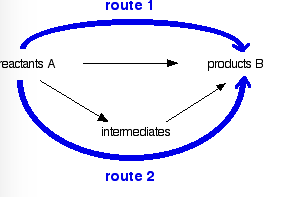
how do you calculate the enthalpy change of the reaction from bond enthalpies?
reaction enthalpy = sum bond enthalpies of reactants - sum bond enthalpies of products
reasons for differences between true reaction enthalpy and bond calculated reaction enthalpy?
• bonds are not average • usually reactants and products are not in gaseous state as in definition