Option D unit D4 - Glycogen
No description yet. This curated deck is ready for daily study.
Card preview (5)
what is glycogen
Glycogen is converted to glucose in muscles for ATP generation during exercise
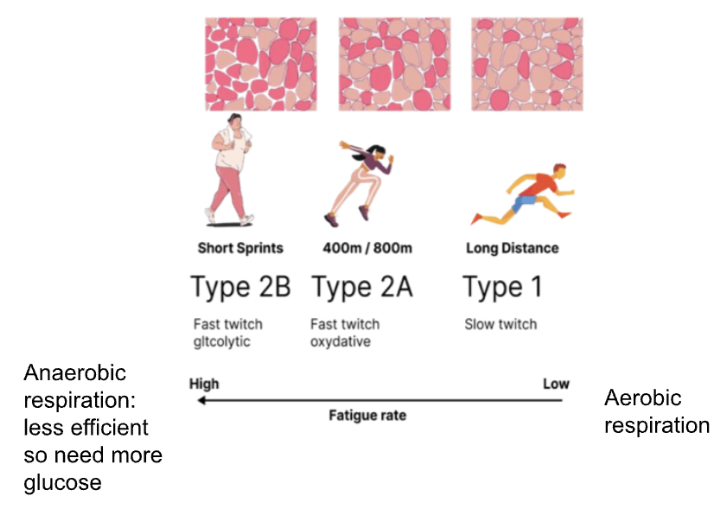
Glycogen content of specific skeletal muscle fiber types:
• Slow twitch (type I) - low glycogen content • Fast twitch type IIa - medium glycogen content • Fast twitch type IIb - high glycogen content • Low intensity exercise predominantly uses slow twitch muscle fibers = less oxygen (aerobic) • High intensity exercise predominantly uses fast twitch/type II muscle fibers = more glycogen (anaerobic)
carb digestion
• Glycogen is stored glucose (carbs). Different foods have different rates of carb digestion. • Glucose is released at different speeds from food we eat. • Glycemic Index (GI) : the ranking system for carbohydrates based on how quickly the glucose (sugar) enters the bloodstream after digestion –> High glycemic index = will enter the bloodstream faster and all at once –> Low glycemic index = enters the bloodstream slow and over time Does not depend on how much glucose Ex. 10 grams of glucose High = all 10 grams enter the bloodstream fast and at once Low = 2 grams enters the bloodstream slowly → takes longer for all 10 grams to enter the blow stream.
The relevance of GI with regard to carbohydrate consumption by athletes pre- and post competition:
• consuming foods containing carbohydrates before and after exercise may be beneficial in aerobic performance and recovery • Key is when do you want the glucose to impact the body • During exercise (ex. Running a race) = ASAP = high glycemic index foods • Before exercise = in a while = low glycemic index foods • Post workout = quick for faster recovery = high glycemic index foods to replenish glycogen stores faster
The interaction of carbohydrate loading and training programme modification prior to competition
Carb loading: used to maximize stored glycogen in muscles, requires training + nutrition More common in people that have significant time during competitions - ex. Marathon, cycling Training: * Complete and exhaustive session approximately ~ 1 week prior to the event * The training load is tapered over the remaining days Diet: * Approximately 7 to 4 days prior the diet is low in CHO (high in fat and protein) * This increases the activity of the enzyme glycogen synthase * Results in greater glycogen storage when CHO diet increases → because the body was starved from carbohydrates * The final ~ 2 days has a high CHO diet