Chapter 10 (reaction rates and equilibrium)
No description yet. This curated deck is ready for daily study.
Card preview (15)
What changes rate of reaction ?
• temperature • concentration of reactants • catalyst • pressure (gasses) • the surface area
What is needed for a successful reaction ?
• they need sufficient activation energy • correct orientation of the molecules • particles need to collide
What is the effect of increasing concentration on rate of reaction
• increasing concentration leads to more reacting particles in a given volume • this means the particles are more crowded and there will be a higher frequency of collisions • if the required activation energy is there is an increase in the rate of successful collusions • therfore a greater average rate of reaction
What are the 2 types of catalysts ?
• homgeneous catalysts - catalyst is in same phase as the reactants e.g both reactants and catalysts in solution • Heterogenous catalysts means the catalyst is in a different phase to reactants, e.g gasses and solids
What are the benefits of using a catalyst ?
• activation energy lowered, meaning less energy is needed for the reaction • lower temperatures can be used, saving money as well as resources • therefore more profit and less harmful effects of energy generation
What does a Boltzmann distribution graph look like ?
• In the model we assume that all collisions between particles and the surface of the container are elastic (no loss in kinetic energy) • the total area under the graph stays the same
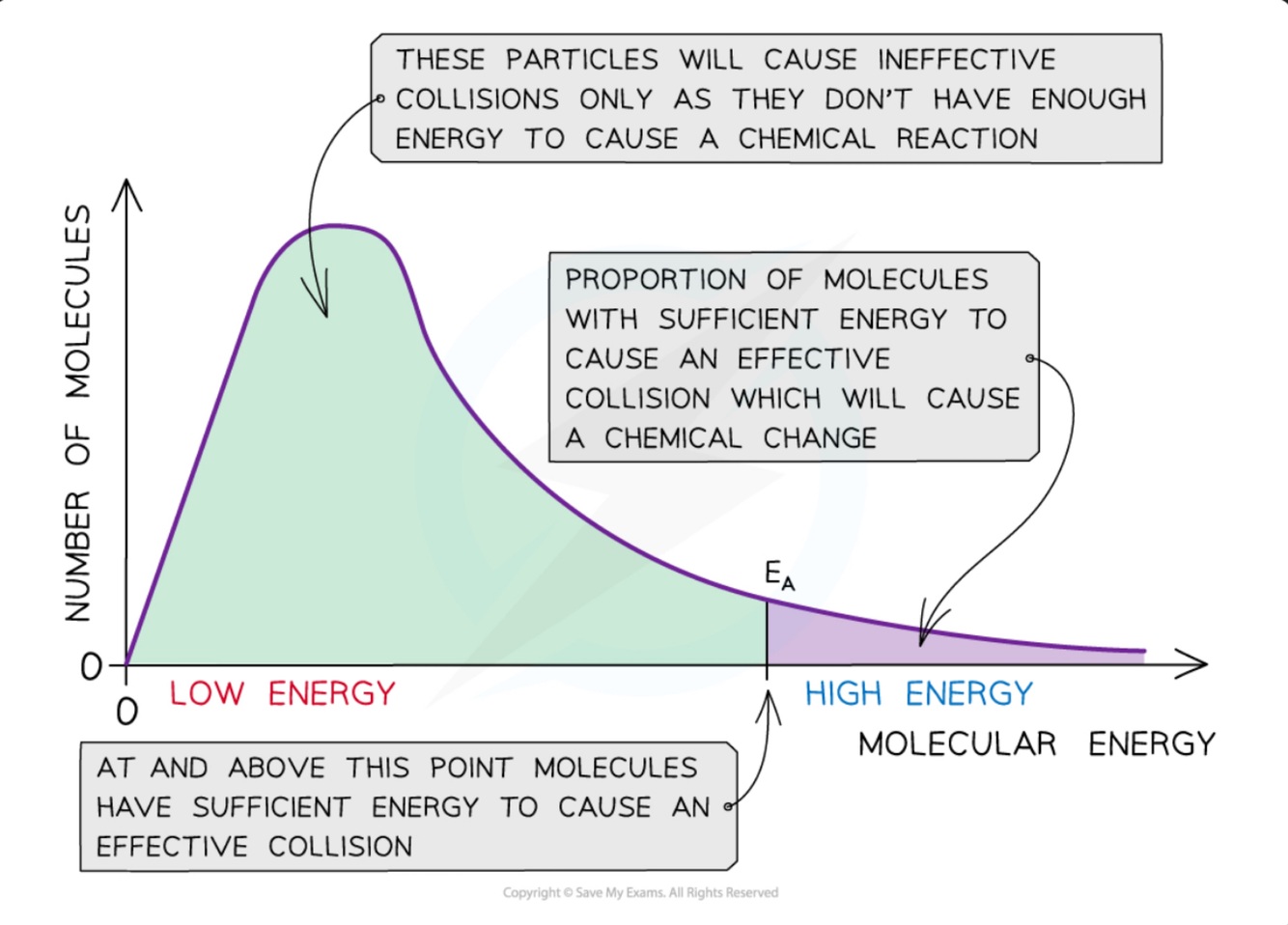
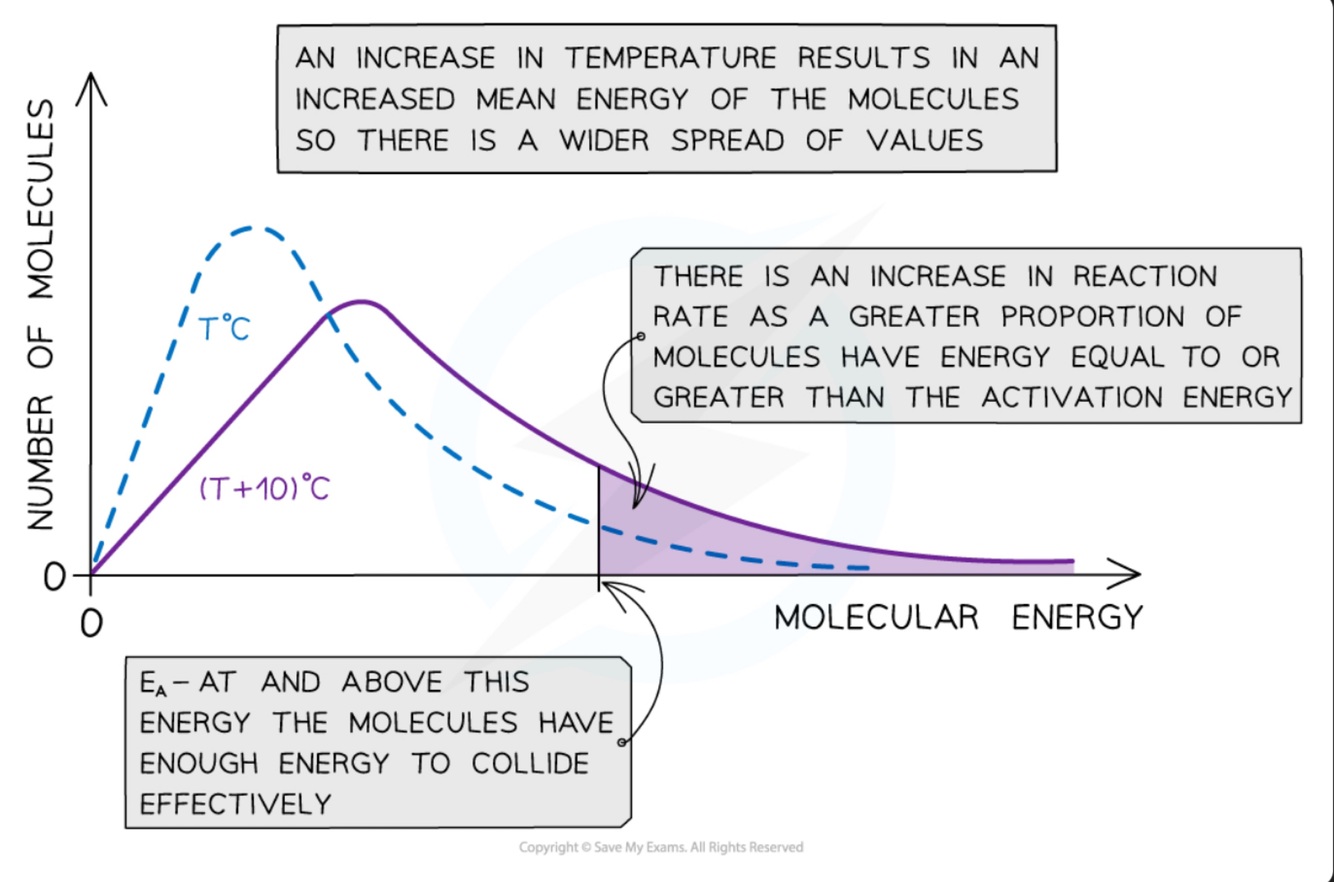
What happens to boltzmann distribution curve after an increase in temperature ?
• the peak flattens and shifts to the right
What does an equilibrium graph look like ?
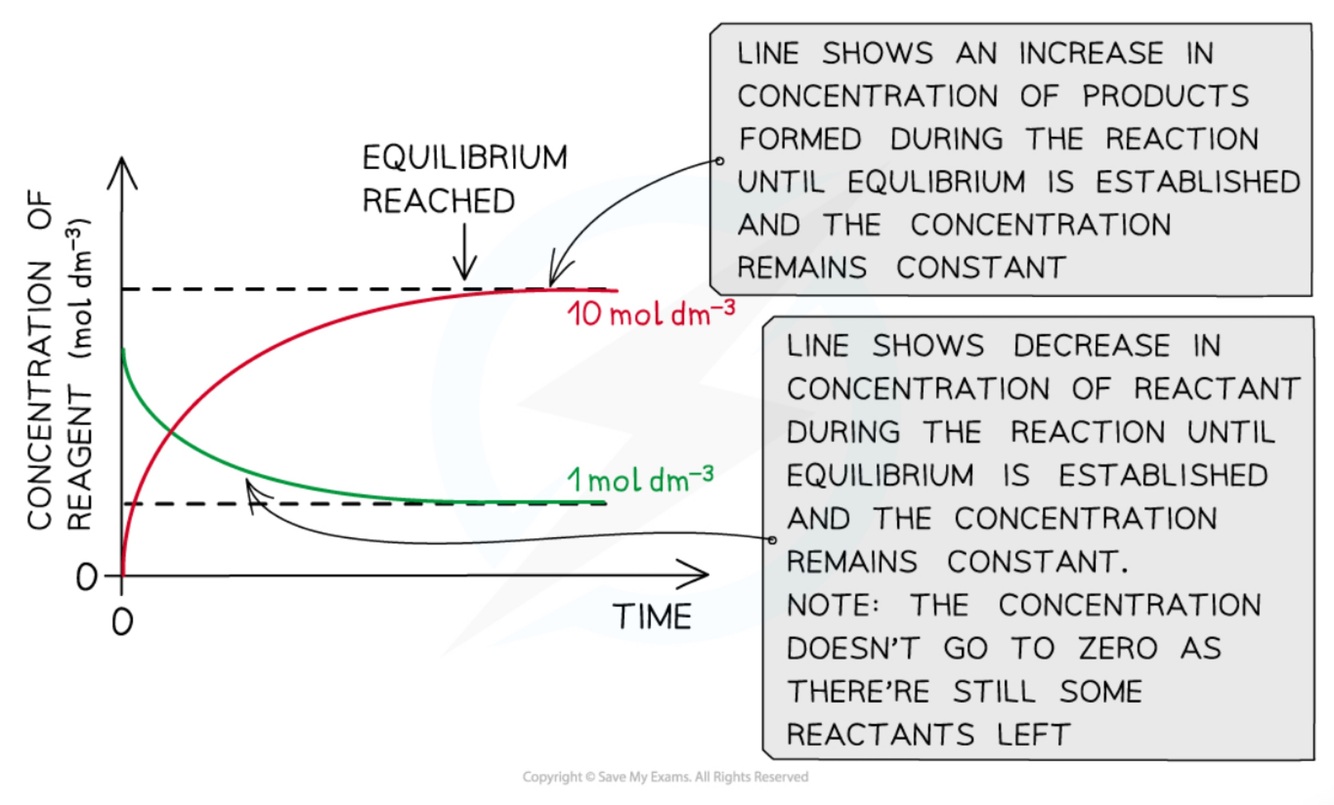
What is dynamic equilibrium?
• closed system • the rate of the forward reaction = the rate of the backwards reaction • concentration of reactants and products stay the same
What is Le Chatelier’s principle ?
when a change is made to a reaction of equilibrium, the position of equilibrium moves to oppose the original change ?
What happens when you change the concentration of the system ?
If concentration of reactants increases - the equilibrium position move away from the reactants, therefore shifts to the right, to increase the concentration of products and favour the forwards reaction. If concentration of reactants decrease - the equilibrium position shifts to the left to favour the backwards reaction to increase the concentration of reactants.
What happens if you change the temperature of the system ?
Increase in temperature - more energy in the system favours the endothermic reaction to reverse the change, shift to the right Decrease in temperature - less energy in the system favours the exothermic reaction to reverse the change, shift to the left
What happens when you change the pressure of a system ?
If the pressure is increased - favours the reaction with less moles of gas to decrease the pressure again If pressure is decreased - favours the reaction with more moles of gas to increase the pressure E.g N2 + 3H2 -> 2NH3, to increase the production of ammonia increase pressure to favour forwards reaction
What do the values of Kc indicate ?
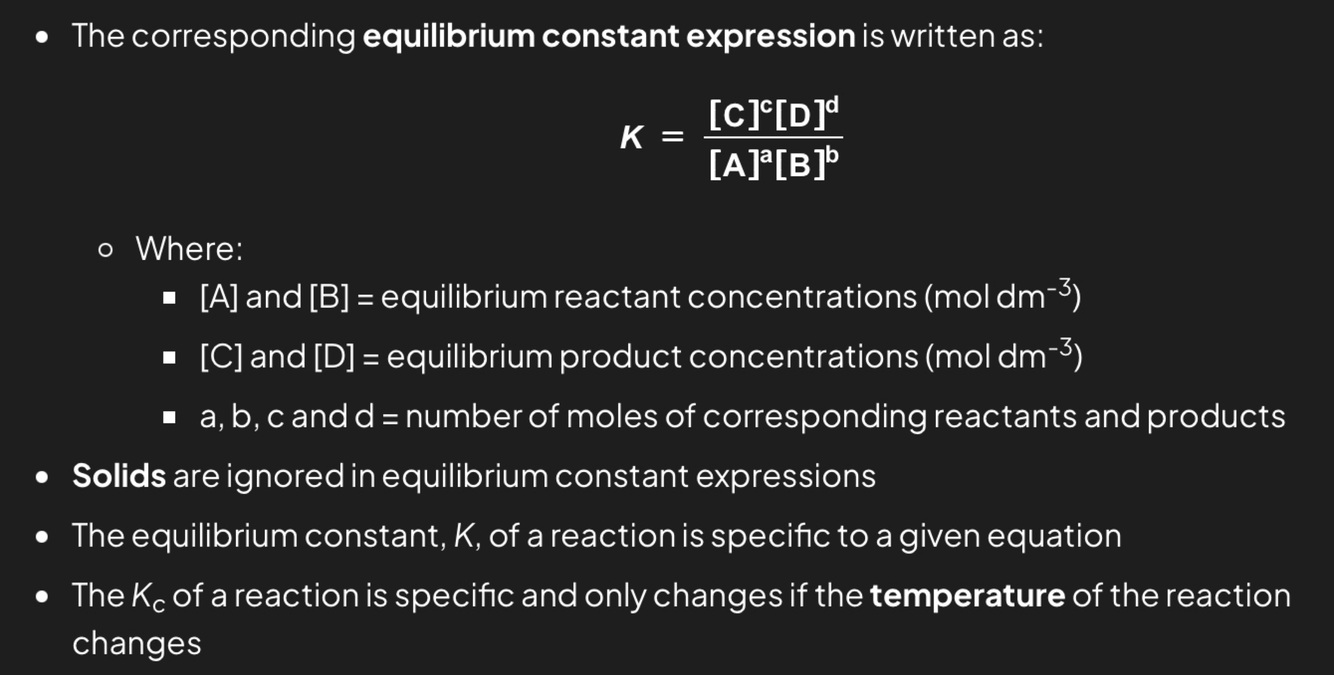
• Kc = 1, indicates that the position of equilibrium is halfway between the reactants and products • Kc > 1, indicates that the position of equilibrium is towards the products • Kc < 1, indicates that the position of equilibrium is towards the reactants • the larger the value, the further the position of equilibrium lies to the right and the greater the concentration of products.
How do you calculate Kc ?