Chapter 17- Aromatics
No description yet. This curated deck is ready for daily study.
Card preview (24)
What is the product of Benzene and Br2?
No reaction!
How does aromaticity affect stabilization?
Enhanced stability
What is the criteria to be classified as an aromatic?
• cyclic • continuous conjugation across atoms in cycle • Planar • Delocalized pi electrons (enhances stability) • # of pi electrons equation
What is the equation (Huckel’s rule) for determining aromaticity?
pi electrons = 4N + 2
What is the criteria to be classified as an anti-aromatic?
• cyclic • continuous conjugation across atoms in cycle • Planar • Delocalized pi electrons (Destabilized) • # of pi electrons equation
What is the equation (Huckel’s rule) for determining antiaromaticity?
pi electrons = 4N
What is the criteria to be classified as Non Aromatic?
• not cyclic • not planar • no continuous conjugation
Rank the stability of aromatic, antiaromatic and nonaromatic molecules
aromatic > nonaromatic > antiaromatic
What is the rule dealing with lone pairs of a heteroatom?
If the heteroatom’s lone pair is necessary for aromaticity, it will be counted in the Huckel number of pi electrons. (only count 1 LP, not the other one, if there is one)
What is the general rule for Basicity?
If the lone pair is necessary for aromaticity, then the lone pair will not be basic
What is the general rule for Acidity?
If the loss of the proton provides an aromatic stabilized conjugate base, it is favorable.
What is important to remember when drawing MO diagrams
• vertex down • cut shape in half -label bonding, n , and antibonding -lowest orbitals get filled first
Name this molecule.
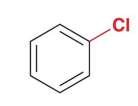
chlorobenzene
Name this molecule.
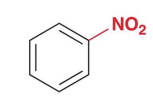
nitrobenzene
Name this molecule.
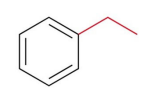
Ethylbenzene
Name this molecule.
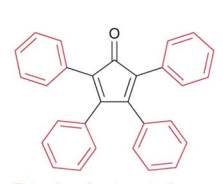
tetraphenylcyclopentadienone
Name this molecule.
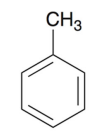
Toluene
Name this molecule.
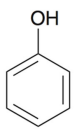
phenol
Name this molecule.
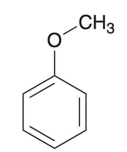
Anisole
Name this molecule.
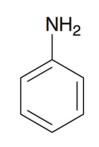
Aniline
Name this molecule.
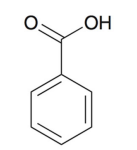
Benzoic acid
Name this molecule.
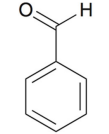
benzaldehyde
Name this molecule.
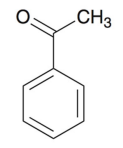
Acetophenone
Name this molecule.
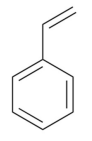
styrene