equilibria 5.6
No description yet. This curated deck is ready for daily study.
Card preview (16)
what is a reversible reaction?
a reaction that can go backwards as well as forward ⇌
what does reversible reaction depend on in terms of it going either forwards or backwards?
amount of reactants and products and the conditions (such as temperature and pressure)
how does enthalpy change factor into reversible reactions?
enthalpy change for a reversible reaction always refers to the forwards reaction for the backwards reaction, enthalpy change is the same number but the opposite sign for example: in the reaction in which enthalpy change is +113 kJ/mol +113kJ/mol = forward reaction -113kJ/mol = backwards reaction
hydration/dehydration of copper sulphate:
CuSO4 5H2O ⇌ CuSO4 + 5H2O to make reaction go forward you heat hydrated copper sulphate crystals = blue to white as they evaporate all their water to make the reaction go backwards you add water to anhydrous copper sulphate = the white powder absorbs the water and turns blue in the process
thermal decomposition of ammonium chloride:
NH4Cl(s) ⇌ NH3(g) + HCl (g) to make the reaction go forward you heat to make the reaction go backwards you allow NH3 and HCl to mix in the absence of heat = white NH4Cl forms immediately wherever the cold gases meet
what is dynamic equilibrium?
when a reversible reaction is left in a sealed container, this results in the forward and backwards reactions eventually balancing out therefore the mixture of reactants and products in the container is referred to as being in dynamic equilibrium
why is dynamic equilibrium called this?
dynamic = the forward and backwards reactions are still happening just as the same rate equilibrium = the concentration of reactants and products remain unchanged
what is the equilibrium position?
the resulting balance of products and reactants in an equilibrium mixture is called the equilibrium position
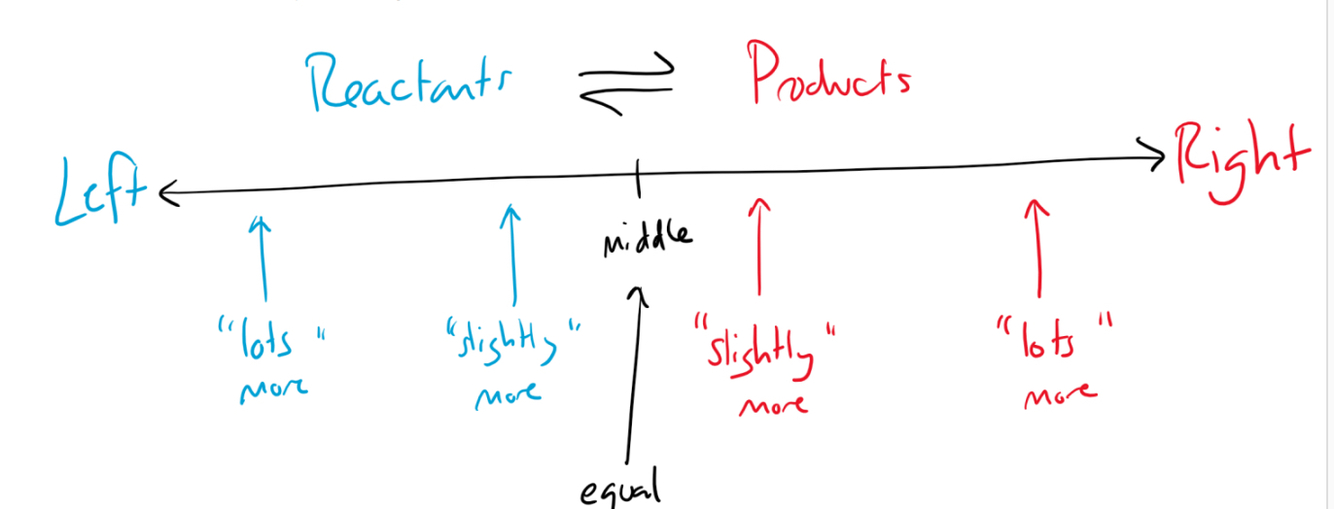
what variables can result in a shift in equilibrium?
• amount of reactants or products • gas pressure • temperature
how would adding a substance shift the equilibrium?
in whichever direction uses it up shift to remove the extra you added
how would removing a substance shift the equilibrium?
in whichever direction creates it shift to create more of it
how does increasing gas pressure shift the equilibrium?
to whichever side has the fewest moles of gas
how does decreasing gas pressure shift the equilibrium?
to whichever side has the most moles of gas
how does increasing temperature shift the equilibrium?
in whichever direction is endothermic
how does decreasing the temperature shift the equilibrium?
in whichever direction is exothermic
what effect do catalysts have to rates of forward and backwards reactions?
they balance as catalysts increase the rates of both forward and backward reactions therefore having no effect on the position of equilibrium