Organic 3: Halogenoalkanes
No description yet. This curated deck is ready for daily study.
Card preview (17)
Why do halogenoalkanes have polar bonds?
Because halogens are more electronegative than carbon So the electrons are drawn towards the halogen Making the carbon delta positive (electron deficient) And the halogen delta negative
Describe the solubility of halogenoalkanes.
Halogenoalkanes are insoluble in water because the polar C-X bonds are not polar enough to interact with polar water molecules
Describe the boiling points of halogenoalkanes.
Boiling points increase with increased carbon chain length Also increase going down the halogen group Both are because of increased van der Waal forces
Why do halogenoalkanes have higher boiling points than alkanes with similar chain lengths?
1) Increased molecular mass due to halogen - more van der Waals, higher boiling point 2) Polarity increases strength of IMFs (i.e. dipole-dipole bonding) so more energy needed to overcome IMFs
What are the two factors that determine how readily the C-X bond reacts?
Bond polarity Bond enthalpy (more important)
How does bond polarity affect reactivity of halogenoalkanes?
More polar bonds are more reactive More electronegative halogens attract more electrons in the C-X bond Making the carbon atom more delta positive (electron-deficient) So more attractive to nucleophiles (electron pair donors)
What is a nucleophile?
A donor of a lone pair of electrons
How does bond enthalpy affect halogenoalkane reactivity?
Bonds get weaker down the group Because atomic radius increases So force of attraction between the valence electron involved in the C-X bond and nucleus is weaker So the C-X bond is weaker If the bond is weaker, it is easier to break, So a lower bond enthalpy makes a halogenoalkane more reactive
What are the three products of a nucleophilic substitution reaction with a halogenoalkane?
1) Amine 2) Alcohol 3) Nitrile
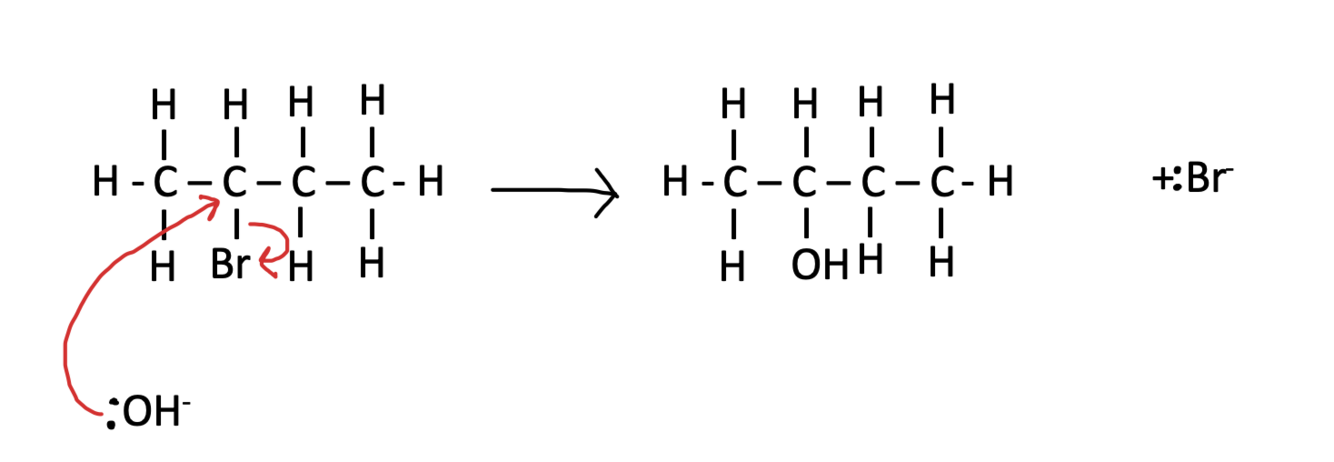
Describe the mechanism of producing an alcohol from a halogenoalkane.
Nucleophilic substitution Reagents = Ethanolic aqueous NaOH or KOH Conditions = Warm :OH- acts as nucleophile Na/K from NaOH/KOH react with halide nucleophile produced
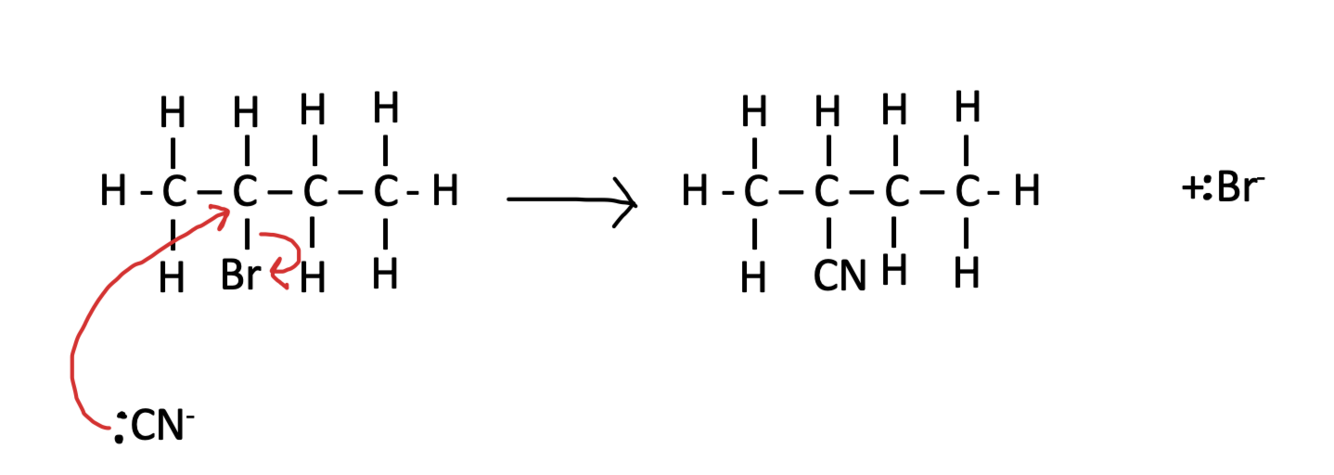
Describe the mechanism of producing a nitrile from a halogenoalkane.
Mechanism = Nucleophilic substitution Reagents = Ethanolic aqueous KCN Conditions = Warm :CN- acts as nucleophile K from KCN reacts with halide nucleophile produced
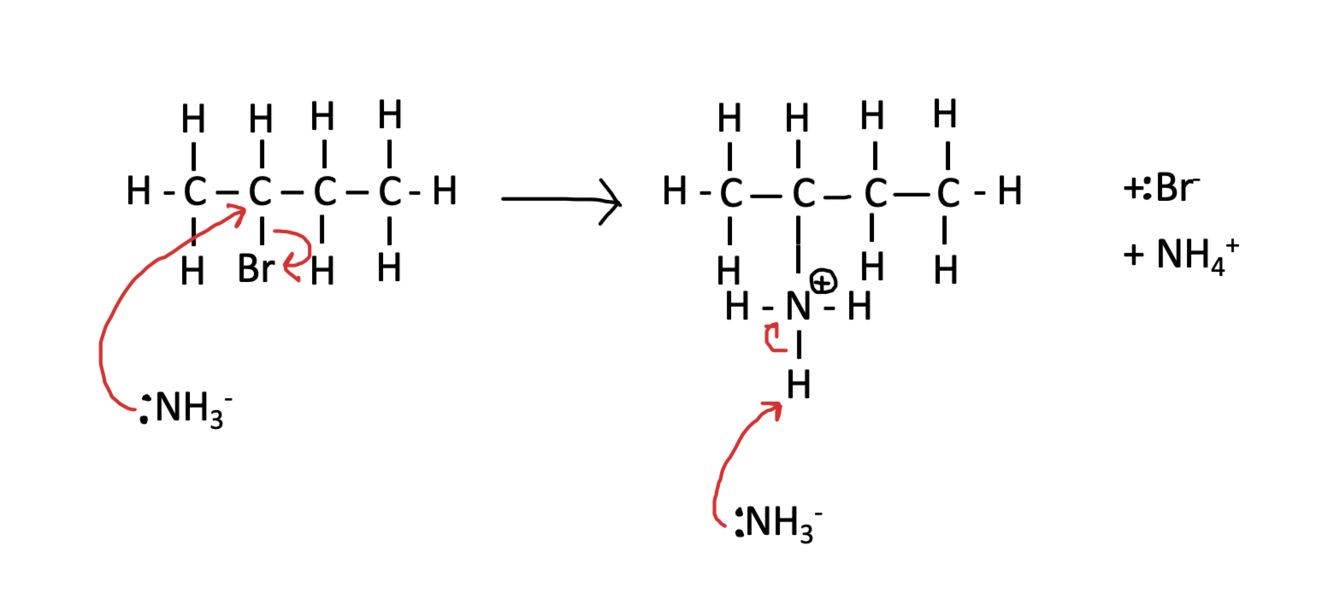
Describe the mechanism of producing an amine from a halogenoalkane.
Nucleophliic substitution Reagents = Excess ethanolic concentrated ammonia Conditions = Under pressure :NH3- acts as nucleophile NH4+ reacts with halide nucleophile to produce ammonium halide
Explain the mechanism for nucleophilic substitution.
1) X is more electronegative than carbon, so attracts the electrons in the C-X bond, making the carbon partially positive so attractive to nucleophiles 2) Nucleophiles donate their lone pair to the delta positive carbon atom 3) The C-X bond breaks, and a bond forms between the nucleophile and carbon atom 4) The halogen is removed as the leaving group with its pair of electrons, forming a halide ion
Explain is the second step of the nucleophilic substitution reaction with ammonia.
1) A proton must be lost from the NH3 group to form the neutral amine NH2 2) The lone pair from a second ammonia molecule is attracted to the delta positive hydrogen atom, removing the H+ and forming a bond to produce an ammonium ion
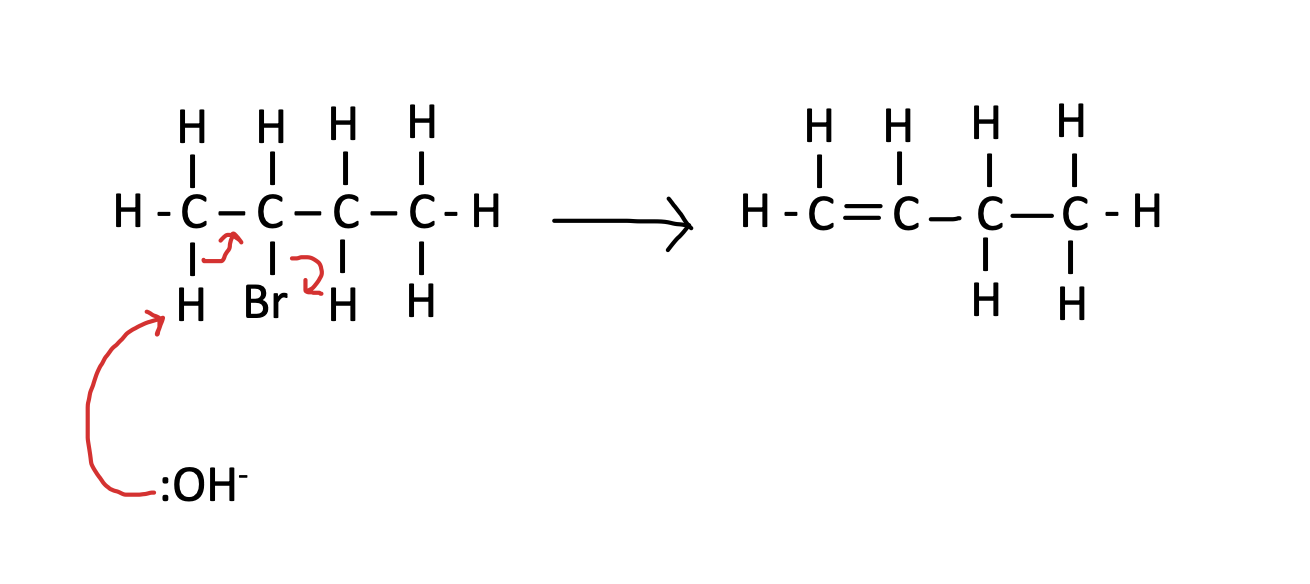
Describe the mechanism of producing an alkene from a halogenoalkane.
Eliminiation Reagent: Hot ethanolic KOH or NaOH Conditions: Heat OH- ion acts as a base Produces water and a halide ion which reacts with K or Na to produce KX or NaX
Explain the mechanism for producing an alkene from a halogenoalkane.
1) The OH- ion uses its lone pair to form a bond with one of the hydrogen atoms on the carbon next to the C-X bond because these hydrogens are slightly delta positive 2) The electron pair from the C-H bond becomes part of the carbon-carbon double bond 3) The halogen takes the pair of electrons in the C-X bond and leaves as a halide ion
What are chlorofluorocarbons?
Halogenoalkanes that contain chlorine and fluorine but no hydrogen atoms They decompose in the atmosphere to give chlorine atoms Which decompose ozone, breaking down the ozone layer