Section 6
暂无描述。系统推荐的高质量记忆内容,适合每天坚持背诵学习。
卡片预览 (24 张)
What is taxis and give an example
Directional movement in response to a stimulus The direction of the stimulus affects the response Example - Woodlice move away from a light source to favourable damp conditions
What is kinesis and give an example?
Non- directional (random) movement in response to a stimulus The intensity of the stimulus affects the response Example - In high humidity woodlice move slowly and turn less often so they stay where they are and in dry enviroments they more quicker and turn more often so they move into a new area
What is a choice chamber?
Container with different compartments to create different envirmental conditions (maggot practical)
What is a receptor and what do they do?
They detect stimuli and can be cells or proteins on membranes Receptors are specific to one type of stimuli
What is an effector and what do they do?
Cells that bring around a response to a stimuli to produce an effect Can be muscles or glands
What is the nervous system made up of?
Sensory neurones - transmit electrical impulses from receptors to the central nervous system (the brain and spinal cord) Motor neurone - transmits electrical impulses from the CNS to the effectors Relay neurone - trabsmit electrical impulses between these neurones
Describe the term simple reflex
A rapid involentary response to a stimuli The pathway goes through the spinal cord and not the conscious part of the brain
What is a reflex arch?
The pathway of neurones linking receptors to effectors Stimulus - receptor - sensory neurone - CNS (relay neurone in spinal cord) - motor neurone - effector - response
What is tropism?
The response of a plant to a directional stimulus from a particular direction by regulating its growth
What are auxins/ IAA?
Chemicals in the tip of plants which diffuse into plant cells and cause them to elongate - the cell wall becomes loose and stretchy so the cell can get longer They stimulate growth in shoots but inhibit growth in roots
What is the resting potential? (general)
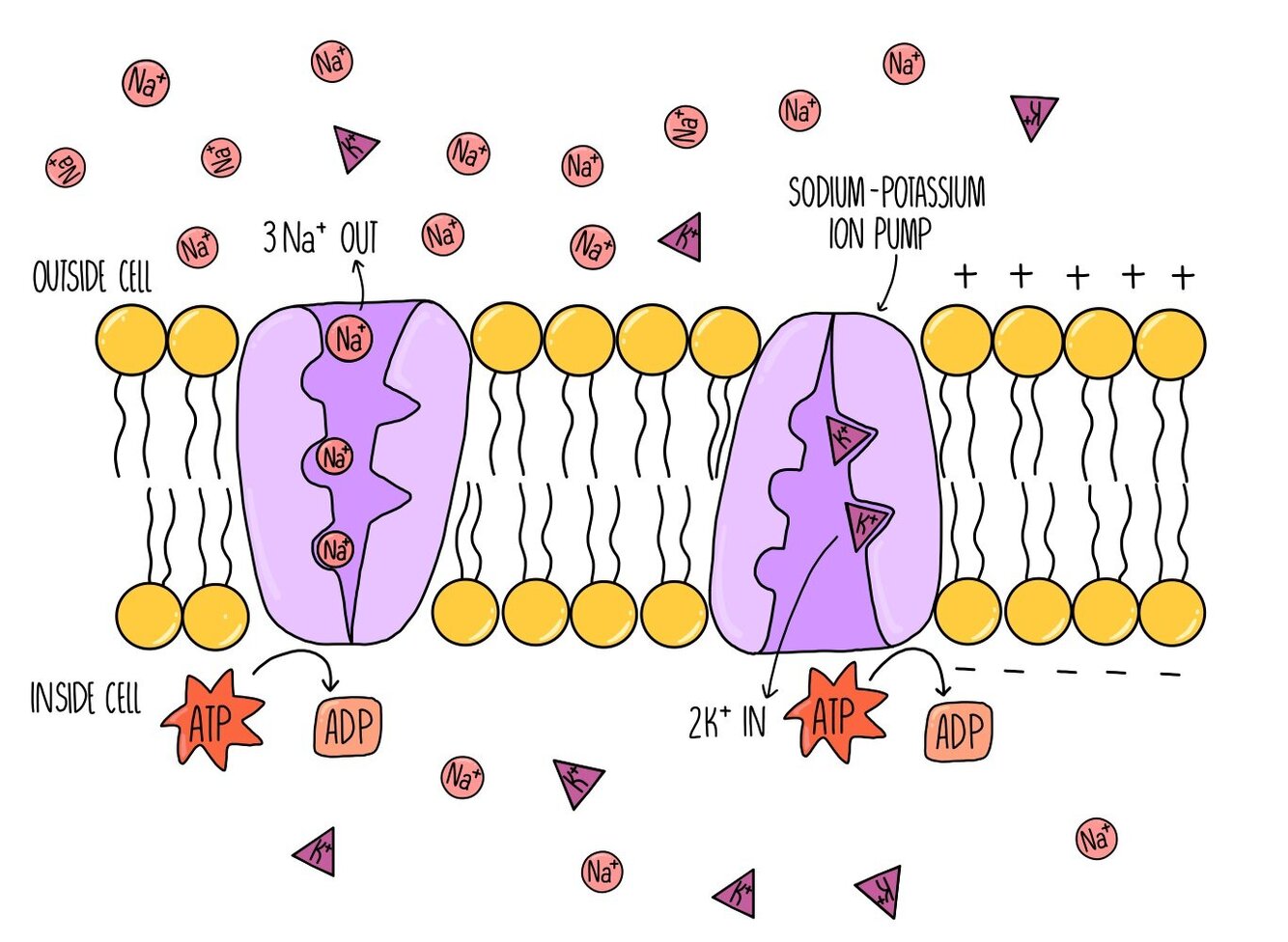
When a receptor is in its resting state there is a difference in charge between the inside and outside of the cell - the inside is negatively charged relative to the outside - the membrane is polarised an is -70mv This resting potential is created by ions pumps and channels
What is the generator potential?
When a stimulus is detected the cell membrane is excited and becomes more permable allowing more ions to move in and out of the cell changing the potential difference. This change is called the generator potential
What is the action potential? (general)
If the generator potential is big enough it will trigger an action potential - an electrical impulse along a neurone An action potential is only triggered if the generator potential reaches the threshold level Action potentials are all one size so the strength of the stimulus is measured by the frequency of action potentials triggered in a time period
What are pacinian corpuscles and how are they activated?
Mechanoreceptors - detect mechanical stimuli Found in the skin Contains the end of a sensory neurone wrapped in loads of layers of connective tissue called lamellae When the pacinian corpuscle is stimulated (pressure) the lamallae and deformed and press on the sensory nerve ending This causes the sensory neurone cell membrane to stretch deforming the stretch mediated sodium ion channels These channels open and sodim ions diffuse into the cell creating a generator potential
Describe the structure of the eye
Iris muscles - controlls how much light goes in Lense - focuses the light Retina - lines the inside of the eye and contains photoreceptor cells Fovea - area of the retina where there are lots of receptors Optic nerve - carries impulses from receptor to brain Blind spot - where the optic never leaves the eye - no receptors
How to photoreceptors work?
Light enters the eye, hits the photoreceptor and is absorbed by light snesitive optical pigments. Light bleaches the pigments casuing a chemical change and altering the permability to sodium ions A generator potential is created and if the threshold is reached a nerve impulse is sent along the bipolar neurone (connects photoreceptors to the optic nerve)
What are the differences between rods and cones?
Rods Found around the outside Black and white Very sensitive to light becuase many rods join to one bipolar neurone so many generator potentials combine to reach the threshold Low visual acuity becuase many rods join to the same bipolar neurone so they brain doesn’t know which one the signal is coming from Cones Gathered in the middle Colour 3 types (RBG) Less sensitive becuase one cone connects to one bipolar neurone High visual acuity becuase one cone is joined to one bipolar neurone so they brain knows exactly where the signal is coming from
What is visual acuity?
The ability to tell apart points that are close together
What is the difference between the central nervous system (CNS) and the peripheral nervous system (PNS)?
CNS - brain and spinal cord PNS - the neurones that connect the CNS to the rest of the body
What is the PNS made up of?
The somatic (controls conscious activities) and autonomic system (controls unconsicous activities) The autonomic nervous system is split into sympathetic (fight or flight system) and parasympathetic (rest and digest system)
What does myogenic mean?
the muscle can contract and relax with out signals from nerves
Describe control of heat beat
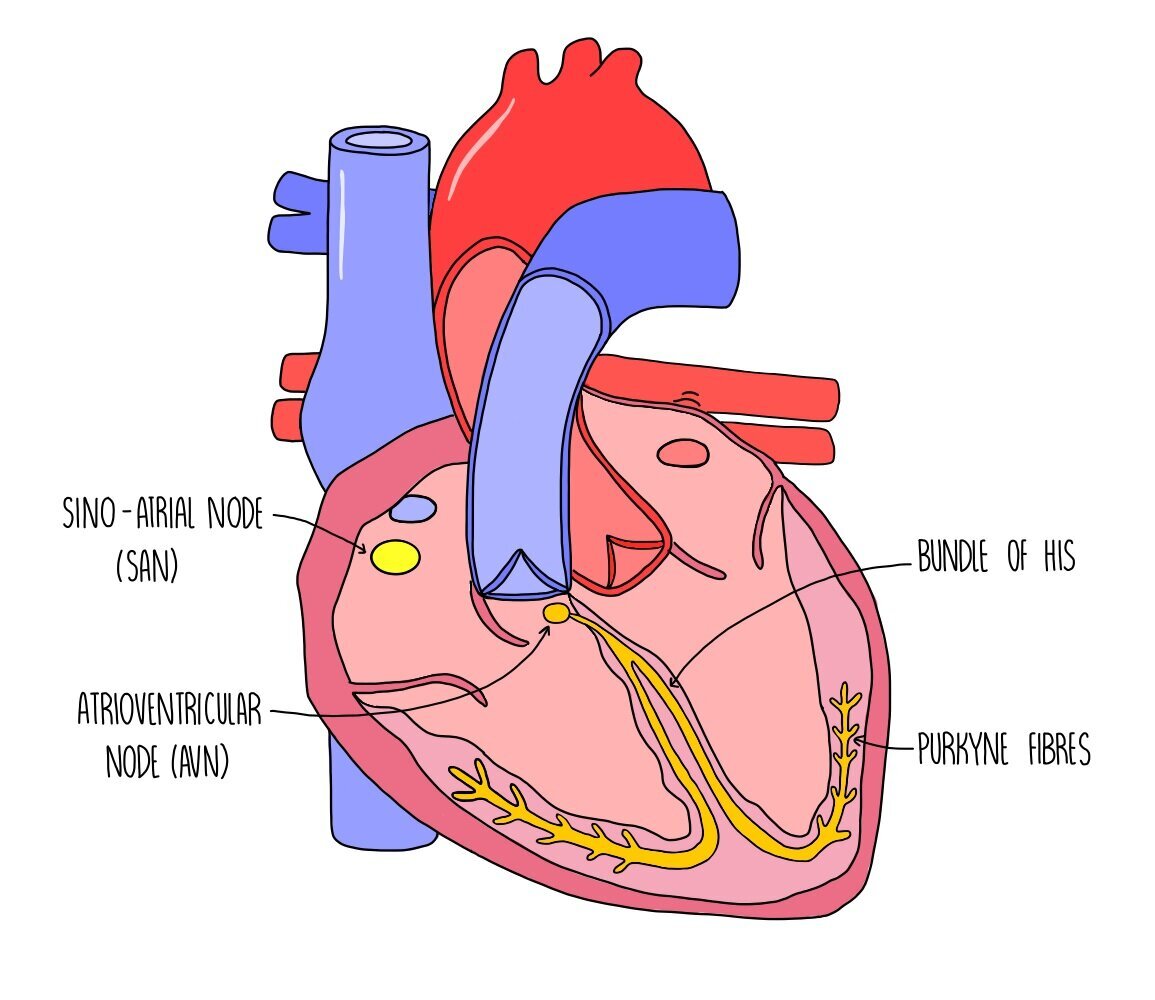
Starts in the sinoatrial node (SAN) which is a small mass of tissue in the wall of the right atrium - it is like a pacemaker - it sets the rhythm of the heartbeat by sending out regular waves of electrical activity to the atrial walls This causes the right and left atria to contract at the same time. A band of non- conducting collagen tissue prevents the electrical activity from being passed directly from the atria to the ventricles. The waves are transfered from the SAN to the atrioventricular node (AVN) The AVN passes the waves to the bundle of His. There is a slight delay before the AVN reacts to make sure the atria have emptied before the ventricles contract The bundle of His is a group of muscle fibers which conduct waves between ventricles to the apex (bottom) of the heart The bundle splits into finer muscle fibers in the right and left ventricle walls called the Purkyne tissue - this carries the aves into the muscular walls of the right and left ventricles causing them to contract at the same time from the bottom up Silly Ants Have Pants SAN AVN bundle of His Purkyne fibers
Describe commonication between the heart and the brain
The SAN generates electrical impulses the cause cardic muscles to contract. The rate at which the SAN fires (heart rate) is controlled by the medulla. There are pressure receptors called baroreceptors in the aorta and carotid atreries - stimulated by high and low blood pressure There are chemical receptors called chemoreceptors in the aorta, carotid arteries and the medulla. They monitor oxygen levels in the blood and CO2 and pH Electrical impulses sent from receptors are sent to the medulla along the sensory neurones and the medulla sends impulses to the SAN along sympathetic or parasympathetic neurones.
How is high blood pressure controlled?
Baroreceptors detect high blood pressure and send impulses along sensory neurones to the medulla which sends impulses along parasympathetic neurones. These secrete acetylcholine which binds to receptors on the SAN causing heart rate to slow