Transition Metals
No description yet. This curated deck is ready for daily study.
Card preview (24)
What is a transition metal?
Metals that contain an incomplete d sub shell in at least one of their ions
Where are transition metals found?
In the ‘d block’ (middle, group 3)
Why are Sc and Zn technically NOT transition metals, despite being found in the d block?
They have no or complete d shells Sc 3+ = [Ar] Zn 2+ = [Ar] 3d10
What is a ligand?
An atom or ion which donates a lone pair to form a co-ordinate bond to metal
What is a complex?
A metal ion with ligands co-ordinately bonded to it
What is the co-ordination number?
The number of co-ordinate bonds from ligands to the metal ion in the complex
What is a bidentate ligand?
A ligand which forms two co-ordinate bonds. Two different lone pairs on the molecule donate two electron pairs
Give 2 examples of a monodentate ligand
H2O: :OH- :NH3 :CN- :Cl
When can optical isomerism occur in complex molecules?
Can occur when bidentate ligands are attached to an octahedral complex
Give an example of a multidentate ligand
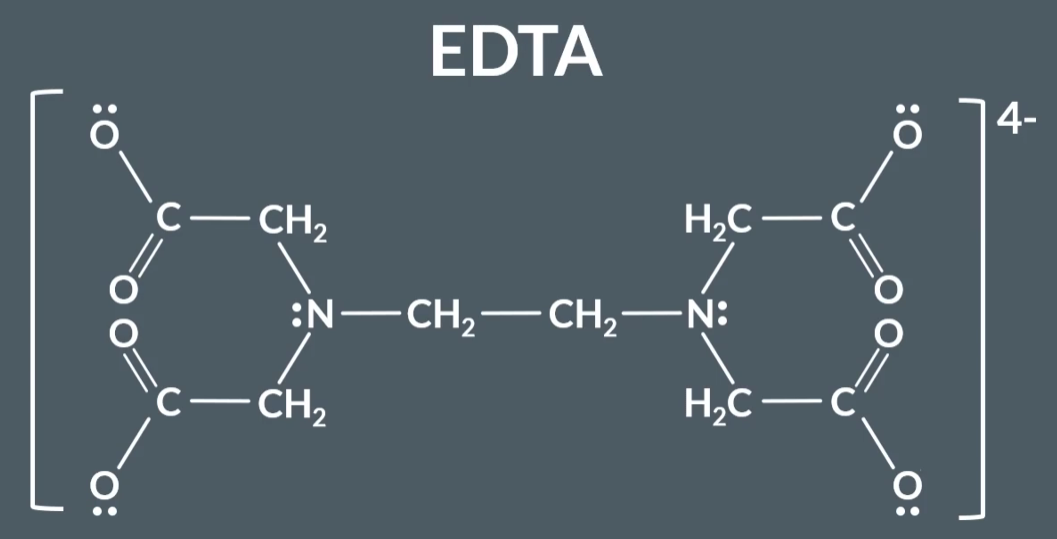
EDTA 4-, haem, [Pt(NH3)2Cl2] (cisplatin), [Ag(NH3)2]+
Why is EDTA 4- such an effective ligand, and what is its structure?
It has 6 lone pairs, and so can form 6 co-ordinate bonds with a metal ion
[Cu(H2O)6]2+ is added with an unknown substance. The solution turns from light blue to dark blue. What was the unknown substance?
Ammonia
Ammonia is added to [Cu(H2O)6]2+. What are the products formed?
[Cu(NH3)4(H2O)2]2+ + 4H2O
Concentrated HCl is added to [Cu(H2O)6]2+. What are the products formed?
[CuCl4]2- + 6H2O
Ammonia is added to [Cu(H2O)6]2+. What is the colour change observed?
Light blue to dark blue
Concentrated HCl is added to [Cu(H2O)6]2+. What is the colour change observed?
Light blue to yellow
Concentrated HCl is added to [Cu(H2O)6]2+. The solution should turn yellow, but it looks more green. Why?
Because it’s going from blue to yellow
Ammonia is added to [Co(H2O)6]2+. What are the products formed?
[Co(NH3)6]2+ + 6H2O
Ammonia is added to [Co(H2O)6]2+. What is the colour change observed?
Pink to pale brown
Concentrated HCl is added to [Co(H2O)6]2+. What is the colour change observed?
Pink to dark blue
Concentrated HCl is added to [Co(H2O)6]2+. What are the products formed?
[CoCl4]2- + 6H2O
Why is the colour change so dramatic when concentrated HCl is added to [Co(H2O)6]2+?
The colour change is dramatic because the co-ordination number also changes (Cl is big so can’t fit round octahedral)
What is the chelate effect and why is it feasible (refer to delta G)?
The substitution of monodentate ligands (eg H2O) by multidentate ligands. This happens as entropy change is positive, /\H is roughly zero and therefore /\G is negative, meaning the reaction is feasible.
What is a use of a chelate?
It is useful in dealing with heavy metal poisoning, as it ‘cages’ up and so limits the poisoning effects