Unit 1-Reaction Quantities
No description yet. This curated deck is ready for daily study.
Card preview (14)
What is meant by the gram formula mass (GFM) of a substance?
The GFM is the mass of one mole of a substance.
How do you calculate the Gram Formula Mass (GFM) of a compound?
Work out the formula then add all the mass numbers together.
What is the GFM of Carbon Dioxide?
CO2 12 + (2x16) = 44
To calculate the mass of a number of moles, or calculate the number of moles in a certain mass, a formula triangle can be used. Describe it.
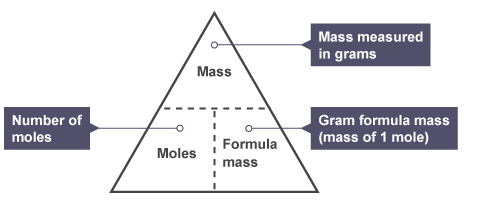
How many moles are present in 25 g of calcium carbonate? (GFM=100)
number of moles = mass/GFM 25/100 = 0.25 moles
Calculate the mass of 0.25 moles of butane (C4H10) RAM of Carbon = 12 RAM of Hydrogen = 1
mass = number of moles x GFM mass = 0.25 x 58 mass = 14.5g
If the number of moles of solute and the volume of solvent used is known, the concentration of the solution can be calculated. Describe the formula triangle.
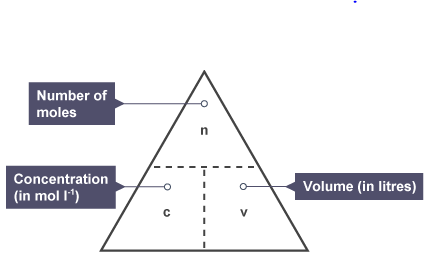
How many of moles in 400cm3 of 0.2 mol l-1 sodium hydroxide (NaOH) solution.
Number of moles = concentration x volume Convert volume to litres by dividing by 1000 = 0.2 x 0.4 = 0.08 moles
Calculate the concentration of the solution formed when 0.75 moles of sodium chloride are dissolved in 500 cm3 of water.
Concentration = number of moles/volume. Convert volume into litres by dividing by 1000. Concentration = 0.75/0.5 Concentration = 1.5 mol l-1
Calculate the volume of sodium hydroxide used in 0.6 mol l-1 solution containing 1.2 mol of solute.
Volume = number of moles / concentration = 1.2 / 0.6 = 2 litres
Equations can be described as being balanced. What does this mean?
A chemical equation is said to be balanced when there are the same number of the same type of every atom on both sides of the equation.
How can you balance an equation?
Balancing is adding BIG numbers. You cannot change any of the small numbers in a chemical formula. If balancing is required, put the number in front of the substance.
How would this equation be balanced? Cu + O2→ CuO
2Cu + O2 → 2CuO
Balance this equation C4H8 + O2 → CO2 + H2O
Balance Carbons C4H8 + O2 → 4CO2 + H2O Balance Hydrogens C4H8 + O2 → 4CO2 + 4H2O Balance Oxygens C4H8 + 6O2 → 4CO2 + 4H2O