24.2 Formation of Complex Ions
No description yet. This curated deck is ready for daily study.
Card preview (20)
How are complex ions formed?
1 or more ligands form dative covalent bond with central metal ion
What is a ligand?
ion/molecule which donates electron pair to central metal ion forming dative covalent bond
What is a dative covalent bond?
Bond formed when 1 atom in bond provides both electrons in shared pair
What is a coordination number?
Indicates number of dative covalent bonds attached to central metal ion
What is a monodentate ligand?
A ligand which can only (donate 1 electron pair / form 1 dative covalent bond) with central metal ion
What is a bidentate ligand?
A ligand which can (donate 2 electron pairs / form 2 dative covalent bonds) with central metal ion
What are common monodentate ligands?
• WATER - H2O: • AMMONIA - :NH3 • CHLORIDE - :Cl- • CYANIDE - :CN- • HYDROXIDE - :OH-
What are common bidentate ligands?
• 1,2 DIAMINOETHANE (en) • ETHANEDIOATE
Draw the structural formula of a 1,2diaminoethane molecule:
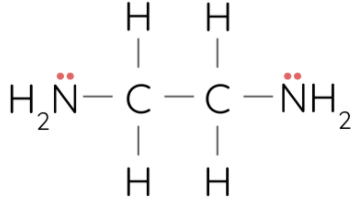
Draw the structural formula of an ethanedioate molecule:
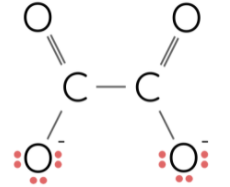
State the formula, shape, & bond angle of this complex ion:
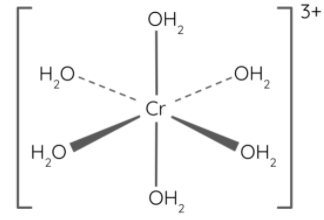
[Cr(H2O)6]3+ octahedral, 90°
State the formula, shape, & bond angle of this complex ion:
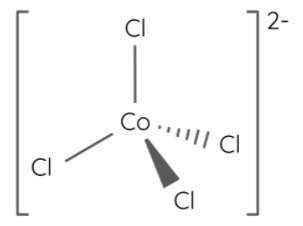
[Co(Cl)4]2- tetrahedral, 109.5°
State the formula, shape, & bond angle of this complex ion:
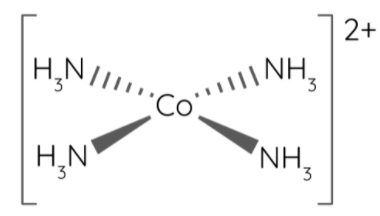
[Co(NH2)4]2+ square planar, 90
Each water molecule has 2 lone pairs on the oxygen atom. Why is it not a bidentate ion?
a single oxygen atom cannot utilise both lone pairs to form 2 dative covalent bonds with the central metal ion because other lone pair would be facing the opposite direction to the central metal ion
What is the chemical formula of a cyanide ion?
:CN-
What is the chemical formula of a diaminoethane ion?
H2CH2CH2NH2
What is the chemical formula of an ethanedioate ion?
(COO-)2
Rank the ligands H2O:, :Cl- & :NH3 in terms of their strength as ligands.
(strongest) :Cl- :NH3 H2O: (weakest)
Describe & explain the differences in strength of H2O:, :Cl- & :NH3 as ligands.
H2O is weakest, ∴ displaced by both • O has high electronegativity, so greater attraction of lone pair. • Does not give up lone pair to form dative covalent bond as easily. NH3 is neither weakest nor strongest, ∴ displaces H2O & displaced by Cl- • N is less electronegative than O, so weaker attraction of lone pair to N. • Gives up lone pair more easily to form dative covalent bond. Cl- is strongest, ∴ displaces both. • negative charge, so repels lone pair. • gives up lone pair much more easily, forming dative covalent bond.
Why can 6 H2O bond to a central metal ion whereas only 4 Cl- can do the same?
Cl ions are much bigger than H2O, so only 4 Cl can fit as opposed to 6 H2O.