Energetics
No description yet. This curated deck is ready for daily study.
Card preview (24)
What can happen to energy during a chemical reaction (process)?
energy can either be absorbed or released from / to the surroundings
Define exothermic
a reaction where the bonds formed are stronger than the bonds in the reactants. making bonds releases energy
Define endothermic
the energy needed to break the bonds in the reactants is more than the energy released when making the bonds in the products. absorbs energy
Can energy change in a reaction be measured? If so, how? If not, why?
yes it can, it is measured as enthalpy change
Define enthalpy
energy stored in chemicals that can be released as heat (stored in bonds)
What is the symbol and unit for enthalpy change?
symbol - △H unit - kJ / mol
Define Ea (activation energy)
minimum energy required for particles to react
When a reaction is exothermic, energy in reactants < or > energy in products
>
What is shown by the blue arrow? What is shown by the blue arrow?
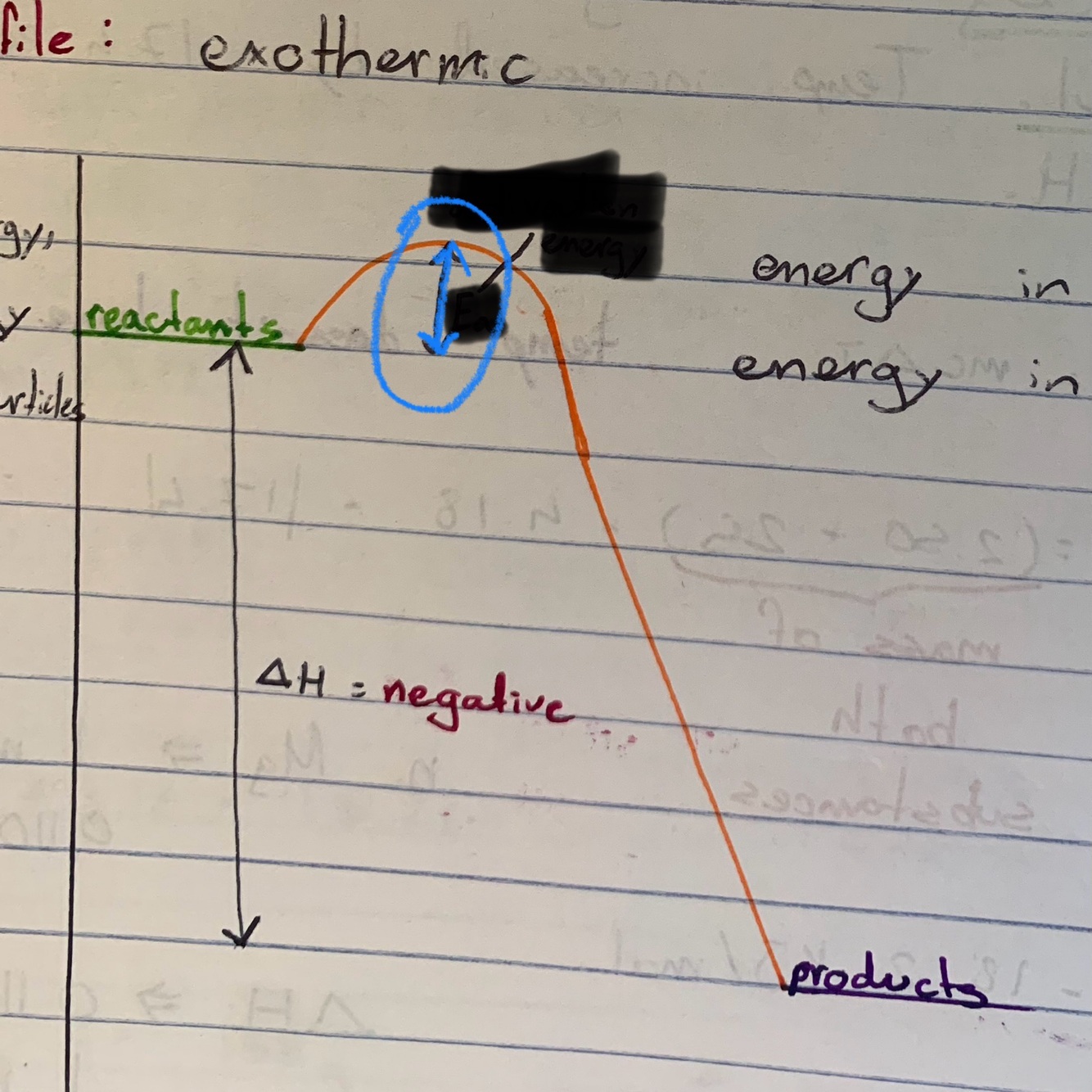
Ea, activation energy
What should be on the x-axis of an energy profile and what should be on the y-axis?
x-axis = time / progress of reaction y-axis = energy Check page on energetics (9th grade)
When a reaction is endothermic, energy in reactants < or > energy in products
<
What is the equation of energy in a reaction
q = mc△T energy in reaction (J) = mass of chemical being heated * (specific heat capacity - water =4.18 J/ºc/g) * temperature change (ºc/K)
What is this apparatus called?
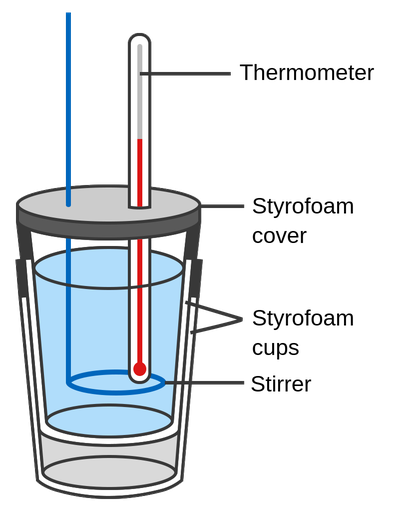
calorimeter
Why is the coffee cup in a beaker when measuring the enthalpy change in a solution of KNO₃ and NH₄Cl? Why should you keep stirring the mixture?
to stop it from falling over keep stirring to spread energy evenly
When measuring the enthalpy change in a solution of KNO₃ and NH₄Cl, what do you need to measure?
mass, initial and final temperature, volume of water
Define bond enthalpy
quantity of energy needed to break one mole of a specific type of bond
Is the process of breaking electrostatic forces between atoms exothermic or endothermic?
endothermic
Is forming bonds exothermic or endothermic?
exothermic
Which bonds are affected by temperature and which are not?
IMFs are affected by temperature and covalent bonds are not
Only covalent bonds are not affected by temperature. What can be assumed by this statement?
that, therefore, bond enthalpies only apply to covalent substances
Complete the sentence with endothermic or exothermic: _________________ reactions have stronger / more bonds in the products (compared to reactants)
exothermic
Complete the sentence with endothermic or exothermic: _________________ reactions have weaker / less bonds in the products (compared to reactants)
endothermic
How do you calculate △H using bond enthalpies? How do you know if the reaction in exothermic or endothermic?
Add up all of the bond enthalpies in the reactants. Do the same for the products. Calculate the bond enthalpy change by subtracting the bond enthalpies of the reactants from the bond enthalpies of the products. If the answer is negative, it’s exothermic, and vice versa.
How is bond enthalpy calculated?
△H = sum of bonds broken − sum of bonds made