Alkenes
No description yet. This curated deck is ready for daily study.
Card preview (24)
What is an alkene
An unsaturated hydrocarbon
What is the general formula for alkenes
CₙH₂ₙ
What mechanism can alkenes undergo when they react with an electrophile
Electrophilic addition
Why are alkenes attacked by electrophiles
They contain a double bond with a high electron density
What is an electrophile
An electron pair acceptor They are deficient in electrons and are therefore attracted to the double bond in alkenes
Give two categories which can be electrophiles
Positively charged ions Polar molecules
What is the test for alkenes
When we add bromine water, if alkenes are present, a colour change will occur from brown/orange to colourless
What do we form when we add bromine to an alkene
A dibromoalkane
By what mechanism does bromine react with an alkene
Electrophilic addition
Draw the mechanism for the reaction between bromine and ethene
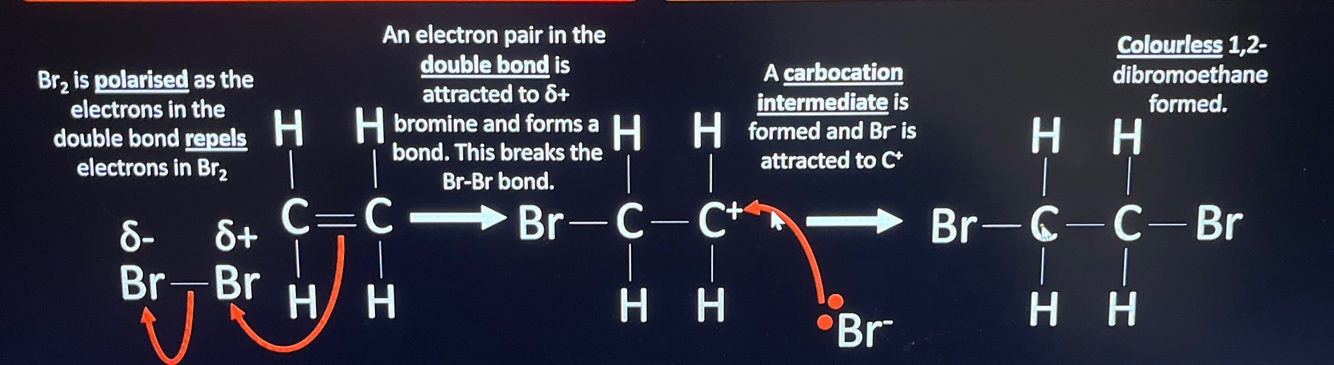
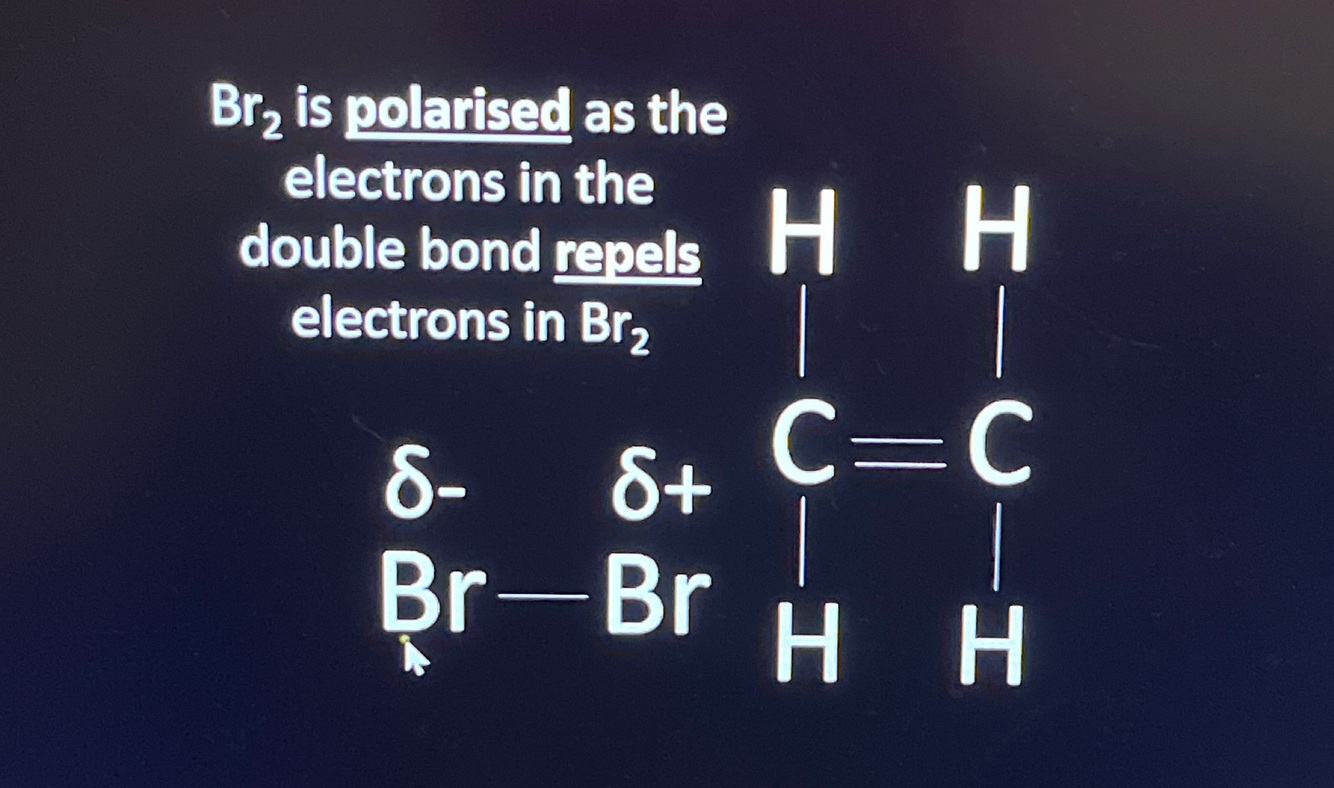
Explain how Br2 is polar when reacting with an alkene
When a bromine molecule approaches the double bond in an alkene, the electrons in the nearest Br atom repel the high electron density in the double bond, causing a temporary induced dipole, and the nearest bromine atom to be be delta positive, and the bromine molecule to be polar
What is the intermediate called which is formed when bromine reacts with an alkene
A carbocation
What colour are dibromoalkanes
Colourless
What is formed when an alkene reacts with a hydrogen halide
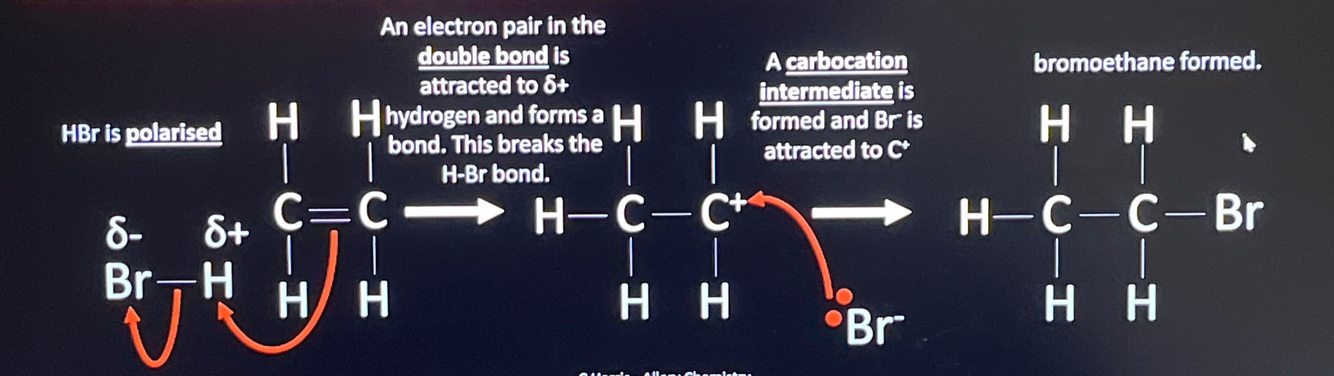
Halogenoalkanes
Draw the mechanism for the reaction between hydrogen bromide and ethene
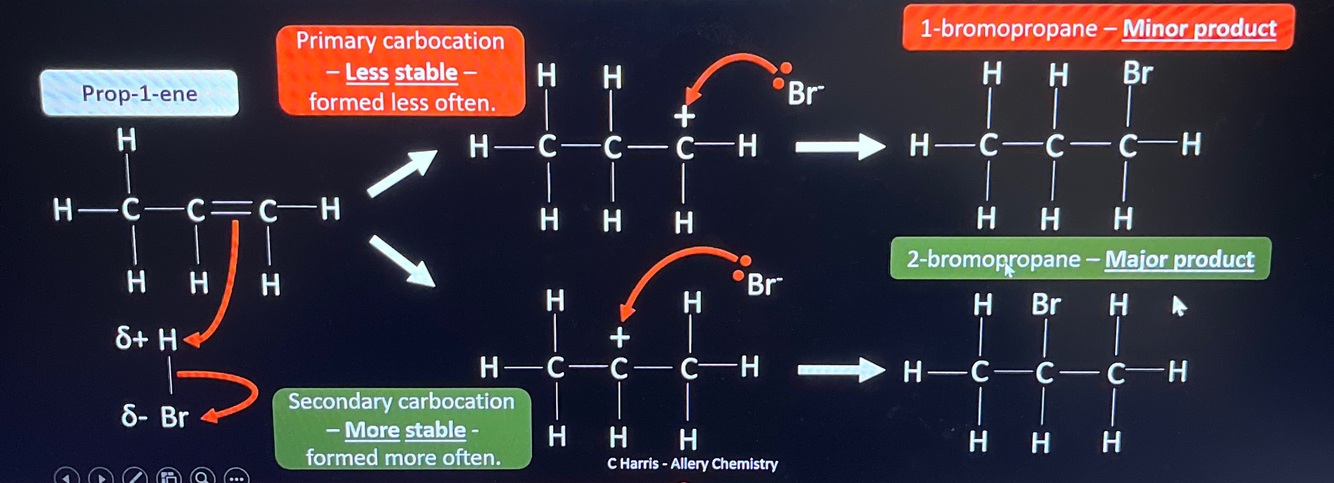
How many products do we form when a hydrogen halide reacts with an unsymmetrical alkene
2 (Due to ability for different carbocations to form)
What is the amount of a specific product that is produced dependent on when an unsymmetrical alkene reacts with a hydrogen halide
The stability of the carbocation intermediate
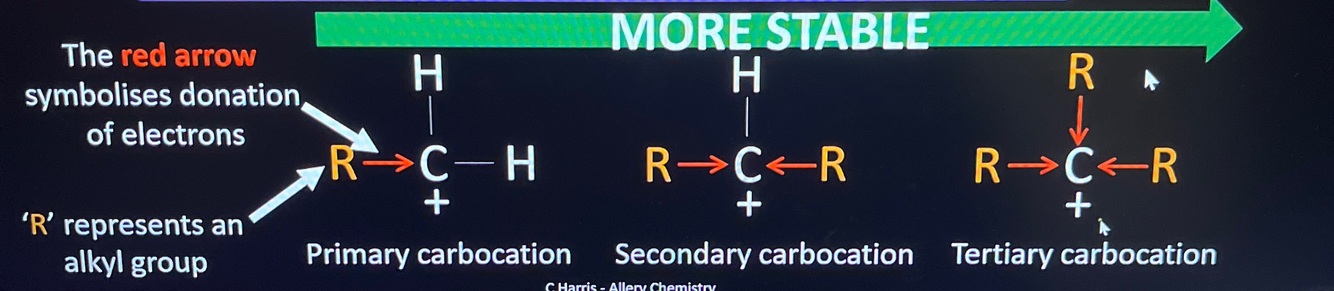
What determines the stability of a carbocation and explain why this is the case
The number of alkyl groups bonded to the positive carbon The more alkyl groups bonded, the more stable the carbocation is This is because alkyl groups push electrons towards the positive carbon stabilising it
What is a primary, secondary and tertiary carbocation
Primary - 1 alkyl group bonded to the positive carbon Secondary - 2 alkyl groups bonded to the positive carbon Tertiary - 3 alkyl groups bonded to the positive carbon
What do we call the product formed from a less stable carbocation when an unsymmetrical alkene reacts with a hydrogen halide
Minor product
What do we call the product formed from a more stable carbocation when an unsymmetrical alkene reacts with a hydrogen halide
Major product
Draw the mechanism for the reaction between prop-1-ene and hydrogen bromide. Identify which is the major product
What are the conditions for the reaction of bromine with an alkene
Room temperature (not in UV light)
What are the conditions for the reaction of hydrogen halides with an alkene
Room temperature