Ch10 Rates of Reaction and Equilibrium
No description yet. This curated deck is ready for daily study.
Card preview (24)
What is the definition of rate of reaction?
ROR = change in concn of a reactant or a product in a given time.
What is the equation for Rate?
Rate = change in concn / time
What are the units for rate?
mol dm-3 s-1
What is collision theory?
• Particles must collide before a reaction can take place. • Not all collisions lead to a reaction • Reactants must possess at least a minimum amount of energy (= activation energy) • Partciles must approach each other in a certain relative way (= steric effect)
What factors are required to increase the ROR?
• More FREQUENT collisions - increased particle speed, have more particles present • More SUCCESSFUL collions - give particles have more energy, lower activation energy
What methods increase the rate?
• Increase the SA of solids • Increase temp • Shine light (radical reactions) • Add a catalyst • Increase pressure of any gas • Increase the conc of reactants
How does increasing SA increase ROR?
• Increasing SA increases chance of collision because more particles are exposed • Powdered solids react quicker than larger lumps • Catalysts are finely divided for this reason
How does increasing the concentration increase ROR?
• Increasing conc = more frequent collisions = increased ROR Increasing the conc of some reactants have greater effects than others.
How does increasing pressure increase ROR?
• Increasing pressure forces gas particles closer together in a given volume • This increases the frequency of collisions, so ROR increases. • Increasing the pressure could have an affect on the position of equilibrium and therefore the yield.
radical reactions How does shining light affect ROR?
• shining a suitable light source onto reactants increases ROR • light (often UV) provides energy to break bonds and initiate reactions • the greater the intensity of light, the greater the effect • e.g. radical reactions • Initiation, propogation, termination
How does increasing temp increase ROR?
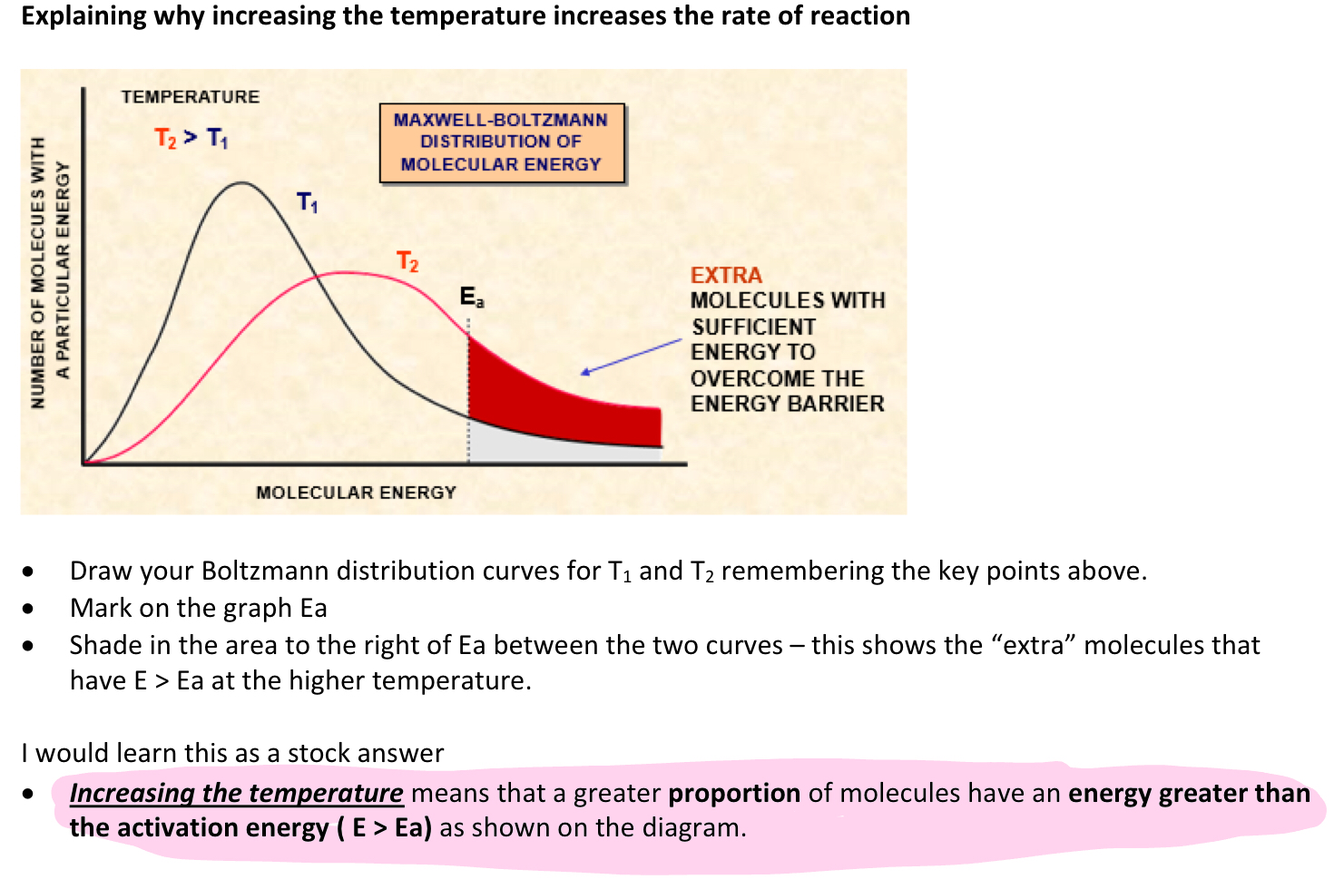
• Increasing temp increases ROR • As particles get more energy so they can overcome the energy barrier • particles speeds up, also, increases the frequency of collisions. • Only the reactants with energy equal to or greater than Ea (Activation Energy) will react. Look at energy profile diagrams
How does adding a catalyst affect the ROR?
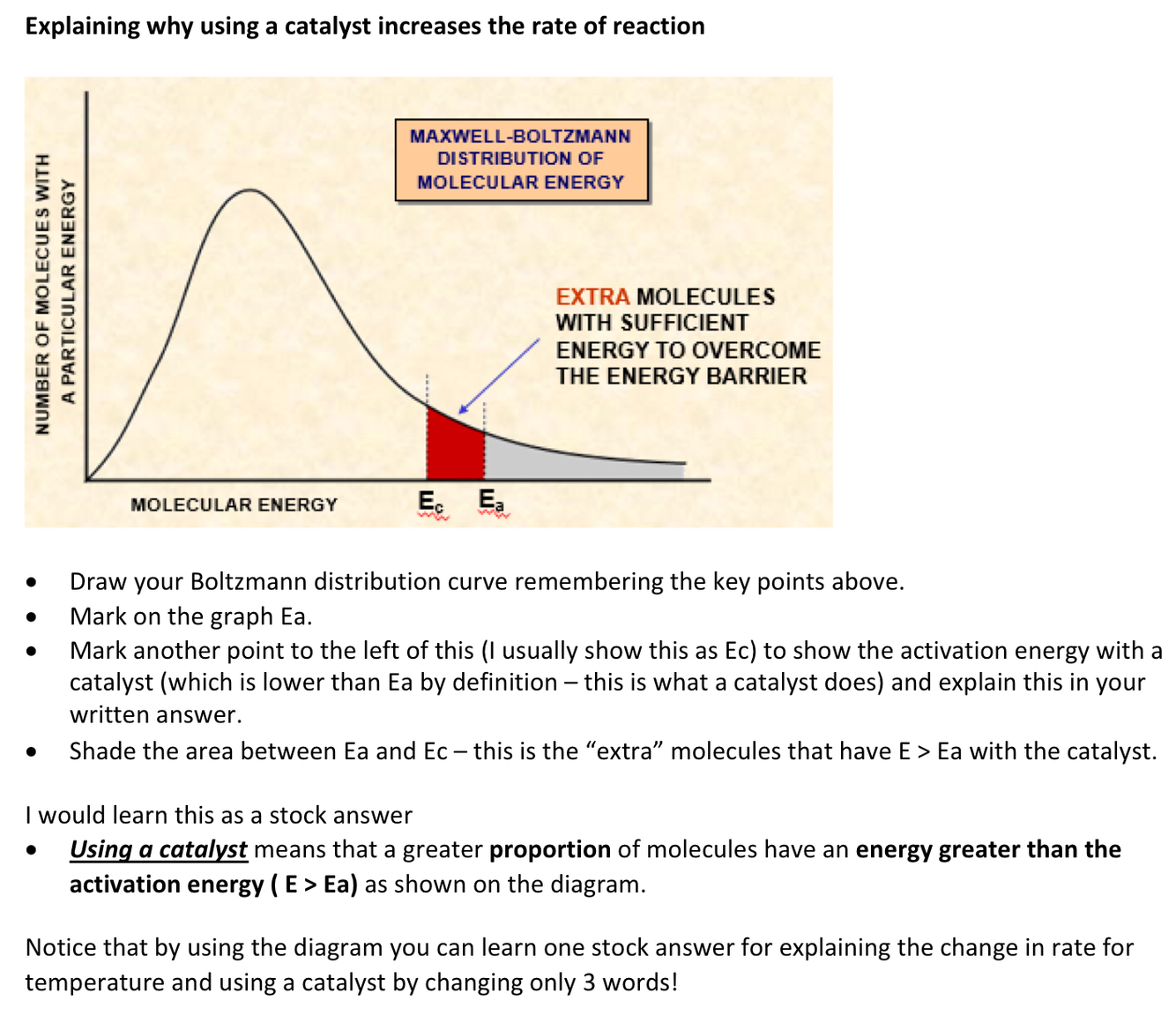
• Catalysts provide an alternative reaction pathway with lower Ea. • A lower Ea = more particles have sufficient energy to overcome energy barrier + react
What is the definition of a catalyst?
A catalyst lowers Ea without being chemically changed/used up at the end of a reaction.
Why are catalysts useful in industry?
• Catalysts do not affect the position of equilibirum, therefore do not affect yield in an equilibrium system where an increase in temp = lower yield. (e.g. Haber + Contact) • They are safer and cheaper to use, as it means less energy is required to help reactants reach Ea.
What are the two types of Catalysts?
• Homogenous Catalyst: same physical state/phase as reactants • Heterogenous Catalyst: different physical state/phase as reactants.
What is a limitation of using catalyst?
A catalyst gets affected by impurities in a chemical reaction and stops working.
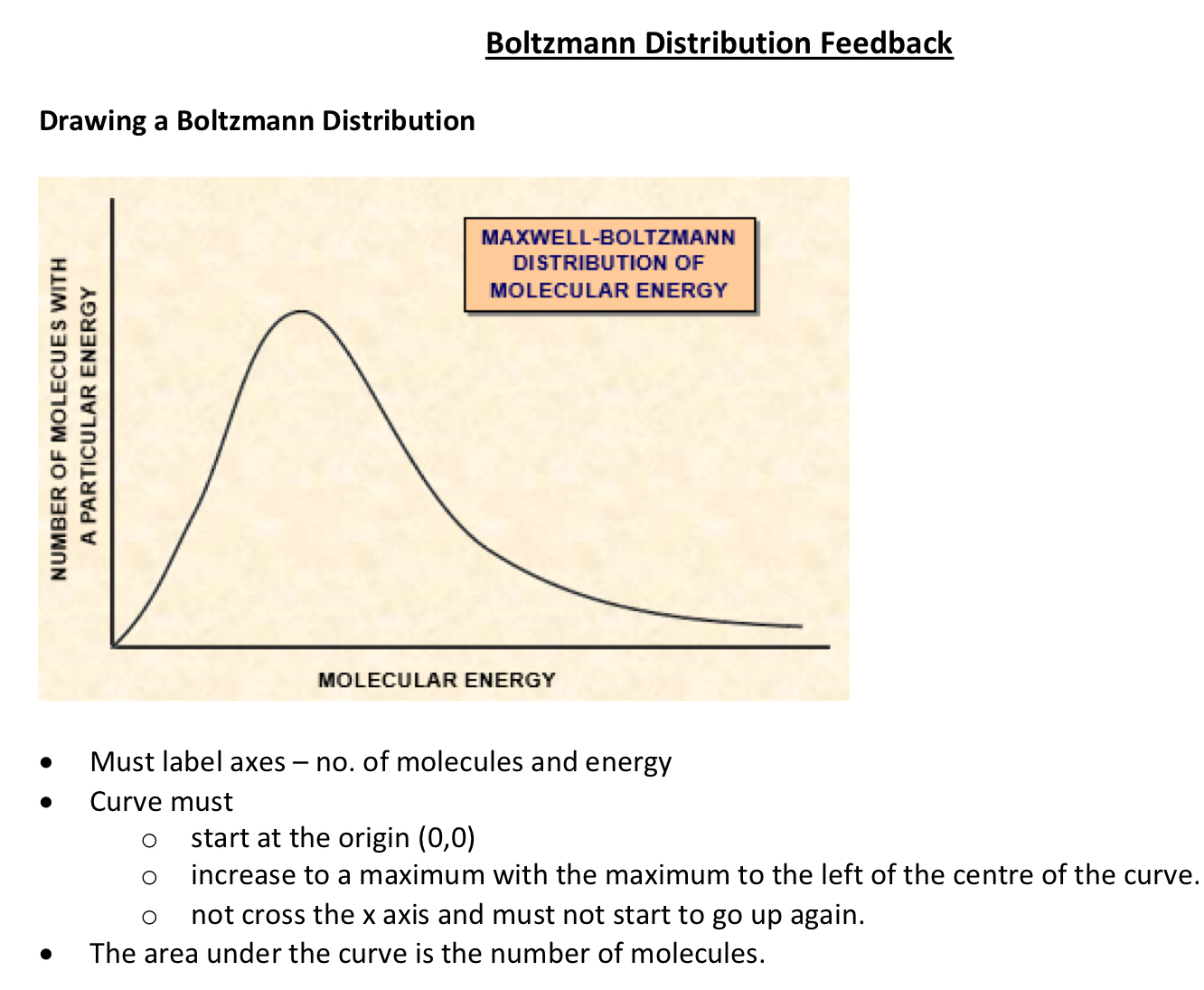
Draw a Boltzmann Distribution graph:
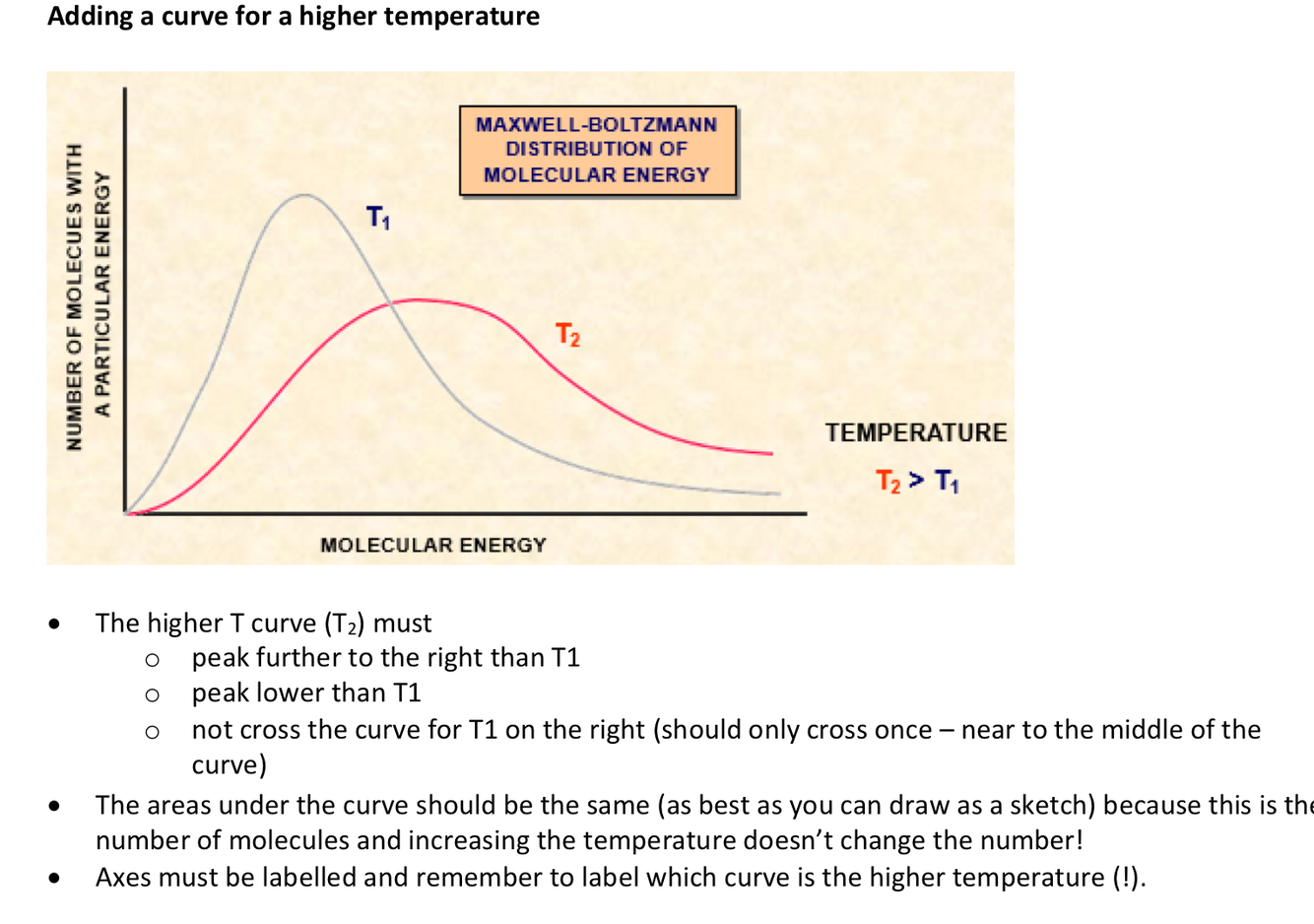
Draw a Boltzmann Distribution graph with a curve for a higher temperature:
Using a boltzmann distribution curve, explain why increasing temp increases ROR
Using a boltzmann distribution curve, explain why using a catalyst increases ROR:
Define: a dynamic equilibrium:
A dynamic equilibrium is an equilibrium that exists in a closed system, when rate of forward reaction is equal to the rate of the reverse reactions, and the concentrations of reactants and products does not change.
What are the conditions needed for a system to reach a dynamic equilibrium?
• Rate of forward reaction equal to rate of reverse reaction • Concentrations of reactants + products do not change • A dynamic equilibrium occurs in a closed system
What does Le Chatelier’s Principle state:
When reaction has reached dynamic equilibrium and a change occurs, (change in conc, pressure, temp) the position of equilibrium will move to counteract change and restore equilibrium.
How does changing concentration effect the equilibrium?
• If equilibrium lies to the right; increase in conc of reactants decreases conc of products. • If equilibrium lies to the left; decrease in conc of reactants increases conc of products. If more products are formed, equilibrium lies to right If more reactants are formed, equilirbium lies to left.