D and F Block
No description yet. This curated deck is ready for daily study.
Card preview (24)
Definition of transition elements
D block elements having unpaired e- or partially filled d-orbital in any O.S.
elements that are not transition elements but they are d-block elements.
Cd,Hg,Zn
Elements in 3D series
Sc,Ti,V,Cr,Mn,Fe,Co,Ni,Cu,Zn
Elements in 4D series
Y,Zr,Nb,Mo,Tc,Ru,Rh,Pd,Ag,Cd
D block elements with Exceptional Electronic config and the only element with a difference of 2 electron?
Nb Cu Cr Rg Mo Tc Ru Rh Pd Au Ag Pt (Navab Cu kare(Cr) Raag Maut Tak Rooh Raah Pade Aur Aaj Pitaai hogi) only Pd has a difference of 2 electrons and rest have only one electron difference
why do transition elements have typical metallic properties
because they have strong metallic bonds, they are hard, and have high enthalpy of ionisation
why do second and third transition series have greater enthalpies of atomisation
shielding effect
shielding effect order of spdf
s>p>d>f
mettalic bonds depends on?
unpaired electrons
mettalic bonds depends on?
unpaired electrons
why do MP and BP of transition elements increase at first and then decrease
because the metallic bonding increass first and decreses as they are directly realted to unpaired electrons which also first increase then decrease
whats the most important feature of transition elements
low difference in energy of ns and (n-1)d
radius order of transition elemtns
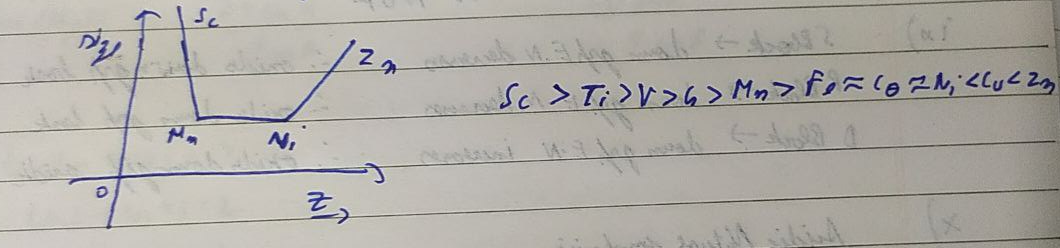
oxidation state table
whats the most common OS In 3D series
+2
why are transition elemnts are good catalyts
because they have variable valencies, they form unstable intermediates with less activation energy they have suitable surfaces for catalysts
TI,Zr,Hf atomic radius order
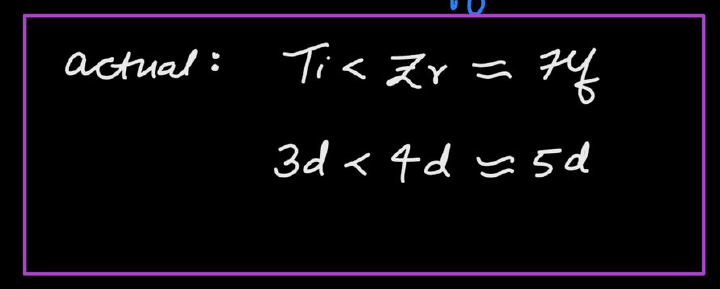
d block atomic readius order down the grp

color of Fe2+ and Fe3+
Fe2+ :- green Fe3+ :- yellow
exception in the atomic radius order dwon the grp of d block
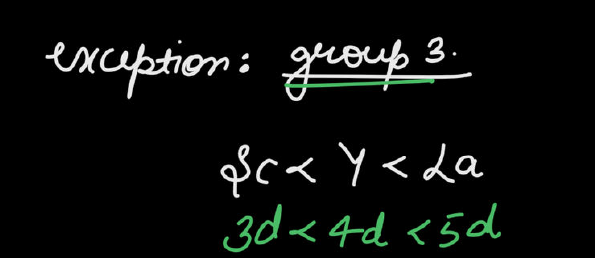
O.S of Fe and NO in sodium nitroprusside
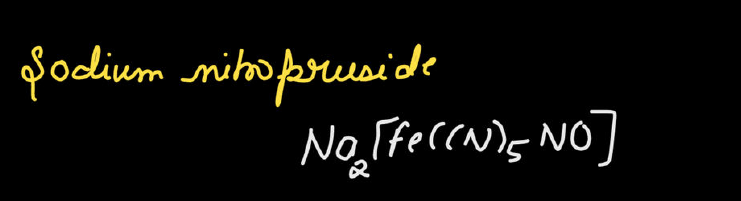
O.S. of Fe= +2 O.S. of NO= +1
elements of D block first period
Sc Ti V Cr Mn Fe Co Ni Cu Zn
Eu(Z=63) Electronic configuration
[Xe] 4f7 6s2
the Cr-O-Cr bond in Cr2O7 ion (dichromate) is
non-linear and symmetrical