Natural fats and oils
No description yet. This curated deck is ready for daily study.
Card preview (10)
What are fats and oils?
Fats and oils are all part of a group of compounds called esters. They all have chains of carbon atoms.
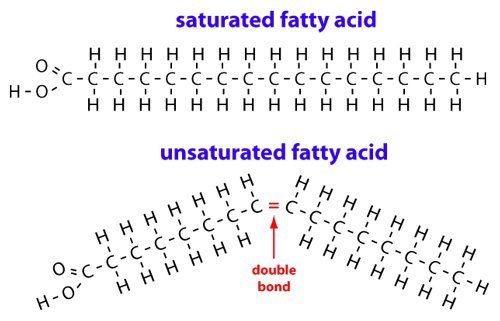
Saturation
• If the carbon chain contains only single carbon-carbon bonds, the fat is saturated. • If the carbon chain contains some double carbon-carbon bonds then the oil unsaturated.
Unsaturation test
• To test for unsaturation the oil is shaken with bromine water, which is orange. • Unsaturated compounds loose their colour decolorise. • The colour remains orange with saturated compounds.
Vegetable oils are:
unsaturated
One industrial use of vegetable oils is to make margarine.
• The first stage is to ‘harden’ the oils, turning them into saturated compounds. • Hydrogen is bubbled through the oil at about 200 ºC using a nickel catalyst. • The hydrogen reacts with the carbon-carbon double bonds and turns them into single bonds.
Where do saturated fats and oils come from?
• Saturated fats and oils usually come from animals and unsaturated fats and oils usually come from plants. • ‘Polyunsaturated’ means the compound contains more than one carbon-carbon double bond. • People whose diet is rich in unsaturated fats and oils have lower levels of the type of cholesterol that causes heart diseases.
Getting fats into water
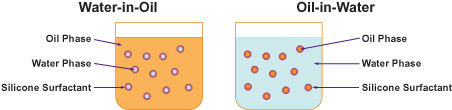
• Oil and water are immiscible liquids. They do not dissolve in each other, but disperse into tiny droplets to form an emulsion. • Milk is an oil-in-water emulsion. • Cold cream and margarine are water-in-oil emulsions.
What is bromine?
• Bromine is an orange liquid. Bromine reacts, in an addition reaction, with the carbon-carbon bonds in the chain. • The reaction uses up the bromine molecules, making a dibromo compound. This compound is colourless. • Saturated compounds cannot react with bromine since they have no carbon-carbon double bond.
Saponification
• Fats and oils can be split up using hot sodium hydroxide to make soap and glycerol. • The reaction of splitting up natural oils with alkalis is called saponification.
When an ester reacts with sodium hydroxide
• Saponification occurs. • This ester forms one glycerol molecule and three soap molecules. • This reaction is really the reaction of alkaline water so it is a hydrolysis reaction. The reaction is: • fat + water ⇒ soap + glycerol