Topic 14 Standard Electrode (redox) Potentials
No description yet. This curated deck is ready for daily study.
Card preview (24)
The standard hydrogen electrode
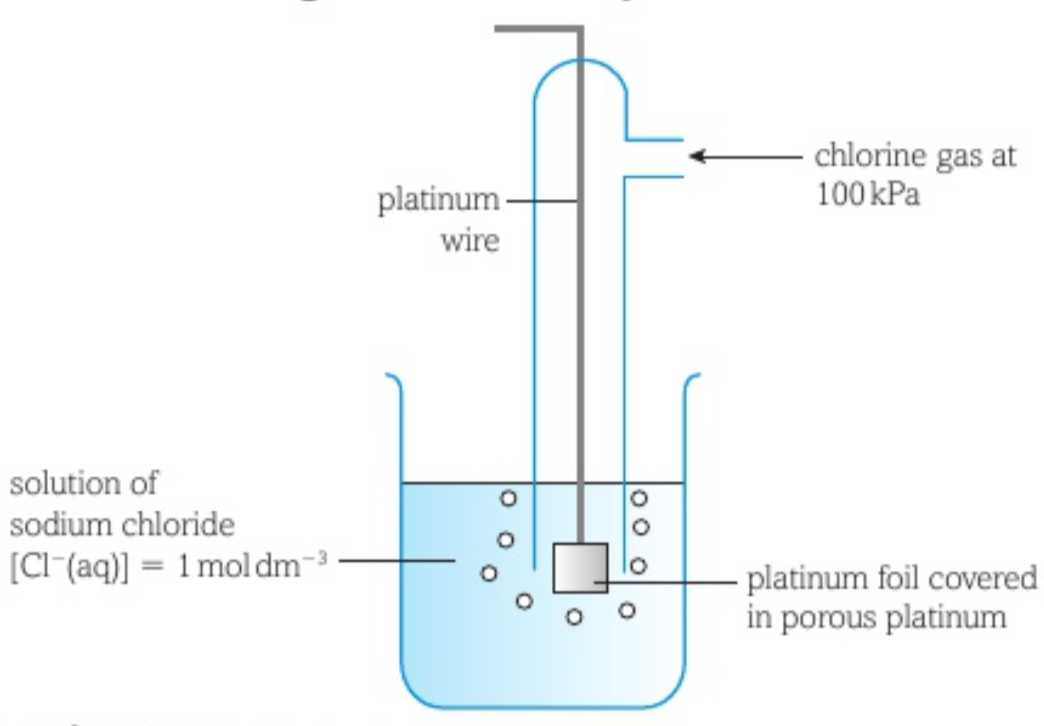
The electrode consists of: - Hydrogen gas at a pressure of 100kPa. - Bubbling over a piece of platinum foil dipped into hydrochloric acid. - Hydrogen ion concentration of 1moldm^-3 at a temperature of 298K. —> The surface of the foil is covered in porous platinum- large surface area and allows an equilibrium between hydrogen ions in solution and hydrogen gas to be established quickly.
Why do we need an unreactive salt bridge?
• It is needed to complete the electrical circuit. • Allows movement of ions.
Standard conditions
• 100kPa • 298K • 1 moldm^-3 (conc. of ions) The position of an equilibrium can be changed by altering conditions.
What do E°cell values tell us?
• The more negative the E° value, the further to the left the equilibrium (ie. the more readily the metal ions loses electrons). • The more positive (/less negative) the E° value, the further to the right the equilibrium lies (ie. the less readily the metal loses electrons to form ions).
Electromotive force (emf)
• The potential difference = the electromotive force (emf). • Symbol: E°cell • Sometimes called the standard cell potential.
The reference point when measuring standard electrode potentials
The reference point is the potential of the standard hydrogen electrode, which is set at zero.
Standard electrode potential definition
The standard electrode potential of a half-cell is the emf of a cell containing the half-cell connected to the standard hydrogen electrode. Standard conditions apply.
The electrochemical series: in order of their E° values
• In order of their standard electrode (redox) potentials. • The most negative E° values are placed at the top of the series, and most positive at the bottom.
The electrochemical series: reducing agents
• The most powerful reducing agent: lithium (its redox system has the most negative E° value). • The least powerful reducing agent: fluoride ion F- (its redox system has the least negative (most positive) E° value).
The electrochemical series: oxidising agents
• The most powerful oxidising agent is fluorine. • The least powerful oxidising agent is the lithium ion, Li+.
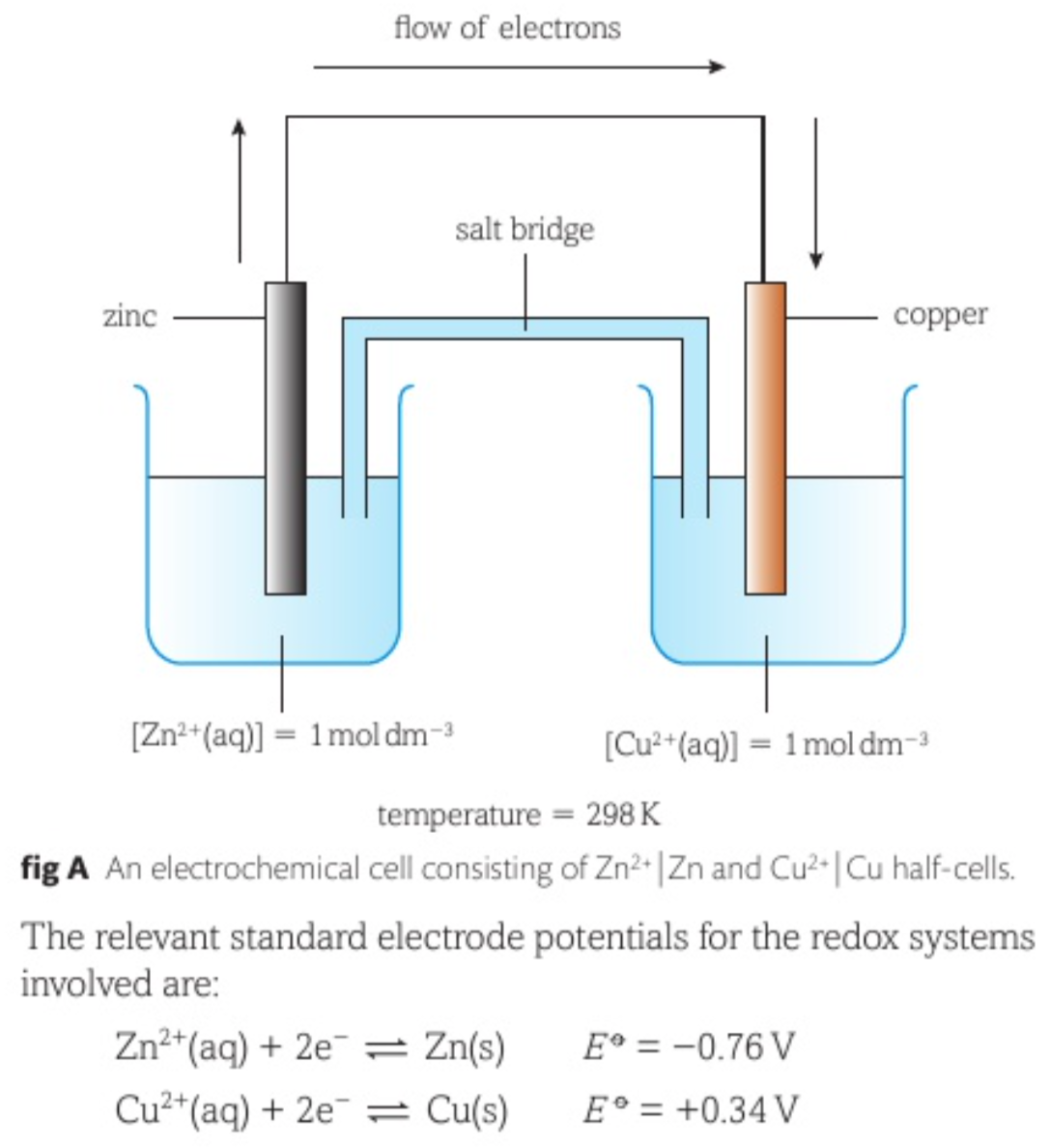
Electrochemical cells
Thermodynamic feasibility
• Can be predicted using standard electrode potentials. • Although the standard electrode potentials indicate that a reaction is thermodynamically feasible, it may not take place for two reasons: -the reactant may not be kinetically stable because the activation energy for the reaction is very large. -the reaction may not be taking place under standard conditions.
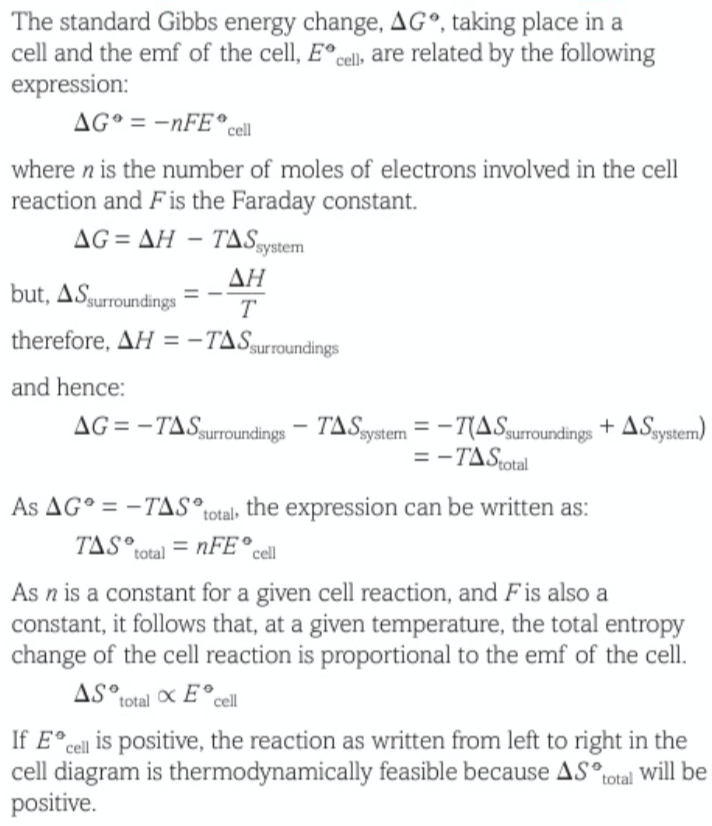
Relationship between total entropy and E°
What type of species goes on the outside (furthest from the salt bridge) in standard cell notation?
The most reduced species.
What symbol is used to represent a salt bridge in standard notation?
II
What does | indicate in standard cell notation?
Phase boundary (change of state).
Standard cell notation
Zn | Zn^2+ || Cu^2+ | Cu reduced | oxidised || oxidised | reduced
What happens at the left-hand electrode?
Oxidation occurs. The left-hand electrode is the half cell with the most negative E° value.
What happens at the right hand electrode?
• Reduction occurs. • The right-hand electrode is the half cell with the most positive E° value.
Which side of the cell has the most negative E° value and what happens to the metal with the most negative E° value?
The left-hand electrode is most negative. The metal will be oxidised.
What does it mean for the E° value to be more negative?
It means it is a better reducing agent (ie. easier to oxidise).
What does it mean for the E° value to be more positive?
It means it is a better oxidising agent (ie. easier to reduce)
What factors will change E° values?
• Concentration of ions • Temperature
What happens if you reduce the concentration of the ions in the left-hand half cell?
• Equilibrium moves to the left to oppose the change of removing ions. • This releases more electrons. • The E° of the left hand cell becomes more negative, so the emf of the cell increases.