Alcohols
No description yet. This curated deck is ready for daily study.
Card preview (20)
What are the conditions for the direct hydration of ethene?
Conc. phosphoric acid catalyst 300*C 6000kPa
Direct hydration of ethene produces a low yield. How can you increase the yield?
Recycling unreacted ethene several times
What are the raw materials needed for the direct hydration of ethene?
Ethene (from crude oil)
What are the conditions for the industrial fermentation of ethene?
Enzymes produced by yeast 25-40*C Absence of oxygen
What is an advantage and disadvantage of using industrial fermentation rather than direct hydration to produce ethanol?
Advantages - Utilises renewable resources Cheaper equipment Lower temp and pressure Disadvantages- Lower rate of reaction Not continuous process
What are biofuels?
The fuels made from a renewable biological source
If you partially oxidise a primary alcohol what is produced?
An aldehyde
If you fully oxidise a primary alcohol what is produced?
A carboxylic acid
How do you get an aldehyde from a primary alcohol?
Partially oxidise. If you use an excess of alcohol and distil off the aldehyde as soon as it forms. Separates from oxidising agent
How do you get a carboxylic acid from a primary alcohol?
Fully oxidise Alcohol heated under reflux with an excess of the oxidising agent Carboxylic acid distilled off once the reaction is complete
Why, when making in aldehydes, is the product distilled off as soon as it forms?
To remove it from the oxidising agent to prevent it from being oxidised further into a carboxylic acid
How are alcohols produced industrially?
The hydration of alkenes in the presence of an acid catalyst
What is the name of the reaction whereby alcohols are converted to alkenes?
Elimination reaction
What is a suitable catalyst for the elimination reaction of alcohols to produce alkenes?
Hot concentrated sulphuric acid
What can the product of an elimination reaction of alcohols be used for?
Can supply alkene monomers for polymerisation from a renewable raw material
Describe and explain the simple acid-catalysed elimination mechanism with propan-2-ol

What is a suitable oxidising agent?
Acidified potassium dichromate (VI)
What are secondary alcohols oxidised to?
Ketones
Describe and explain the simple acid-catalysed hydration mechanism with ethene

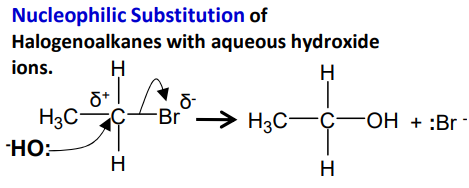
Describe and explain the production of ethanol from the nucleophilic substitution of bromoethane