Enzymes & Kinetics
No description yet. This curated deck is ready for daily study.
Card preview (24)
What are some general properties of enzymes?
Enzymes are proteins with catalytic activity which increase the rate of a chemical reaction without being consumed; exhibit stereospecificity.
What is the energy of activation in a reaction?
The amount of energy it takes for a reaction to occur.
What are the six enzyme classifications?
(1) Oxidoreductases (2) Transferases (3) Hydrolases (4) Lyases (5) Isomerases (6) Ligases
What are some characteristics of isoenzymes?
They catalyze the same reaction as enzymes, but they can exist in a different form. They can exist due to different amino acid composition, different physical properties, and different enzymatic properties.
Complete the following equation: _____ (active form) = _____ (inactive form) + _____
Holoenzyme Activity = Apoenzyme Activity + Cofactor
Define cofactor(s).
non-protein molecule conjugated to an enzyme.
What are examples of cofactors?
Essential ions, coenzymes, inorganic and organic, Ca, Cl-, Mg+, NADH, NADPH. Digestive Enzymes.
Define Prosthetic Group.
A tightly bound cofactor. E.g. heme bound to peroxidase.
What are factors influencing enzyme activity?
Temperature, pH, Activators (cofactors), inhibitors, substrate concentration, and enzyme concentration.
How does the temperature of the reaction effect the activity?
As temperature increases, activity will increase until the optimum temperature is reached, then denaturation of the protein will occur.
How is activity of an enzyme reaction affected by activators and inhibitors?
Activators (cofactors) enhance the reaction (reaches max velocity the fastest). Inhibitors delay the reaction (reaches the max velocity the slowest).
How does the concentration of the substrate affect the enzyme reaction?
Reaction velocity is dependent on substrate concentration.
During zero order kinetics, at saturating {S}, velocity is ___ of substrate concentration and ___ proportional to {E} enzyme concentration.
independent; directly
Define competitive inhibitor.
Binds at the active site and competes with the substrate for binding sites.
How is Km and Vmax altered during competitive inhibition?
Raises Km; Vmax is unaffected.
What kind of inhibitor represents this graph?
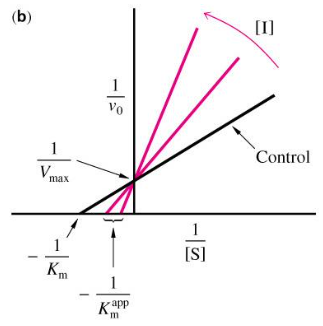
Competitive Inhibitor.
Define noncompetitive inhibitor.
Binds at an allosteric or regulatory site, which may be at or far removed from the active site.
How is Km and Vmax altered during noncompetitive inhibition?
Km is unaffected; Vmax decreases.
What kind of inhibitor represents this graph?
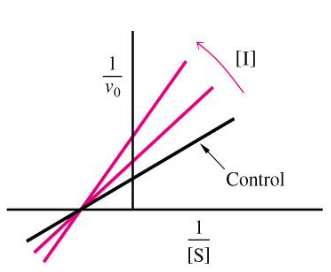
Noncompetitive Inhibitor
Define uncompetitive inhibitor.
Binds to the enzyme-substrate complex and not to free enzyme; prevents product formation.
How is Km and Vmax altered during uncompetitive inhibition?
Lowers Km; Lowers Vmax; Vmax/Km unchanged.
What kind of inhibitor is represented by this graph?
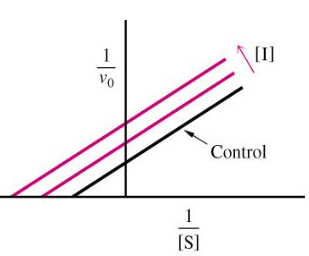
Uncompetitive inhibitor.
Define irreversible inhibition.
An inhibitor that binds specifically to the active site; forms stable covalent bond with enzyme inactivating it.
Enzyme measurement is dependent on what?
Temperature and pH changes, activator concentration, inhibitor concentration, and substrate concentration.