U3-1-2 - Redox Reactions
No description yet. This curated deck is ready for daily study.
Card preview (14)
Redox reaction
A reaction involving a transfer of electrons. (One reactant loses electrons, the other gains them)
Loss of electrons
Oxidation (remember - OIL RIG)
Gain of electrons
Reduction (remember - OIL RIG)
Oxidation
Loss of electrons (rememeber - OIL RIG)
Reduction
Gain of electrons (rememeber - OIL RIG)
How do you turn this reduction equation into an oxidation equation? Cu2+ + 2e– → Cu
Reverse it Cu → Cu2+ + 2e–
When copying equations from the ECS, which equation gets reversed?
The one higher up in the ECS OR read equations anticlockwise
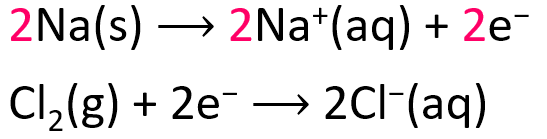
What has to be done before these equations can be added up?
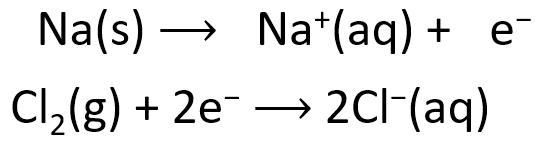
Electrons must be balanced (so multiply whole Na equation by 2)
What type of reaction is this? MgO + H2SO4 → MgSO4 + H2O
Neutralisation (base + acid)
What type of reaction is this? C2H4 + Br2 → C2H4Br2
Addition (multiple reactants, only one product)
What type of reaction is this? 3Na(s) + AlCl3(aq) → 3NaCl(aq) + Al(s)
Displacement (Na displaces Al from a compound)
What type of reaction is this? Li(s) + HCl(aq) → LiCl(aq) + H2(g)
Redox (Li loses electrons, H+ gains electrons) NOT neutralisation as no water is made
What type of reaction is this? AgNO3(aq) + KCl(aq) → AgCl(s) + KNO3(aq)
Precipitation (solid, AgCl, is formed from aqueous reactants)
What is wrong with this redox equation? Cu2+ + Ag + e– → Cu + Ag+
Still has e– (Electrons were not balanced before adding up equations)